Showing posts with label Journal. Show all posts

Friday, 1 April 2016

GROWING OF E-COMMERCE AND SHOPPING ONLINE: IMPACT TO THE PROPERTY MARKET IN MALAYSIA

GROWING OF E-COMMERCE AND SHOPPING ONLINE:
IMPACT TO THE PROPERTY MARKET IN MALAYSIA
by
DR. AZMIZAM ABDUL RASHID

THE GROWING OF E-COMMERCE AND SHOPPING ONLINE

In a 1997 article, Baen and Guttery predicted that the emergence of the web as an open medium for commerce would threaten the role of the real estate professional as a market intermediary. They predicted that the internet would provide increased consumer access to information which in turn would lead to an increase in for-sale-by-owner (FSBO) listings, and a decrease in the employment and income level of real estate professionals. This prediction was tied to the belief that real estate professionals derived their power from the proprietary information they controlled, and thus this power and their position on the supply chain would diminished once this information became more accessible on the internet. At the time this sentiment was echoed by the National Association of Realtors (NAR). When first faced with the emergence of the internet in the industry the NAR fought to prevent the release of the coveted Multiple Listing Service (MLS). In 2003 the NAR proposed bylaws, that according to some, “illegally adopted rules that would discourage new real estate sales practices, including home sales over the internet and discounted realty services” by allowing real estate professionals to withhold their listings from online brokers.

In the developed world, 77 out of every 100 people are now connected to the internet2. This high level of internet penetration coupled with a generation brought up online and familiar with the digitally connected lifestyle, we think has led to comfort in sharing their personal details online. With this comfort in using both the internet and sharing personal details, it seems inevitable that savvy retailers would capitalise on these favourable market characteristics. E-commerce, one of the fastest growing market sectors, is to an ever greater extent affecting the pace and trends in development of the domestic industrial and retail market. The dynamic development of the e-commerce sector represents both an opportunity and a challenge for the industrial and logistics property sector. Due to the growth of the e-commerce sector, the existing distribution models are evolving, the time of delivery is becoming shorter and the range of additional services is now expanding. As per the estimates, the e-commerce sector is generating a combined 10-15% of the total annual demand for modern industrial space.

Unlike traditional stores, whose demand for warehouse space is relatively predictable, the e-commerce sector requires much more flexibility. The range of goods, the number of customers, as well as the place of delivery in case of an online shop vary considerably, therefore it is extremely important that warehouse properties be adapted to the changing demand and landlords enable their tenants to increase the space actually occupied in peak times, such as e.g. during the pre-Christmas rush.

Lease costs along with the quality of services are also an important factor as far as the e-commerce sector growth trends are considered. Therefore, many online shops take the decision to collaborate with specialised logistics and courier companies. The vast majority of the key players have a dedicated line of services focused on e-commerce, starting with preparing orders, storage, handling of returns and exchanges, through to management of incoming and outgoing payments, customer services and software management. Outsourcing this type of services means that the costs may be lower than in the case of managing the entire supply chain internally, as it allows the online shops to concentrate on their core business, which is the selling of goods and services.

E-commerce has entered our lives for good now, changing both the supply chain market and the warehouse property market. In order to gain maximum benefits and explore the sector’s full potential, companies involved in this type of business should understand it well and adapt to the changes that are taking place within it, including the logistics and warehousing aspect thereof. UK retailing is currently being reshaped by new competitive patterns and pressures, contributing to a weakening in retail property performance. The growth of online retailing has been perceived as a further threat to the sector, although the problems facing ‘pure play’ e-tailers mean that Internet shopping is likely to be increasingly dominated by multi-channel retailers. Web-based retailing will add to competitive pressures on retailers and increase general price transparency. Internet sales penetration will vary between products and services and also geographically. Even with Internet sales growth being concentrated on established retailers, there will be impacts on retail floor space productivity, property requirements and store networks, with implications for retail property performance. Online shopping could reinforce the existing trend of polarisation of retail spending into the larger and more attractive centres within the retail hierarchy. Retailers and retail property investors need to find ways of upgrading the shopping experience to respond to the growth of online sales. 

E-COMMERCE AND SHOPPING ONLINE IN MALAYSIA

No one can predict how successful e-commerce will be in Malaysia in this competitive market. Malaysia is still lagging far behind developed countries. Online shopping is supplementary or complementary to existing business as an additional marketing, promotion and fulfilment channel. Malaysia has a huge potential for Internet procurement. It will be hard for Malaysians to rapidly adopt online shopping due to cultural inertia. Malaysians like going to the shops rather than browsing the Internet without an initial inspection of the goods. This culture will change for Malaysian consumers as they become aware of the advantages of online shopping. If the consumer can be convinced that it is safe and reliable to purchase online, the potential will be unleashed. A new economic culture that is in contrast to the traditional one of owning and keeping the intellectual property one creates, may flourish.

In Malaysia, the use of the internet be it via the mobile phone or desktop computer, to purchase things has been rising steadily over the years. In fact, Malaysia is one of only five places in the world where the use of smartphones is higher than computers (51% versus 39%), according to The Connected Consumer Survey 2014.These figures also reveal a shift in how consumers are researching what they want and their purchasing behaviour. For example, the Consumer Barometer with Google data reveals that of the 5,191 Malaysian respondents, 55% use the internet to do product research via smartphones, tablets or computers. Lazada Group was founded in 2011 by Rocket Internet in Singapore. A year later, it soft-launched Lazada Malaysia and other portals in Southeast Asia and Taiwan.

E-commerce platform Lazada Malaysia says on its website that it has “a broad product offering in categories ranging from fashion, consumer electronics to household goods, toys and sports equipment”. The company recently leased a 224,000 sq ft warehouse in Subang Jaya, Selangor.  Before that, it had a warehouse of only 50,000 sq ft,  7km from its new premises.  It also leased 25,400 sq ft of office space in Menara Worldwide on Jalan Bukit Bintang, Kuala Lumpur. “We consider the location of our main office to be strategic — an MSC-status building in the Golden Triangle. It is convenient for our employees, suppliers and partners,” says Lazada Malaysia CEO Hans-Peter Ressel.

Ressel says an ideal warehouse should have clear and separate access points to different areas of operations. “Couriers and suppliers do a lot of deliveries and pick-ups daily so ample space for loading and unloading is a must. “In terms of offices, landlords must be prepared to offer bigger space with supporting facilities to cater for staffing growth. Space is very important for an e-commerce business,”

THE FUTURE OF PROPERTY MARKET IN MALAYSIA

E-commerce in Malaysia is growing, but there has been little impact on the leasing of office and warehouse space by e-tailers as yet. Although retail sales from e-commerce is small — making up less than 5% of total sales,  according to Deloitte Consulting Malaysia executive director Kavita Rekhraj — some companies are taking steps to cater for future growth in view of its potential. “Many of the leading logistics, distribution and warehousing players are seen to be increasing their warehousing capacity. These include Century Logistics and Tiong Nam Logistics Holdings, which are building multi-storey warehouses of up to one million sq ft. SingPost’s acquisition of Axis Plaza in Shah Alam in 2014 also supports the growth potential of e-commerce in the country,” says Kavita.Knight Frank Malaysia executive director for capital markets Allan Sim says, “With regard to warehouses, we understand that a few aggressive e-commerce companies are looking to increase their facilities to at least twice their current capacity, to nearly 200,000 sq ft. We also understand that they have plans to double that capacity in the next three to five years. “When it comes to offices, many e-commerce companies, especially those in the services sector, are occupying Grade A space in the city centre, taking up an average space of 20,000 sq ft, at rents of RM6.50 to RM8 psf per month. Many of the smaller players are scattered around the city, occupying offices of between 4,000 and 6,000 sq ft, which have lower rents of RM3 to RM5 psf per month.”

As online sales grow, industrial properties are expected to draw more attention.“From the real estate perspective, it’s more a matter of how the space is used, and in this case, the winner is the industrial real estate sector,” says Area Management Sdn Bhd chairman Datuk Stewart LaBrooy. “It’s much more efficient and cheaper to spend real estate dollars on distribution centres than on retail space. Stores of the future will have different footprint sizes. Retailers are configuring their stores so that they don’t need so much space for inventory.” Area Management is a regional private equity firm specialising in industrial and institutional real estate development and management. It provides real estate advisory services to institutional clients and due diligence services to institutions acquiring corporate real estate and is currently developing a 1.5 million sq ft inner city distribution hub in AmpangSelangor. LaBrooy notes that e-commerce organisations will seek out warehouse and distribution spaces based on specific criteria to ensure their businesses are not impeded.“ Many companies in the e-commerce sector are searching for space that can meet heavy power requirements and have high clear heights, in addition to being centrally located. They are becoming more specialised and less generic in design as well. With same-day delivery models becoming increasing popular, companies will continue to invest in industrial properties located near their clients or major transport facilities,” he says. “Overall, we expect the industrial real estate sector to continue to transform and lead the way, with e-commerce as its main driver.”

CONCLUSION

Online shopping was introduced to the market in the last decade as many individuals and organizations purchase through the World Wide Web. This project investigates the influence of the World Wide Web online trading on Malaysian daily life, and future trends of online shopping in Malaysia .A number of dot.com companies have been established in Malaysia and about ten thousand websites exist in Malaysia, but only an estimated 30% are capable of providing online shopping facilities for Malaysian consumers. The focus of this paper is on the demographics of the use of online shopping in Malaysia. This study explores the development, current status and future trends of online shopping in Malaysia as well as factors that influence the decision on whether or not to use this form of commerce. Research findings include which and how often online shopping applications are used by consumers in their daily life, the benefits online shopping brings to the Malaysian communities, and factors contributing to the popularity of Internet sites. Initiatives to raise online shopping by various parties are also studied.

Shopping online as an alternative to in-store shopping can make much of traditional retail less attractive. There exists an obvious relationship between e-commerce and the demand for commercial real estate that accommodates physical retail shops. Substantial evidence supports the idea that the demand for physical shops has been affected by the rapid development of e-commerce in China. In order to better understand the sustainability of the commercial real estate market in a context of rapidly developing e-commerce in China, this study seeks to clarify the relationship between e-commerce and the demand for commercial real estate. Methods of inductive and comparative analysis are adopted. The findings show that from 2009 to 2013, the slowing growth rate of commercial property sales and the accelerating vacancy rate of commercial properties are closely related to the dramatic growth of e-commerce. We also found that different forms of commercial properties–supermarkets, department stores and shopping centers–are differently affected by the rise of e-commerce. However, due to the respective advantages and disadvantages associated with online and offline shopping, physical stores will not be completely eclipsed by virtual retail shopping.

Reference


Tuesday, 17 April 2012

MURNInets AND HAPPINESS INDEX STUDY: RELEVANCE REFERENCES

Journal of Happiness Studies : An Interdisciplinary Forum on Subjective Well-Being

Editor-in-Chief: Antonella Delle Fave, ISSN: 1389-4978 (print version), ISSN: 1573-7780 (electronic version)
The peer-reviewed Journal of Happiness Studies is devoted to scientific understanding of subjective well-being. Coverage includes both cognitive evaluations of life such as life-satisfaction, and affective enjoyment of life, such as mood level. In addition to contributions on appraisal of life-as-a-whole, the journal accepts papers on such life domains as job-satisfaction, and such life-aspects as the perceived meaning of life.

The Journal of Happiness Studies provides a forum for two main traditions in happiness research:

1) speculative reflection on the good life, and

2) empirical investigation of subjective well-being.

Contributions span a broad range of disciplines: alpha-sciences, philosophy in particular; beta-sciences, especially health related quality-of-life research; and gamma-sciences, including not only psychology and sociology but also economics. The journal addresses the conceptualization, measurement, prevalence, explanation, evaluation, imagination and study of happiness.

International Journal of Happiness and Development (IJHD)

ISSN (Online): 2049-2804 - ISSN (Print): 2049-2790

IJHD is an interdisciplinary journal that seeks to broaden our understanding of ‘happiness’ and how it may relate to development from economic, political, psychological, and/or sociological perspectives. The journal entertains all definitions of happiness, including ‘subjective well-being’ or ‘life satisfaction’ – commonly used terms in economics. It welcomes rigorous and scientific papers that provide theoretical or empirical investigations which improve our understanding of how happiness is generated and how it may relate to development – interpreted at both micro and macro levels.

The objective of IJHD is to encourage applied and pragmatic critical analysis of issues relating to happiness and development. The journal seeks to establish an effective channel of communication between researchers, policy makers, practitioners and readers interested in individual or societal happiness. IJHD contributes to policy debate or controversies which reflect a range of views on the causes of increased happiness and the consequences of individual or country levels of happiness. IJHD publishes original papers, review papers, case studies and book reviews. Special Issues devoted to important topics in happiness, well-being and development are occasionally published.

Sunday, 5 February 2012

ARTICLE ON URBAN REGENERATION PROGRAMME IN MALAYSIA

REVITALIZING URBAN DEVELOPMENT IN MALAYSIA THROUGH THE IMPLEMENTATION OF URBAN REGENERATION PROGRAMME

Abstract
Malaysia’s modern urban growth, development and urbanisation experiences may be conveniently periodised into three major periods, based on the form, structure and functions of the urban centres. . In Malaysia, given the growing conditions of neglect and degradation of the cities centers.  Since most Malaysian city centers are very old historical cities and seem to be rediscovering now the economic value of creative industries and culture. Urban revitalization and regeneration together with the issues of energy sustainability and the need to reduce pollutant emissions, are today the major challenges facing the planning of cities. The concept of urban regeneration in Malaysia’s cities to promote a “return to the city”, revitalise the city centre, restore activity in a fiercely competitive international context, and implement initiatives to improve the quality of the environment operating in a wide sense towards a smart growth.  Urban regeneration is more than just upgrading the physical environment of an area to hopefully spark private investment. However one of most critical issue in urban regeneration is gentrification. This should not be happend in the true spirit of urban revitalition. Instead of displacing the existing community, they should be relocated to the same site. Therefore urban regeneration processes accomplishes the growing importance in literature of concepts like territorial governance, institutional relational density, creativity, social capital, city branding, city image and place marketing. Kuala Lumpur City Hall is among the municipalities practices urban regeneration by recognizing it as one of the strategic directions the city will take in an effort to encourage more sustainable lifestyles.

Keywords : urban revitalization, urban regeneration, gentrification, public participation

Introduction

By 2050, the world population is expected to increase by 2.5 billion, passing from 6.7 billion in 2008 to 9.2 billion. At the same time, the population living in urban areas is projected to increase from 3.3 billion in 2008 to 6.4 billion in 2050. Thus, the urban areas of the world are expected to absorb all the population growth expected over the next four decades while at the same time drawing in some of the rural population (OECD, 2005). Most of the population growth expected in urban areas will be concentrated in the cities and towns of the less developed regions. Asia, in particular, is projected to see its urban population increase by 1.8 billion, Africa by 0.9 billion, and Latin America and the Caribbean by 0.2 billion. Population growth is therefore becoming largely an urban phenomenon concentrated in the developing world.
There will be an increasingly large population to accommodate in the context of space requirements for economic and social activities. Malaysia’s population in mid-2009 stood at 28.3 million, and the United Nations projects the nation’s population to grow to 40.4 million by 2050. Projections from Malaysia’s National Physical Plan indicate that the population of Peninsular Malaysia would increase to 26.8 million in 2020, from a total of 18.5 million in 2000. Peninsular Malaysia’s population would largely reside in urban areas of various levels and categories. While Peninsular Malaysia’s urban population stood at 65.4 percent (12.1 million) in 2000, it is expected to increase to 75 percent (20.1 million) in 2020. Spatial requirements for urban and city development would thus continue to be a challenge to meet the needs of the ever increasing population (OECD, 2001).
Cities and towns will expand in size and nature to play very important roles as engines of growth to spur development. Cities are expected to provide economic opportunities, and create conducive social environments for a better quality of life. Cities will grow, evolve and age over time into complex and dynamic systems to meet the needs of evolving businesses, employment, housing needs and lifestyles through generations. However, the urban population’s expansion over the last 50 years has placed excessive pressure upon the limited resources of the environment. Excessive industrial growth, increased motorized transportation movements and social lifestyle expectations, contribute to the expansion and continued sprawling of cities’. This gives rise to the excessive use of energy and carbon burning which affects the environment and the inner cities (OECD,2001).
At the same time, older cities now face deteriorating urban infrastructure and services, inefficient water supply, sanitation, waste management, and transportation problems as well as worsening environmental conditions. Challenges in planning and managing urban and cities development, would therefore escalate in time when land for expansion is scarce. Continued sprawling and expansion of cities into valuable greenfield areas consequently leave areas of inner cities to run down and decay in dilapidated conditions. This adversely affects the physical, economic, and social environments of inner city areas (Paddison,1993). ...to be continued ...

Futher enquiry about this article kindly contact :


DR. AZMIZAM ABDUL RASHID
 Research and Development Division,
 Federal Department of Town and Country Planning,
 Ministry of Housing and Local Government,
 Unit No. 50-12-2B, & 50-13-1, Wisma UOA Damansara,
 No. 50, Jalan Dungun, Damansara Heights,
 50490 Kuala Lumpur,
 Malaysia


 email address : mailto:bpp@townplan.gov.my

Sunday, 13 November 2011

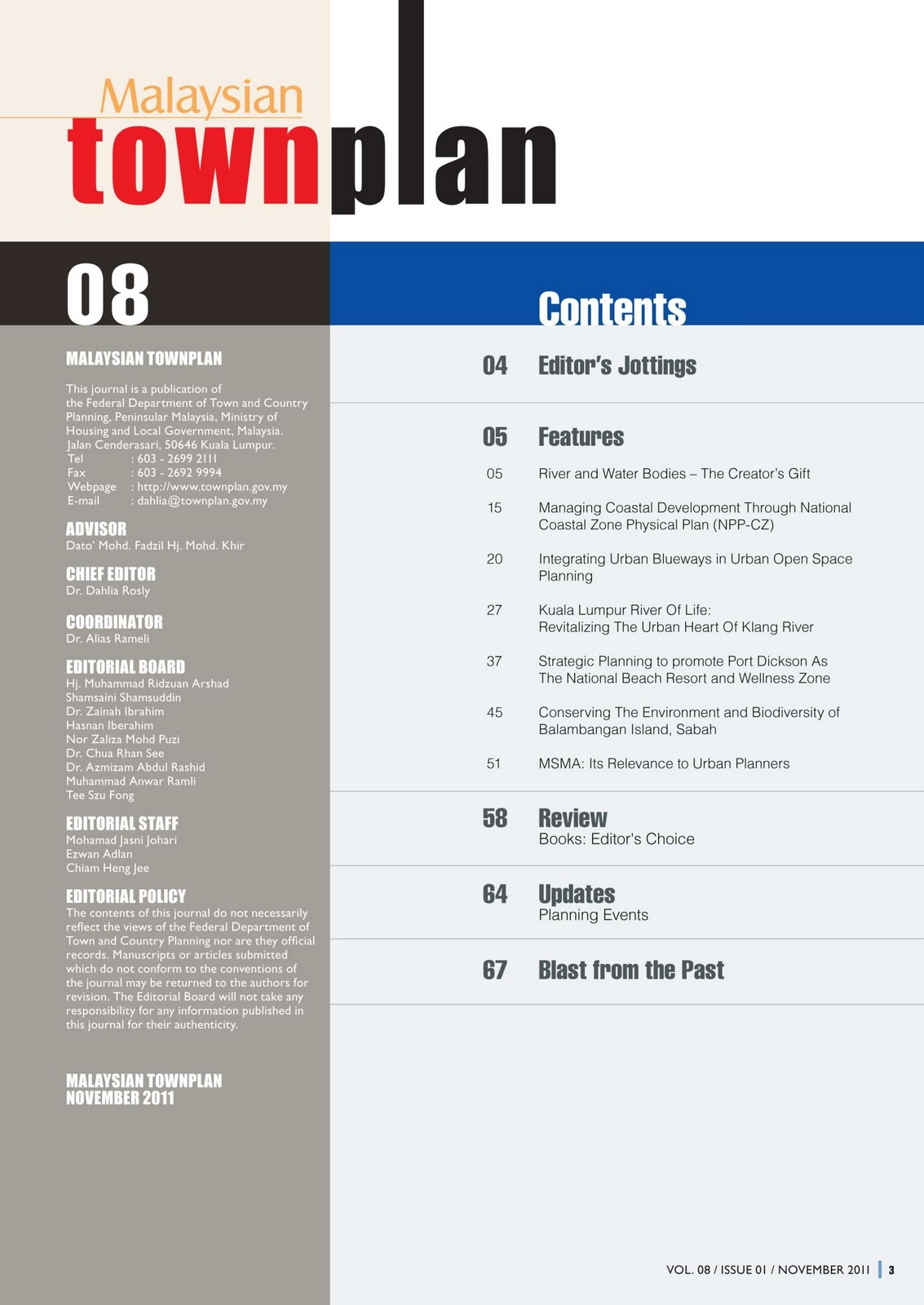
MALAYSIAN TOWNPLAN JOURNAL Vol 8 Issue No 01 November 2011

Malaysian Townplan Journal 2011 (Malaysia's Town Planning Journal No. 1) themed `Planning in Blue', published by the Federal Department of Town and Country Planning Malaysia (JPBD) now availabe in hard copy version. A hard copy is available from 15 November 2011 during the launching of Malaysian World Planning Day Celebration at Sheraton Imperial Hotel, Kuala Lumpur. This journal tries to bring readers to appreciate river and water bodies as the Creator's Gift up to how to connect river with the people, and many more!..for details, please visit http://www.townplan.gov.my/ or http://www.%20mytownnet.%20blogspot.com.with/ RM20, the knowledge about the history and how to plan the river is yours...limited copy, first come first basis applied.Do contact us (Research and Development Division, JPBD) at 03-20816 000. Get your copy today!http://www.townplan.gov.my/devo/download/Banner%20Page/Promotion_Malaysian%20Journal%20Townplan.pdf


Monday, 10 October 2011

MY ACADEMIC JOURNALS PUBLICATIONS FROM 2008-2011

1. Empowering the Global City-Region - The Crucial Roles of Local Government published by World Applied Sciences Journal Volume 13 (Sustainable Development Impact from the Socio-Environmental Perspectives) page 82-86, 2011http://www.idosi.org/wasj/wasj13(SDISEP)11/5.pdf

2. The Efficient Urban Governance in Managing and Enhancing Competitiveness of Property Markets in Kuala Lumpur City-Region published by E-Bangi / The National University of Malaysia (UKM), Volume 5, Issue 1, page 116-131, October 2010.http://www.ukm.edu.my/e-bangi/index.php/en/component/jresearch/?view=publication&task=show&id=93

3 The Implementation of E-Government in Local Authorities Towards Enhancing Urban Governance Efficiency : Case Study Subang Jaya Municipal Council published by GEOGRAFIA - Malaysian Journal of Society and Space / The National University of Malaysia (UKM) Volume 6, Issue 1, page 1-12, January 2010. http://www.ukm.my/geografia/images/upload/1.2010-1-Azmizam%20Hamzah%20Jalal-english-3.pdf

4. Efficient Urban Governance in Managing and Enhancing Competitiveness of The Kuala Lumpur City-Region published by Asian Profile : Asia's International Journal, Volume 37, Issue 56, page 597-612 / Asian Research Service, Canada December 2009.
http://www.asianresearchservice.com/v37.htm#6

5. The Role of Efficient Urban Governance in Managing Kuala Lumpur City-Region Development published Asian Social Science, Volume 5, Issue 8, page 14-32 / Canadian Center of Science and Education, August 2009. http://www.ccsenet.org/journal/index.php/ass/article/view/3431/3109

6. Efficiency in Urban Governance Towards Sustainability and Competitiveness of City: A Case Study of Kuala Lumpur published by World Academy of Science, Engineering and Technology (WASET) Paris,  Issue 16 Article 79 page 443- 456, April 2008. http://www.waset.org/journals/waset/v40/v40-79.pdf

Saturday, 24 September 2011

EMPOWERING THE GLOBAL CITY-REGION - THE CRUCIAL ROLES OF LOCAL GOVERNMENT

My new article was published at World Applied Sciences Journal Volume 13 (Sustainable Development Impact from the Socio-Environmental Perspectives), page no 82-86 ISSN 1818-4952 by IDOSI Publication 2011. Detail article can read at http://www.idosi.org/wasj/wasj13(SDISEP)11/5.pdf. This is my 7th article published in academic journal since 2008.

Sunday, 12 December 2010

MY ABSTRACT ARTICLE FOR INTERNATIONAL GEOGRAPHY UNION (IGU) BOOK 2009

I am submitted my draft article with a title of THE EFFICIENT URBAN GOVERNANCE IN MANAGING MARGINALIZED SOCIETY WITHIN KUALA LUMPUR CITY-REGION to Assoc Prof Dr Jamalunlaili Abdullah from UiTM and Emeritus Professor Walter Leimgruber from University of Fribourg Switzerland, book editors of  PLANNING FOR CHANGE: RESPONSES TO SOCIO-ECONOMIC MARGINALIZATION. This book will be published and lauched in May 2011.

The publication of the book is conjuction with the International Geography Union (IGU) Conference 2009 with the theme of  Critical Issues of Marginalization in A Globalising World and in The South in Particular which held in Faculty of Architecture, Planning and Surveying UiTM  6-8 July 2009 . Below is my draft abstract for the above article.

ABSTRACT

This paper discusses on the preliminary study on the concept of efficient urban governance (EUG) in managing marginalized society within city-region. The analysis of marginalized areas and peoples demonstrates that as a consequence of global, regional and localized forces marginal regions worldwide are under-going significant changes due to the volatility of external and internal political, social and economic processes which impact on them. The process of globalization is having profound positive and negative effects, on nations, regions, localities, people and communities. Development equality has been a major issue in the country’s latest development agenda. The issue is more obvious in city-region due to its role as an engine of growth economy development. Now, with its sights set on attaining the economic level of a fully developed nation by 2020, Malaysia must focus on securing a credible share of the lead sectors of the globalised economy. Kuala Lumpur city-region (KLCR), which is the most developed region in the country and an important catalyst towards national economic growth. How well do urban governance responsible to efficiency and effectiveness of local authorities in city-region? What kind of EUG is required to achieve equal and earning opportunities among marginalized society within city-region? The world today needs a new, comprehensive and holistic model of urban governance that involves all sectors (government, business, civil and other marginalized societies) as equal partners in development. EUG which integrates all sectors including public, private and other social organizations in a participatory decision making. EUG is characterized by sustainability, subsidiarity, equity, transparency and accountability, civic engagement and citizenship and security. In line with this, the importance EUG would make Malaysia more sustainable and well-being to facilitate the achievement of the nation’s development goals. Therefore, KLCR will manage and govern efficiently.

Keywords: Development equality, sustainable, efficient urban governance, marginalized society

Friday, 10 December 2010

MY NEW RESEARCH MANAGEMENT SOFTWARE

Mendeley Desktop is a free reference management tool for my desktop and the web that can help dramatically increase my research productivity, collaborate with others online, and discover the latest research.

Azmizam Abdul Rashid's bibliography

Tuesday, 23 November 2010

CRACK MY HEAD TO THINK AND WRITE

1st Article

Try hard  beyond my limit to write an article with 5,000 words for the book PLANNING FOR CHANGE: RESPONSES TO SOCIO-ECONOMIC MARGINALIZATION under  International Geographical Union (IGU). The book will be published under UiTM and will be ready in the market early March 2011.  The topic for the article is THE EFFICIENT URBAN GOVERNANCE IN MANAGING MARGINALIZED SOCIETY OF KUALA LUMPUR CITY-REGION. My dateline submission to Dr Jamal before 10 December 2010. However need to submit to my co-author Associate Prof Dr Hamzah Jusoh before 5 December 2010. Think....think.. how to make the article interesting to read....!!!!!!

 Related site : http://www.conferencealerts.com/seeconf.mv?q=ca1m0ihh


2nd Article

The dateline to submit an abstract to WORLD PLANNING SCHOOLS CONGRESS 2011 is 30th November 2010. My topic is THE CONTRIBUTION OF  EFFICIENT URBAN GOVERNANCE INDEX TO ENHANCE DEVELOPMENT EQUALITY IN KUALA LUMPUR CITY-REGION. However need to submit to my co-author Associate Prof Dr Hamzah Jusoh before 29 November 2010.  Prior to that in March 2010, I had to prepare for the full article for submission to WPSC 2011 committee. Think....think.. how to make the article and the concept of efficient urban governance can contribute to urban planning knowledge. Hello!! Perth Here We Come!!!!!!!!!!!

Thursday, 18 November 2010

MY NEW JOURNAL PUBLICATION....E-BANGI JOURNAL OF FSSK, UKM 18 NOVEMBER 2010

JILID 5, BILANGAN 1, 116-131, 2010.ISBN: 1823-884x


THE EFFICIENT URBAN GOVERNANCE IN MANAGING AND ENHANCING COMPETITIVENESS OF PROPERTY MARKETS IN KUALA LUMPUR CITY-REGION
(Keefisienan Governans Bandar Dalam Mengurus dan Memperkasakan Daya Persaingan Pasaran Hartanah di Wilayah-Bandar Raya Kuala Lumpur)

Azmizam Abdul Rashid, Hamzah Jusoh & Habibah Ahmad

ABSTRACT

This article discusses on the preliminary study of efficient urban governance (EUG) towards enhancing competitiveness of the property market especially shopping complexes and office sectors in city-region economy. City-region competitiveness has been a major issue in the country’s latest development agenda. The study was carried out in 2009 and based on latest information Kuala Lumpur Cily Plan 2020 and National Property Information Centre (NAPIC) 2009. The issue is more obvious in city-region due to its role as an engine of growth economy development. Now, with its sights set on attaining the economic level of a fully developed nation by 2020, Malaysia must focus on securing a credible share of the lead sectors of the globalised economy. Kuala Lumpur city-region (KLCR) is the most developed region in the country and an important catalyst towards national economic growth. How well do urban governance responsible to efficiency of local authorities (LAs) in city-region? Did EUG can enhance competitiveness property market within city-region? The main challenge of enhancing competitiveness of property sector in city-region is the implementation of efficient urban governance by LAs. The world today needs a new, comprehensive and holistic model of urban governance that involves all sectors (government, business and the civil society) as equal partners in development. Urban governance which integrates all sectors including public, private and other social organisations in participatory decision making. EUG is characterized by sustainability, subsidiarity, equity, transparency and accountability, civic engagement and citizenship and security. In line with this, the importance EUG would make property market more competitive and attractive to investors and facilitate the achievement of the nation’s development goals.

Keywords: efficient urban governance, competitiveness, property market, city-region

ABSTRAK

Artikel ini membahas tentang kajian awal keefisienan governans bandar (KGB) terhadap pemerkasaan daya persaingan pasaran hartanah khususnya sektor bangunan pusat membeli-belah dan pejabat dalam ekonomi wilayah-bandar raya. Persaingan wilayah-bandar raya telah menjadi isu utama dalam agenda pembangunan terkini negara. Kajian ini telah dijalankan pada tahun 2009 dan berdasarkan kepada analisis laporan Pelan Tempatan Bandar Raya Kuala Lumpur 2020 dan Pusat Maklumat Hartanah Negara 2009 (NAPIC). Isu ini lebih jelas di wilayah-bandar raya kerana peranannya sebagai enjin pembangunan pertumbuhan ekonomi. Pada masa kini, dengan dasar yang ditetapkan untuk pencapaian tahap ekonomi sepenuhnya menjelang tahun 2020, Malaysia perlu memberi fokus dalam sektor-sektor utama ekonomi global. Wilayah-bandar raya Kuala Lumpur (WBKL) adalah wilayah yang paling membangunkan dan pemangkin penting kepada pertumbuhan ekonomi negara. Bagaimana governans bandar menentukan keefisienan pihak berkuasa tempatan (PBT) di wilayah-bandar raya? Adakah KGB mampu meningkatkan daya persaingan pasaran hartanah di dalam wilayah-bandar raya? Cabaran utama dalam meningkatkan daya persaingan sektor hartanah di WBKL adalah perlaksanaan KGB oleh PBT. Dunia hari ini memerlukan model baru, komprehensif dan holistik governans yang melibatkan semua sektor (kerajaan, perniagaan dan masyarakat sivil) sebagai rakan setara dalam pembangunan. Governans bandar yang mengintegrasikan semua sektor termasuk organisasi sosial masyarakat, swasta dan lain-lain dalam membuat keputusan bersama. KGB selaras dengan kemapanan, subsidiari, keadilan, ketelusan, akauntabiliti, penglibatan awam, kewarganegaraan dan keselamatan. Seiring dengan hal ini, pentingnya KGB akan membuat pasaran hartanah lebih berdaya saing dan menarik bagi pelabur dan memudahkan pencapaian tujuan pembangunan negara.

Katakunci: Keefisienan governans bandar, daya persaingan, pasaran hartanah, wilayah-bandar raya

Tuesday, 28 July 2009

ASIAN PROFILE INTERNATIONAL JOURNAL

On 22 July 2009, I received an email from Mr Nelson Leung editor from ASIAN PROFILE AN INTERNATIONAL JOURNAL that my article collaboration with my main supervisor Assoc Prof Dr Hamzah Jusoh and co supervisor Dr Jalaluddin Abdul Malek has been scheduled for publication in one of the next current issues in Vol. 37 (2009). In the August issue and in their website our article has been included in the Articles to be published. Thank you to Dr Hamzah and Dr Jalal for your encouragement and support....I feel want write more....


ABSTRACT.
EFFICIENT URBAN GOVERNANCE IN MANAGING AND
ENHANCING COMPETITIVENESS OF THE
KUALA LUMPUR CITY-REGION


BY
HAMZAH JUSOH
JALALUDDIN ABDUL MALEK
AZMIZAM ABDUL RASHID
hj@pkrisc.cc.ukm.my, jbam@ukm.my, azmizam67@yahoo.co.uk

This paper discuss on the concept of efficient urban governance in enhancing competitiveness of the city-region. City competitiveness has been a major issue in Malaysia latest development agenda. Kuala Lumpur City-Region, which is the most developed region and important catalyst towards national economic growth. How well do urban governance responsible to efficiency and effectiveness of local authorities in city-region? What kind of urban governance is required to enhance competitiveness and earning opportunities within city-region? The world today needs a new, comprehensive and holistic model of urban governance that involves all sectors (government, business and the civil society) as equal partners in development of city-region. Urban governance is characterized by sustainability, subsidiarity, equity, efficiency, transparency and accountability, civic engagement and citizenship and security. In line with this, the importance efficient urban governance would make Malaysia more competitive and attractive to investors and facilitate the achievement of the nation’s development goals.

Keywords : Economic planning, sustainable, efficiency, urban governance and city competitiveness.

Friday, 26 June 2009

EUROPEAN JOURNAL OF SOCIAL SCIENCES (EJSS)

On 24th June 2009, I received an email from EJSS that my articles Efficient Urban Governance in Managing And Enhancing Competitiveness of the Retail and Office Sectors in Kuala Lumpur City-Region has been approved for publication by EJSS's external reviews. I am so happy because my two articles are going to be published before December 2009. I would like to thank my supervisors Assoc Prof. Dr. Hamzah Jusoh and Dr Jalaluddin Abdul Malek for their advices and encouragement.

ABSTRACT
This paper discuss on the preliminary study on the concept of efficient in urban governance towards enhancing competitiveness of the property market especially retail and office sectors in city-region economy. City-region competitiveness has been a major issue in the country’s latest development agenda. The issue is more obvious in city-region due to its role as an engine of growth economy development. Kuala Lumpur City-region, which is the most developed region in the country and an important catalyst towards national economic growth. How well do urban governance responsible to efficiency and effectiveness of local authorities in city-region? What kind of urban governance is required to enhance competitiveness property market within city-region? The world today needs a new, comprehensive and holistic model of urban governance that involves all sectors (government, business and the civil society) as equal partners in development and participatory in decision making. Efficient urban governance is characterized by sustainability, subsidiarity, equity, efficiency, transparency and accountability, civic engagement and citizenship and security. In line with this, the importance efficient urban governance would make our property market more competitive and attractive to investors and facilitate the achievement of the nation’s development goals. Therefore Kuala Lumpur City-region will manage and govern efficiently.

Keywords: competitiveness, efficient urban governance, property market and city-region

Wednesday, 24 June 2009

ABSTRACT FOR ASIAN SOCIAL SCIENCE

The Role of Efficient Urban Governance in
Managing Kuala Lumpur City-Region Development
by
Hamzah Jusoh
Jalaluddin Abdul Malek
Azmizam Abdul Rashid
Faculty of Social Sciences and Humanities, National University of Malaysia,
43600 UKM Bangi,Selangor Darul Ehsan, Malaysia
Telephone no: 03-89215683/5680,

Abstract

This paper discuss on the preliminary study on the concept of efficient in urban governance towards managing development of Kuala Lumpur City-Region. City-region development has been a major issue in the country’s latest development agenda. The issue is more obvious in city-region due to its role as an engine of growth economy development. Now, with its sights set on attaining the economic level of a fully developed nation by 2020, Malaysia must focus on securing a credible share of the lead sectors of the globalised economy. Kuala Lumpur City-Region, which is the most developed region in the country and an important catalyst towards national economic growth. How well do urban governance responsible to efficiency and effectiveness of local authorities in city-region? What kind of urban governance is required to enhance competitiveness and earning opportunities within city-region? The main challenge of enhancing city competitiveness in city-region is efficient urban governance. The world today needs a new, comprehensive and holistic model of urban governance that involves all sectors (government, business and the civil society) as equal partners in development. Urban governance which integrates all sectors including public, private and other social organisations in participatory decision making. Efficient urban governance is characterized by sustainability, subsidiarity, equity, efficiency, transparency and accountability, civic engagement and citizenship and security. In line with this, the importance efficient urban governance would make Malaysia more competitive and attractive to investors and facilitate the achievement of the nation’s development goals. Therefore Kuala Lumpur City-Region will manage and govern efficiently.

Keywords: Economic planning, sustainable, efficiency, urban governance and city competitiveness

Tuesday, 23 June 2009

JOURNAL OF ASIAN SOCIAL SCIENCE

On 22 June 2009, I received an email from Canadian Center of Science and Education (CCSE) that my manuscript journal with title of The Role of Efficient Urban Governance in Managing Kuala Lumpur City-Region Development have been approved for publication but minor amendment. I submitted the draft manuscript to CCSE on 1 June 2009. The journal will be published as Vol. 5, No. 8, August 2009. CCSE is required to submit the amended manuscript within 2 weeks from the date of approval. According to UKM requirement, PhD students are required to submit their journal according to their scope of research. We must submit at least 2 manuscripts for publication for eligiblity to sit viva presentation. I have one more journal to be published. Thank you to my supervisors Assoc Prof. Dr. Hamzah Jusoh and Dr Jalaluddin Abdul Malek for their advices and encouragement. Acknowledgement also given to Prof. Dr. Rahimah Abdul Aziz for her support and guidance.

CCSE is an independent non-government organization delivering supports and services to education and research in Canada and the world.Canadian Center of Science and Education established in 2006, is the result of contributions from the Canadian federal government, province governments, enterprises as well as NGOs.In partnership with federal government, province governments, community organizations, public agencies, enterprises and other foundations, CCSE offers a variety of programs to support and promote education development, international cooperation, including educational programs for students, financial support for researchers and international education projects, as well as scientific publication.

Comments from External Reviewers

Contribution to existing knowledge - The paper visits the vexing question of better governance of cities which are facing insurmountable problems made more difficult through poor integration, poor consultation and participation of all stakeholders. The age old governance model that placed the government at the centre of urban governance in Malaysia needs rethinking and this paper makes a good case for it. The paper integrates the issue of new governance into urban economic development and globalization with special focus on Metropolitan Kuala Lumpur.

Evidence supports conclusion - The article adds to the growing corpus of knowledge on urban governance. Makes the case for rethinking the model that has served well in the past but struggling to cope with the present.The argument (for improved governance) is well supported by drawing on the urban life and challenges.

I have submitted four manuscripts to various high impact journal since May 2009. There are Urban Studies, Cities, Asian Profile Journal and European Journal of Social Sceience. I am waiting journal publisher external reviews and approval. The scope of my research for these journal manuscripts are related to efficient urban governance. I wish to publish these journal before end of December 2009.

PEOPLE AROUND ME..FAMILY AND FRIENDS.

PEOPLE AROUND ME..FAMILY AND FRIENDS.
To my Wife, Zulaini, my sons Zulazlan, Zulazman, Zulazmir, Zulazmin dan my daughter, Nuris Zulazlin...I love you all..thank you being with me

CIRCLE OF FRIENDS... KUALA LUMPUR PROJECT OFFICE

CIRCLE OF FRIENDS... KUALA LUMPUR PROJECT OFFICE
Thank you guys...for your support and encouragement

2007 / 2008 METHODOLOGY AND QUALITATIVE RESEARCH COURSE FOR PHD CANDIDATES

2007 / 2008 METHODOLOGY AND QUALITATIVE RESEARCH COURSE FOR PHD CANDIDATES
My new friends during my course in INTAN 9 Jan -2 Mac 2007

KUALA LUMPUR PROJECT OFFICE, JOURNEY TO MOUNT OF KINABALU SABAH 21-22 JANUARY 2006

KUALA LUMPUR PROJECT OFFICE, JOURNEY TO MOUNT OF KINABALU SABAH 21-22 JANUARY 2006
WE CAME, WE SAW, WE CONQUERED 4095.2 METER ABOVE SEA LEVEL

How are you, guys? Where you are now?

FOOD CLOCK