Since December 2007, I created this research blog to facilitate me to do my PhD. I completed my research in December 2010 and I want to keep this blog. Its allow me to continue writing and sharing my views on urban and regional planning. This blog will create a new networking among researchers and give me a confidence but never allowed me to become complacent...DR. AZMIZAM ABDUL RASHID
Showing posts with label Urban Governance. Show all posts
Friday, 25 March 2016
Sunday, 1 April 2012
THE ROLE OF EFFICIENT URBAN GOVERNANCE TO ENHANCE URBAN LIVEABILITY AND ECONOMIC GROWTH
There is no doubt that the lives of cities and of the businesses located in them are inextricably intertwined. But how closely linked are cities' economic growth and their liveability? A survey of urban professionals conducted by the Economist Intelligence Unit shows that the idea of liveability has a number of different components. Jobs and cost of living, public transport and roads, safety and security and culture and nightlife all rank highly among our respondents' list of factors contributing to a city's attractiveness as a place to live and work.
In the first report in this series, we spelled out the strategies policymakers need to adopt in order to maintain and improve liveability for citizens. Some of the key steps include providing a good public transport system, getting a bigger say in planning policy, taking a more sensitive approach to urban design and handing over more control of public services to citizens. This second report explores the relationship between business performance and liveability in cities, and highlights some of the ways in which business and policymakers are working together to make cities more liveable.
Whatever the type of challenge being faced by an individual city, improving liveability can only help to strengthen its attractiveness for residents, workers and potential investors. But coming up with a realistic and effective strategy for boosting economic growth is a hugely difficult challenge, particularly when wider economic forces are working in the opposite direction. History has shown that long-term shifts in patterns of trade across the globe and the introduction of new technologies or production methods can undermine the industries upon which some cities were built. Declining cities in the former manufacturing heartlands of the north of England and in the "rust belt" of the United States provide powerful evidence of this. And, try as they might, policymakers have frequently found it agonisingly difficult to hold back the tide of change.
Even in those cities where economic growth is occurring, the challenge of enabling this can be enormously complex. Often the problem is that those people already living in high growth areas resent the changes associated with it and try to block the developments and investments—in housing and transport, for example—that are needed to facilitate growth. Rather than blocking growth altogether, however, these kinds of obstructions frequently lead to congestion and affordability problems as more and more people and businesses try to cram into houses, offices and trains that were simply not designed to meet such high levels of demand.
It is important to look at liveability—a misunderstood and often misused term—but equally important to understand that for citizens and companies, there is a clear hierarchy of needs. What is clear from our research is that what business primarily wants from city leadership is policy that helps to stimulate job creation, followed by basic liveability factors such as good infrastructure, schools and so on.Mayors and civic leaders can occasionally be beguiled by the "softer" aspects of liveability. Opera houses, parks and other assets associated with liveability are all important components of great cities' brands, but getting the basics right first helps cities to compete globally on a more equal footing. Among the key findings of our research are:
Jobs take precedence over liveability when people are choosing where to locate. Our survey shows that the main reason for urban professionals to move to a city is its jobs market and cost of living. Moreover, respondents say that their organisation's main benefit in being located in their city is its access to talent and labour. But with workforces increasingly prepared to relocate for the best opportunities, there is a question mark over policymakers' ability to develop local skill levels and encourage skilled workers to remain in their city.
Deliver the housing needed to meet demand. As we spelled out in our first report, rising house prices are often seen as a sign of a city's economic success. One important challenge for policymakers who are looking for ways to help maintain their city's economic growth is to make sure that there is enough housing to meet demand in economically dynamic areas. Failure to do so can result in housing affordability problems, dissuading talent from moving from low-performing to high-performing areas. This is not simply an issue for policymakers. As Todd Sinai of the University of Pennsylvania's Wharton School of Business points out, "in a city that's more expensive, the first thing that has to happen is that workers need to get paid more".
Open the door to foreign investment. In difficult economic times, policymakers are often pressured into favouring support for local businesses over foreign companies. But such strategies are not necessarily the right way forward, according to our survey—only 15% of respondents see that as a priority for their civic leaders, as opposed to almost one-third who would prefer it if multinationals were encouraged to set up shop in their city, in order to make it more competitive for business. The presence of multinational companies in a city can raise its image elsewhere, and branding can play a big role in the business life of a city. More than one-half of respondents regard their city's international profile and good reputation as important benefits to their organisation's decision to locate there, and nearly three-quarters believe their city's image helps it to attract important industries.
Enlist the help of the commercial sector. Respondents to our survey consider that it is the public sector that should shoulder most responsibility for services such as public transport and the maintenance of parks and schools. But the business sector already plays a key role in developing cities' liveability, supporting culture, sporting events, healthcare facilities, transport infrastructure and environmental initiatives. As civic leaders face tighter budgets they should be prepared to take the initiative in asking business for more help. The cost to the city of London's ambitious cycle hire scheme, for example, would have been far greater without a substantial investment from Barclays, a bank. Of course, in engaging in philanthropic endeavours an organisation's ambition may largely be to generate brand awareness. But Londoners, for their part, have shown that they are prepared to become two-wheeled advertisements for Barclays in exchange for a more convenient journey around town.
Focus on the basics of urban life – transport, roads, houses, schools and safety. When a city secures a major sporting event such as the Olympic Games, is it a boon for business? Urban professionals don't think so. They think it is far more important to get the basics right by improving public transport and roads, providing better schools and improving safety. CEOs such as FedEx's Fred Smith agree. "Ultimately, you have to have both good economics and good quality of life—they feed each other," he says.
Saturday, 14 January 2012
THE GLOBAL PERSPECTIVE ON THE ROLE OF URBAN GOVERNANCE IN SUSTAINABILITY CITIES
More than half of today’s global population currently resides in urban areas and this figure is growing. This means that any credible call for sustainable development on a global level must involve urban areas – a fact that finds expression in the concept of sustainable cities. Governing urban areas in a sustainable manner is, however, fraught with contradictions and dilemmas. The keys to understanding these difficulties, we argue, are to be found in the interpretation of good governance and sustainability and in their inherent contradictions. For the last two decades, the Urban Governance agenda has been based on ideas of democratic, decentralized, localized community and participatory approaches, most of which emanate from a development discourse and from experiences in rural and/or semi-rural areas. Sustainability is, ultimately, a global term – especially in the era of global climate change – and it may extend beyond the scope of urban government. Hence, urban areas – and in particular the emerging mega-cities that seem to be becoming an increasingly dominant sign of contemporary urban political economy – do not easily harmonize with either of these processes.
On the contrary, these areas are designed to be the nexuses of various kinds of flow – rural-urban; domestic-global – and they seem ill-suited to territorial decentralization and/or participatory local democracy. Moreover, major cities, which harbour vast numbers of high-consuming inhabitants in a limited space, are typically the sites of unsustainable processes that exact a price from surrounding areas (ultimately the globe). So, major cities are often not amenable to established governance practices and they often fail to follow basic principles of sustainability. This paper aims to scrutinize the dilemmas involved in governing sustainable cities, and it offers a suggestion for how the challenge might be addressed. In addition to presenting a review of the literature, we will briefly explore some experiences gained from a number of pilot cases of sustainable cities and use these to illustrate the kind of dilemmas involved and to suggest possible solutions.
Finally, we present a discussion about what may be the most appropriate future agendas for research and development agencies alike. One of the questions that is often raised is whether participatory governance is likely to benefit or jeopardize democracy. The failure of representative democracy to govern complex cities and to solve current problems is frequently pointed out. The idea of grassroots democracy and participatory democracy may simply represent the interests of groups with good resources and organizational strengths and may be pushed through at the expense of the common good. From this perspective, participatory governance implies a risk of pseudo-democratic elites with special interests gaining dominance (Raymond 2002:183). Also the increasing complexity of knowledge-based society is used as an argument that elected elites are and should be responsible for representing the public good and they should not be led by the uninformed masses.
On the other hand, successful city management must be concerned with democratic renewal as well as with management innovation and ideally participation transforms citizens who have hitherto pursued selfish interests into responsible citizens who are focused on the public good . Many local authorities in a number of countries have also introduced various forms of area based decision making to increase the participation in planning and budgeting processes. Ward committees in South Africa are one example. The Local Agenda 21 programme was set up on the basis of participatory procedures. Local processes have no decision making authority, but can offer advice to the representative bodies with whom responsibility for making fiscal decisions rest. Within such processes, a high value is placed on incorporating marginalized groups such as youth and women.
When urban governance is successful in mobilizing the necessary support and getting local decision-making structures in place, outcomes - in urban areas – may still fail to yield higher technical standards of governance due to the urban areas’ increasingly complex and interconnected nature. Moreover, even if we accept urban as a partial success (for now) in terms of participation, there is no evidence that sustainable development practices are being pursued or that such policies as are being pursued actually foster sustainable development on a global scale. Instead, we need a locally grounded process that operates not on the basis of voluntary engagement or temporary enthusiasm but within a clear framework that is set at the national level, anchored in the legal system and developed in policy. Such a framework should in turn be in concert with international imperatives and should be outlined in research and at major conferences and UN conventions.
Hence, we need to look for the quality of the local processes, and in this, three links require further attention: i) deepened local government-to-people relations in order to ground any process and establish local advocates; ii) better local government-central government relations so that the local can operate freely, but still within the limitations determined by the central state; and, iii) central government should develop a proactive stance towards global sustainability through engagement in international negotiations and standard setting. Neither the local nor the centre can solve these sorts of problems without the support of the other. Hence, the interaction between the local and the centre is crucial and it is imperative that views are shared about who should do what and with which methods.
Thursday, 15 December 2011
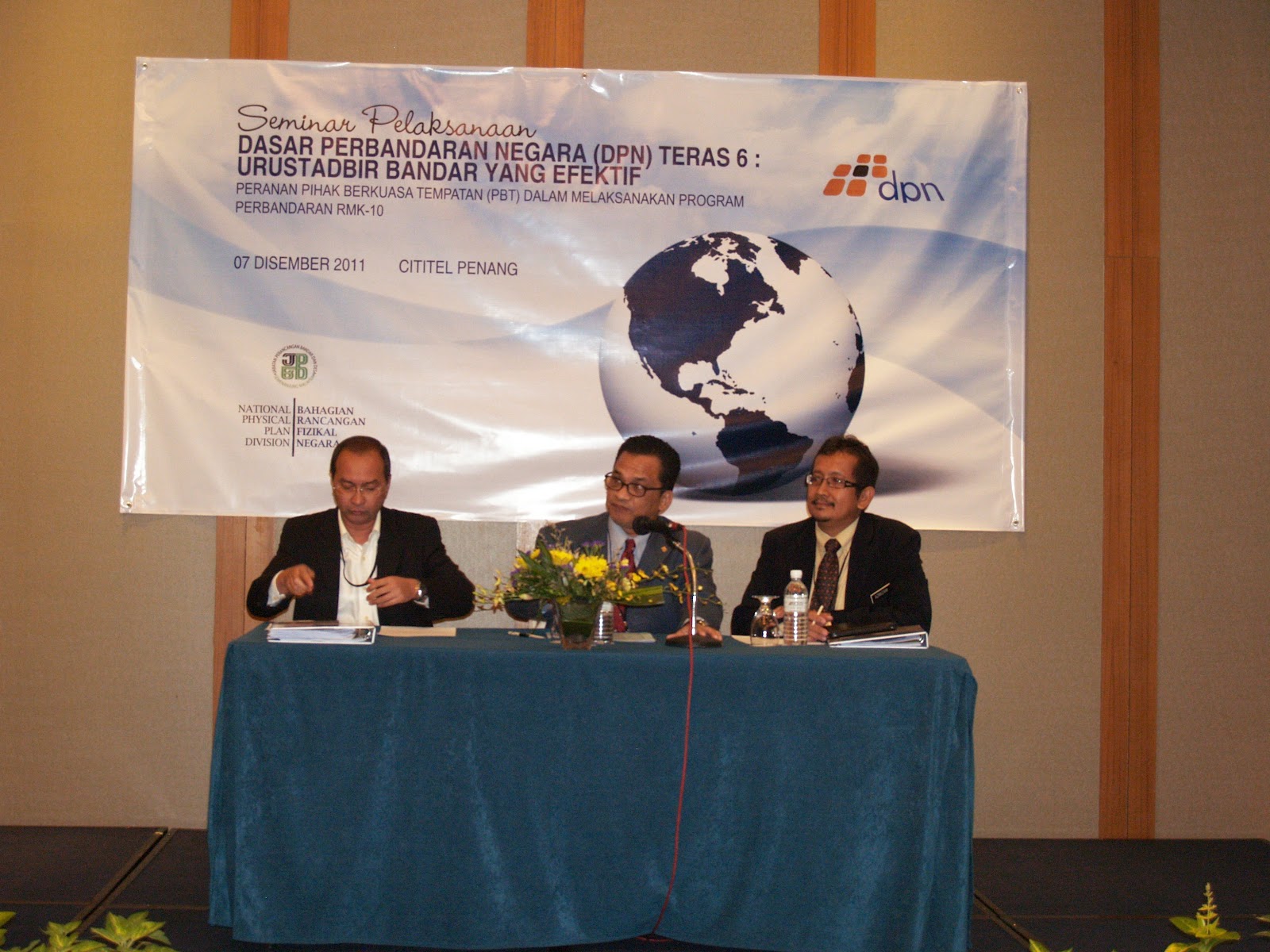
CORE 6: EFFECTIVE URBAN GOVERNANCE UNDER NATIONAL URBANIZATION POLICY (NUP)
NUP 27
a. Restructure the institutions of urban management organizations
b. Increasing employment in all levels of local authorities include improving the technical staff of the management team and professionals
c. Referring to the benchmark and adjust the developed countries in order to determine the number of employment professionals
d. Expanding services at the local government to enable job rotation, more opportunities for promotion and transfer of officers of local authorities in the same country
e. Review and coordinate the relevant legislation the administration and urban management
f. Entered the planning of a comprehensive human resource development, including job rotation, 'job enrichment', promotion opportunities and provide ongoing training to enhance the capacity, capability and staff expertise
g. Establish a special training institutions for urban management
h. Provide leadership and management of a dynamic, robust and good performance capabilities
i. Identify new revenue sources and improve financial management
j. Implement asset management more efficient and systematic manner to ensure quality of service and extend the life span of equipment
k. Streamline regulations and procedures related to planning approval and land use
l. Expedite approval of development
m. Using information and communications technology to improve management quality and improving the provision of services by implementing electronic systems such as e-licensing ',' e-assessment ',' e-Submission 'and
n. aking innovative approaches and methods to improve the effectiveness of the procedure, control is more flexible, broader community participation and use of latest technology
NUP 28
a. Applying the principles of corporate governance in the administration
b. Implement programs Islam Hadhari
c. National Integrity Plan (PIN)
d. Reduce bureaucracy
e. Running an efficient and strict monitoring
f. Improve delivery systems
g. Implementing effective leadership and management
h. Applying transparency
i. Managing finance and resources wisely
j. Implement 'Key Performance Indicators'
k. Prepare and adopt a code of city governance for all local authorities
l. Practicing management and work culture based on knowledge
m. mproving institutions directly involved in community activities
NUP 29
ENCOURAGED COMMUNITY INVOLVEMENT IN PLANNING AND URBAN GOVERNANCE
a. Implement the "Local Agenda 21" in the process of preparing policies, strategies and action plans of sustainable development
b. Establish a division of the local authority for coordinating and managing programs to enhance participation of local communities
c. Ensure that all local authorities established the public relations unit
d. Federal and state governments provide funding for managing Comunity Involvement Program
e. Facilitate the public to obtain information relating to planning and urban governance
f. Increasing public awareness of the cultural aspects of design and maintenance
g. Encourage community participation, private and BBK in development planning and managing the urban environment
h. JKKK move and encourage the formation of residents' associations and Neighbourhood Watch
i. Encourage private companies and NGOs to contribute to the development of community facilities
NUP 30
a. Develop and use innovative technology in the planning, provision of infrastructure and utilities, and management of urban services
b. Using information and communication technology efficiently to enhance the performance of administrative services and information dissemination to the public
c. Adopt technologies that reduce waste generation
d. Promoting environmentally friendly building with the concept of 'green building' and the efficient use of energy
e. Using renewable energy resources efficiently
INSTITUTIONAL CAPACITY BE STRENGTHENED TO IMPLEMENT THE URBAN ADMINISTRATION AND MANAGEMENT MORE EFFICIENT AND EFFECTIVE
a. Restructure the institutions of urban management organizations
b. Increasing employment in all levels of local authorities include improving the technical staff of the management team and professionals
c. Referring to the benchmark and adjust the developed countries in order to determine the number of employment professionals
d. Expanding services at the local government to enable job rotation, more opportunities for promotion and transfer of officers of local authorities in the same country
e. Review and coordinate the relevant legislation the administration and urban management
f. Entered the planning of a comprehensive human resource development, including job rotation, 'job enrichment', promotion opportunities and provide ongoing training to enhance the capacity, capability and staff expertise
g. Establish a special training institutions for urban management
h. Provide leadership and management of a dynamic, robust and good performance capabilities
i. Identify new revenue sources and improve financial management
j. Implement asset management more efficient and systematic manner to ensure quality of service and extend the life span of equipment
k. Streamline regulations and procedures related to planning approval and land use
l. Expedite approval of development
m. Using information and communications technology to improve management quality and improving the provision of services by implementing electronic systems such as e-licensing ',' e-assessment ',' e-Submission 'and
n. aking innovative approaches and methods to improve the effectiveness of the procedure, control is more flexible, broader community participation and use of latest technology
NUP 28
THE PRACTICE OF GOOD CORPORATE GOVERNANCE TO PROMOTE AN OPEN MANAGEMENT CULTURE, INTEGRITY AND RESPONSIBILITY
a. Applying the principles of corporate governance in the administration
b. Implement programs Islam Hadhari
c. National Integrity Plan (PIN)
d. Reduce bureaucracy
e. Running an efficient and strict monitoring
f. Improve delivery systems
g. Implementing effective leadership and management
h. Applying transparency
i. Managing finance and resources wisely
j. Implement 'Key Performance Indicators'
k. Prepare and adopt a code of city governance for all local authorities
l. Practicing management and work culture based on knowledge
m. mproving institutions directly involved in community activities
NUP 29
ENCOURAGED COMMUNITY INVOLVEMENT IN PLANNING AND URBAN GOVERNANCE
a. Implement the "Local Agenda 21" in the process of preparing policies, strategies and action plans of sustainable development
b. Establish a division of the local authority for coordinating and managing programs to enhance participation of local communities
c. Ensure that all local authorities established the public relations unit
d. Federal and state governments provide funding for managing Comunity Involvement Program
e. Facilitate the public to obtain information relating to planning and urban governance
f. Increasing public awareness of the cultural aspects of design and maintenance
g. Encourage community participation, private and BBK in development planning and managing the urban environment
h. JKKK move and encourage the formation of residents' associations and Neighbourhood Watch
i. Encourage private companies and NGOs to contribute to the development of community facilities
NUP 30
USE OF INNOVATIVE TECHNOLOGY IN THE DESIGN, DEVELOPMENT AND MANAGEMENT OF URBAN SERVICES
a. Develop and use innovative technology in the planning, provision of infrastructure and utilities, and management of urban services
b. Using information and communication technology efficiently to enhance the performance of administrative services and information dissemination to the public
c. Adopt technologies that reduce waste generation
d. Promoting environmentally friendly building with the concept of 'green building' and the efficient use of energy
e. Using renewable energy resources efficiently
Friday, 9 December 2011
Monday, 10 October 2011
MY ACADEMIC JOURNALS PUBLICATIONS FROM 2008-2011
1. Empowering the Global City-Region - The Crucial Roles of Local Government published by World Applied Sciences Journal Volume 13 (Sustainable Development Impact from the Socio-Environmental Perspectives) page 82-86, 2011http://www.idosi.org/wasj/wasj13(SDISEP)11/5.pdf
2. The Efficient Urban Governance in Managing and Enhancing Competitiveness of Property Markets in Kuala Lumpur City-Region published by E-Bangi / The National University of Malaysia (UKM), Volume 5, Issue 1, page 116-131, October 2010.http://www.ukm.edu.my/e-bangi/index.php/en/component/jresearch/?view=publication&task=show&id=93
3 The Implementation of E-Government in Local Authorities Towards Enhancing Urban Governance Efficiency : Case Study Subang Jaya Municipal Council published by GEOGRAFIA - Malaysian Journal of Society and Space / The National University of Malaysia (UKM) Volume 6, Issue 1, page 1-12, January 2010. http://www.ukm.my/geografia/images/upload/1.2010-1-Azmizam%20Hamzah%20Jalal-english-3.pdf
4. Efficient Urban Governance in Managing and Enhancing Competitiveness of The Kuala Lumpur City-Region published by Asian Profile : Asia's International Journal, Volume 37, Issue 56, page 597-612 / Asian Research Service, Canada December 2009.
http://www.asianresearchservice.com/v37.htm#6
5. The Role of Efficient Urban Governance in Managing Kuala Lumpur City-Region Development published Asian Social Science, Volume 5, Issue 8, page 14-32 / Canadian Center of Science and Education, August 2009. http://www.ccsenet.org/journal/index.php/ass/article/view/3431/3109
6. Efficiency in Urban Governance Towards Sustainability and Competitiveness of City: A Case Study of Kuala Lumpur published by World Academy of Science, Engineering and Technology (WASET) Paris, Issue 16 Article 79 page 443- 456, April 2008. http://www.waset.org/journals/waset/v40/v40-79.pdf
Tuesday, 23 November 2010
CRACK MY HEAD TO THINK AND WRITE
1st Article
Try hard beyond my limit to write an article with 5,000 words for the book PLANNING FOR CHANGE: RESPONSES TO SOCIO-ECONOMIC MARGINALIZATION under International Geographical Union (IGU). The book will be published under UiTM and will be ready in the market early March 2011. The topic for the article is THE EFFICIENT URBAN GOVERNANCE IN MANAGING MARGINALIZED SOCIETY OF KUALA LUMPUR CITY-REGION. My dateline submission to Dr Jamal before 10 December 2010. However need to submit to my co-author Associate Prof Dr Hamzah Jusoh before 5 December 2010. Think....think.. how to make the article interesting to read....!!!!!!
Related site : http://www.conferencealerts.com/seeconf.mv?q=ca1m0ihh
2nd Article
Try hard beyond my limit to write an article with 5,000 words for the book PLANNING FOR CHANGE: RESPONSES TO SOCIO-ECONOMIC MARGINALIZATION under International Geographical Union (IGU). The book will be published under UiTM and will be ready in the market early March 2011. The topic for the article is THE EFFICIENT URBAN GOVERNANCE IN MANAGING MARGINALIZED SOCIETY OF KUALA LUMPUR CITY-REGION. My dateline submission to Dr Jamal before 10 December 2010. However need to submit to my co-author Associate Prof Dr Hamzah Jusoh before 5 December 2010. Think....think.. how to make the article interesting to read....!!!!!!
Related site : http://www.conferencealerts.com/seeconf.mv?q=ca1m0ihh
2nd Article
The dateline to submit an abstract to WORLD PLANNING SCHOOLS CONGRESS 2011 is 30th November 2010. My topic is THE CONTRIBUTION OF EFFICIENT URBAN GOVERNANCE INDEX TO ENHANCE DEVELOPMENT EQUALITY IN KUALA LUMPUR CITY-REGION. However need to submit to my co-author Associate Prof Dr Hamzah Jusoh before 29 November 2010. Prior to that in March 2010, I had to prepare for the full article for submission to WPSC 2011 committee. Think....think.. how to make the article and the concept of efficient urban governance can contribute to urban planning knowledge. Hello!! Perth Here We Come!!!!!!!!!!!
Related site : http://www.wpsc2011.com.au/index.html
Monday, 12 April 2010
CIVIL SOCIETY IN THE CONTEXT OF URBAN REGIME THEORY
But what, actually, we mean by the urban regime? According to Stone (1989), the regime is an informal yet relatively stable group with access to institutional resources, and which has a significant impact on urban policy and management. It is not a coherent organisation or association, but an informal group of influential persons who derive their power from different sources, who share some policy objectives like that of promoting the growth in their city, and who can gain some economic, political or social rewards from their involvement. The regime is formed as an informal basis for coordination and without an all encompassing structure of command. (Stoker 1995, 59; Anttiroiko 1996a, 66)
An important point to be made here is the view that the politics in different cities seem to be dominated by various types of governing coalitions or regimes. There are pluralist regimes in which strong political leaders bring together a mixed set of private actors. Elitist regimes are run primarily by cohesive business elite. Corporatist regimes, which we may assume to be relevant in the context of Northern countries, combine both strong political leaders and a relatively unified business elite. And lastly, there is a category labelled as the hyperpluralist regime in which any governing coalitions can hardly be identified. One assumption is, that the direction of change within urban governance is towards more pluralist models, though new elites which are able to manage with the informational mode of development may emerge. (Stoker 1995, 62)
The social complexity is central to this perspective. The urban policy is dependent on institutional arrangements, business interest mediation, and some degree of popular control. What is essential is the fact that all the key institutions and actors are involved in an extremely complex web of relationships. The social control and effective management is limited to particular aspects of local development and policy choices. This, in turn, limits the capacity of local government as an agency of authority at local level. Other kinds of limits are determined by the higher levels of government. This is to say that the autonomy of Finnish cities is constrained by two principal factors, those of limited economic resources and local economic conditions, on the one hand, and the political control of the state authorities and European Union, on the other hand. (cf. Gurr & King 1987, 56) This makes it easier to understand why in most of the western countries there can be said to be two groups which dominate the urban regimes, the business elite provided it has structured itself to have a single voice, and the political force which operates within wider institutional and corporatist setting (cf. Stoker 1995, 63). The social complexity, thus, shapes not only local authorities and city management but also the governing coalitions within the urban setting.
Friday, 9 April 2010
IS URBAN GOVERNANCE ORIGINALLY FROM URBAN REGIME THEORY?
The study of urban regimes brings to center stage the issue of how to think about power. In Regime Politics (1989), I drew the distinction between "power over" and "power to" as a way of differentiating a social-production model of power from a social-control model. Over the past few years, as I have sought to understand the politics of social reform in the U.S., reform in urban education in particular, that distinction continues to strike me as critical. Yet, to make such a distinction is not a matter of endorsing one conception of power over the other, but of understanding how each fits into a larger political picture. It is important to see that in everyday political reality the two understandings of power are intertwined. Though conceptually different from "power over," for reasons spelled out below, "power to" has a domination or "over" aspect that should not be ignored in the study of urban regimes. After all, regimes are not neutral mechanisms through which policy is made. Instead, they are arrangements that facilitate action on some issues more readily than upon others
Originally urban regime theory focused on urban politics abstracted from historical epochs connected to changes in the structure of the world economic system. The theory appears to have gained a dominant position in the American literature on local politics precisely because it dispenses with the stalled debates on conventionally conceptualised tensions like those between elite hegemony and pluralist interest group politics, between economic determinism and political machination, and between structural determinants and local choices. It provides a conceptual framework that views these, on the one hand, as false dualisms and, on the other hand, as theoretically driven historical and/or empirical questions. Urban growth coalitions are viewed as only one of the political coalitions that may arise in cities. In addition, it is assumed that they need to be hegemonic for an extended period of time to be considered a corporate controlled regime. Respectively, entrepreneurialism is viewed as only one of the possible leadership approaches that local politicians and government bureaucracies can pursue. Thus, regime theory asks how and under what conditions do different types of governing coalitions emerge, consolidate and become hegemonic, and how they devolve and transform. The recent transference of urban regime theory to contexts outside of the United States as well as its use in comparative cross-national research attests to its dominant position in urban political scholarship. (Lauria 1995) Our primary intention is to apply this theory to the urban governance in the context of restructuring the corporatist 'post-welfare society'. This is a significant aspect to be taken into account when applying the theory to the Nordic cities and their governance relations.
According to Stoker (1995, 54), regime theory holds substantial promise for understanding variety of responses to urban change. It emphasizes the interdependence of governmental and non-governmental forces in meeting economic and social challenges. This is why it pays attention to the problem of cooperation and co-ordination between government, business community, and the third sector or civil society. Some regime theorists, Clarence Stone (1989) in particular, argue that cities are able to accomplish important public purposes by assembling coalitions of political, business and community elites. This has some important implications. It questions the elitist argument that if actual decision-making appears to be democratic, important issues will be effectively kept off the agenda by the real wielders of community power (Wolman 1996, 168-169). It may, indeed, be said that local politics has its relevance and that it can make a difference, though many academics who have studied the impacts of global economic restructuring and the changes in urban governments are pessimist about the ability of local government to shape its own destiny in the face of sweeping changes. (Wolman 1996, 172) In this the regime theory differs from elite theory: any group is unlikely to be able to exercise comprehensive control in a complex world (Stoker 1995, 59).
One of the attractive features of regime theory is that it addresses the questions which are widely discussed within more conventional approaches such as neo-pluralism. In short, the regime theory tries to shed light to following type of questions (Stoker 1995, 57):
1. What are the implications of social complexity for local politics?
2. What does the systemic advantage of certain interests imply for the nature of urban politics and policy?
3. What forms of power dominate modern systems of urban governance?
4. What roles are there for democratic politics and, for example, disadvantaged groups?
Sunday, 28 February 2010
POSITIONING KUALA LUMPUR CITY REGION IN THE GLOBAL CITIES NETWORK: ANALYSING MALAYSIAN URBAN GOVERNANCE STRATEGIES IN THE MILLENNIUM ERA
In the age of globalization, it was argued that major cities in the region should be positioned in the global city system, in order for these cities and their immediate regions are effectively developed. As the urban and regional economic prospects increase reliance on the participation in the fast moving international and global economy, cities that are unable to adapt to these globalchanges and requirements would be marginalized. The marginalisation of major cities from the mainstream of global development will affect their progress and in most cases be determined by exogenous forces. At the same time, the emergence of new global economic and informational societies has created a new form of spatial development, the global cities. Such status was achieved only when a city and its region becomes a major center of international finance, transnational corporate headquarters, related high-level and specialized services, information processing and advanced telecommunications, a city with an international command and control functions (Sassen, 1991).
To what extend the above criteria and indicators really described the position of cities in underdeveloped and developing economies? It is the intention of the paper to deal with such a question, with particular reference to the city of Kuala Lumpur. Although Kuala Lumpur has substantially part of the international economy for the past three decades, it was argued that the city exercises little of the global or even regional control functions that world cities proposes. For this reason, the authors argued that Kuala Lumpur and possibly other cities in the rapidly developing economies be positioned in a different setting, and with different criteria and indicators, as compared to the existing global cities. Regional disparity has long been recognized in Malaysian development scenario, particularly between the more-developed western region and the less-developed eastern and northern regions in Peninsular Malaysia.
All the Five Year Malaysia Plans, starting from the Third Malaysia Plan (1976-1980) have placed special emphasis on the objectives and strategies of regional development. However in the decade of nineties, in conjunction with globalisation era, the direction of Malaysian development plans have been changed, towards becoming more competitive in the global economy. To some extend after 30 years, the issue of regional disparity is remains unsolved, and yet new emphasis on global competition has been dominated in development strategies and plans. However, analysing from the current achievement of national development, the position of Kuala Lumpur in the global cities network still unsignificant, reflecting the uneffectiveness of the strategies toward strengthening Malaysian competitivenes in global era.
Malaysian's Development Vision, particularly toward achieving the status of developed country in the year 2020. Affirmative action as a policy response to ethnic riots is a fairly unusual, indeed unfashionable, policy response, partly because inequality and conflict have a complex and much debated relationship. General vertical income inequality, measured as the gap between poor and rich, has not been found to have a statistically significant relationship with the onset of civil unrest or conflict (Collier & Hoeffler, 2000; Fearon & Laitin, 2003). And yet, an accumulating body of evidence suggests that horizontal inequality, inequalities between identity or ascriptive groups on the multiple and inter-related planes of the political, the socio-economic, and the cultural, may be politically explosive (Stewart, 2001).
These links between ethnicity, inequality and conflict among ethnic groups using a multidimensional approach, with a view to identifying those policies which might work in other situations of ethnic conflict. Taking Malaysia as the model for my research, I investigate and measure to what extent inequalities between ascriptive groups have fallen in that country between 1970 and 2000, a period during which various affirmative action policies were applied in fields ranging from education and government employment to business. Horizontal inequality in the key indicator of income is re-assessed. In addition, changes in access by ethnic group to educational opportunities; the distribution of employment by sector and by occupation; urbanisation and housing distribuition; ownership of household assets such as houses and cars; and infant, toddler and maternal mortality rates are all considered individually, while a multi-dimensional index of socio-economic inequality is subsequently constructed for comparison purposes.
To what extend the above criteria and indicators really described the position of cities in underdeveloped and developing economies? It is the intention of the paper to deal with such a question, with particular reference to the city of Kuala Lumpur. Although Kuala Lumpur has substantially part of the international economy for the past three decades, it was argued that the city exercises little of the global or even regional control functions that world cities proposes. For this reason, the authors argued that Kuala Lumpur and possibly other cities in the rapidly developing economies be positioned in a different setting, and with different criteria and indicators, as compared to the existing global cities. Regional disparity has long been recognized in Malaysian development scenario, particularly between the more-developed western region and the less-developed eastern and northern regions in Peninsular Malaysia.
All the Five Year Malaysia Plans, starting from the Third Malaysia Plan (1976-1980) have placed special emphasis on the objectives and strategies of regional development. However in the decade of nineties, in conjunction with globalisation era, the direction of Malaysian development plans have been changed, towards becoming more competitive in the global economy. To some extend after 30 years, the issue of regional disparity is remains unsolved, and yet new emphasis on global competition has been dominated in development strategies and plans. However, analysing from the current achievement of national development, the position of Kuala Lumpur in the global cities network still unsignificant, reflecting the uneffectiveness of the strategies toward strengthening Malaysian competitivenes in global era.
Malaysian's Development Vision, particularly toward achieving the status of developed country in the year 2020. Affirmative action as a policy response to ethnic riots is a fairly unusual, indeed unfashionable, policy response, partly because inequality and conflict have a complex and much debated relationship. General vertical income inequality, measured as the gap between poor and rich, has not been found to have a statistically significant relationship with the onset of civil unrest or conflict (Collier & Hoeffler, 2000; Fearon & Laitin, 2003). And yet, an accumulating body of evidence suggests that horizontal inequality, inequalities between identity or ascriptive groups on the multiple and inter-related planes of the political, the socio-economic, and the cultural, may be politically explosive (Stewart, 2001).
These links between ethnicity, inequality and conflict among ethnic groups using a multidimensional approach, with a view to identifying those policies which might work in other situations of ethnic conflict. Taking Malaysia as the model for my research, I investigate and measure to what extent inequalities between ascriptive groups have fallen in that country between 1970 and 2000, a period during which various affirmative action policies were applied in fields ranging from education and government employment to business. Horizontal inequality in the key indicator of income is re-assessed. In addition, changes in access by ethnic group to educational opportunities; the distribution of employment by sector and by occupation; urbanisation and housing distribuition; ownership of household assets such as houses and cars; and infant, toddler and maternal mortality rates are all considered individually, while a multi-dimensional index of socio-economic inequality is subsequently constructed for comparison purposes.
Thursday, 4 February 2010
URBAN GOVERNANCE AND DEMOCRACY
Urban governance in most western democracies has seen various forms of public-private concerted actions becoming increasingly important instruments for local governments. These new features of urban governance are often seen as local governments trying to enhance their "capacity to act" by fusing their capabilities with those of other major societal actors. At the same time such transgressions of the border between the public and the private spheres of society make local governments more susceptible to political pressures from those actors. This volume looks at the historical development and present performance of public-private partnerships for local economic development in western Europe and the United States. Local governments in Western Europe have become increasingly involved in network building with the local business community. The author suggests that governance processes are not value neutral but reflect and sustain political values beyond partisan conflict. Comparing managerial, corporatist, progrowth, and welfare governance models of urban governance, the author argues that nation-state factors play an important role in shaping urban governance. Different sectors in urban politics display different models of governance and local political choice matters. Also, cities within the same national context differ significantly with regard to the degree of inclusion of organized interests in urban governance, which, in turn, is reflected in urban policy outcomes.
It remains to be asked how this emergence of urban governance is to be interpreted in terms of democratic legitimacy and accountability. Undoubtedly, governance networks are usually organised in a less hierarchic manner than governments and can be joined by a multitude of different actors much more spontaneously. Yet, this does not automatically render them more democratic. As a matter of fact, urban governance arrangements are usually neither democratically elected nor controlled. Due to their project orientedness and often ephemeral character, these networks are hard to grasp and control for outsiders. Aren’t these features interpretable as a perfect precondition for alarmingly undem ocratic policies thrusting aside governing by government, which – at least to a larger extent – was based on transparency, electoral legitimacy and accountability? In fact, manyscholars have been deeply worried about these developments. They have regarded urban governance networks as the ideal breeding ground for short-term, particularistic and profit-oriented interests. Indeed, these are the main concerns of the authors who fear that European cities run the risk of becoming “Americanised” in the long run. Are these concerns well-founded? Are governance and democracy two contradictory phenomena? At this point, it is helpful to bring to mind the contextual argument again! As the example of the local state debate has shown, we should be careful with universalistic and functionalist conclusions and implications. However, note that asking the question “What kind of effect does a shift from urban government to governance have on the aspect of urban democracy?” clearly does imply these universalistic and functionalist assumptions:
Firstly, it entails that there is a direct causal link between the rise of governance and the issue of urban democracy. Secondly, it suggests we can hope to find a generally and universally applicable answer to this question. In what sense does context matter also for the question of urban governance arrangements? Most importantly, like many other concepts in urban studies the discussion on urban governance has emerged in an Anglo-American context. In the late 1970s and early 1980s, it was in the United States where public- private partnerships (PPP’s) first came to dominate urban politics.4 Instead of referring to a terminology of “governance”, scholars started to deal with this phenomenon using the labels “urban regimes”, “public private partnerships” and “entrepreneurialism”. Soon it became evident that these non-elected public-private arrangements were chiefly dominated by economic interests such as growth, profit, competitiveness and efficiency (see for example: Kearns and Paddison 2000). When in the 1980s, scholars started to recognize that also in European cities elected officials were about to become increasingly dependent on the collaboration with non-governmental actors, it was widely assumed that also the results can be expected to be very similar to those in the USA. In other words, experiences and theories from America have often been directly imported to Europe.
It remains to be asked how this emergence of urban governance is to be interpreted in terms of democratic legitimacy and accountability. Undoubtedly, governance networks are usually organised in a less hierarchic manner than governments and can be joined by a multitude of different actors much more spontaneously. Yet, this does not automatically render them more democratic. As a matter of fact, urban governance arrangements are usually neither democratically elected nor controlled. Due to their project orientedness and often ephemeral character, these networks are hard to grasp and control for outsiders. Aren’t these features interpretable as a perfect precondition for alarmingly undem ocratic policies thrusting aside governing by government, which – at least to a larger extent – was based on transparency, electoral legitimacy and accountability? In fact, manyscholars have been deeply worried about these developments. They have regarded urban governance networks as the ideal breeding ground for short-term, particularistic and profit-oriented interests. Indeed, these are the main concerns of the authors who fear that European cities run the risk of becoming “Americanised” in the long run. Are these concerns well-founded? Are governance and democracy two contradictory phenomena? At this point, it is helpful to bring to mind the contextual argument again! As the example of the local state debate has shown, we should be careful with universalistic and functionalist conclusions and implications. However, note that asking the question “What kind of effect does a shift from urban government to governance have on the aspect of urban democracy?” clearly does imply these universalistic and functionalist assumptions:
Firstly, it entails that there is a direct causal link between the rise of governance and the issue of urban democracy. Secondly, it suggests we can hope to find a generally and universally applicable answer to this question. In what sense does context matter also for the question of urban governance arrangements? Most importantly, like many other concepts in urban studies the discussion on urban governance has emerged in an Anglo-American context. In the late 1970s and early 1980s, it was in the United States where public- private partnerships (PPP’s) first came to dominate urban politics.4 Instead of referring to a terminology of “governance”, scholars started to deal with this phenomenon using the labels “urban regimes”, “public private partnerships” and “entrepreneurialism”. Soon it became evident that these non-elected public-private arrangements were chiefly dominated by economic interests such as growth, profit, competitiveness and efficiency (see for example: Kearns and Paddison 2000). When in the 1980s, scholars started to recognize that also in European cities elected officials were about to become increasingly dependent on the collaboration with non-governmental actors, it was widely assumed that also the results can be expected to be very similar to those in the USA. In other words, experiences and theories from America have often been directly imported to Europe.
Seen from a contextual point of view, this does not seem compelling at all. The mere dominance of governance networks in politics does not tell us anything about the modes of governance yet, i.e. about the actors involved, the power constellations among them, the political goals prevailing within these networks as well as the final outcomes. “Governing by governance” does not per se imply or favour any specific normative political goals – it rather is an empty shell to be filled with content first. As a term, it merely describes the trend of a partial destatisation, multiplication and informalisation of the collective actors in charge of political decision making. As a consequence, the point is that the political and social consequences of such a shift from urban government to governance will differ decisively, depending on the context these arrangements are embedded in and confronted with
Saturday, 23 January 2010
ANWAR FAZAL - URBAN GOVERNANCE AND CIVIL SOCIETY EMPOWERMENT

"In a world that is increasingly violent, wasteful and manipulative, every effort at developing islands of integrity, wells of hope and sparks of action must be welcomed, multiplied and linked..." - Anwar Fazal
We need to create a new paradigm of development and happiness that can generate a three-dimensional peace - peace with ourselves, peace with other people and peace with mother earth. Little people doing little things in little places everywhere can change the world"…Anwar Fazal
WHO IS HE?
Anwar Fazal is a leading international civil society person who has contributed much to our society in areas of consumer, health environment, human rights and social ethics. Deeply concerned about the social injustices, especially those unconscionable marketing practices by the transnational corporations in developing countries, he has strived to and has succeeded in bringing these to international attention way back in the 1970s. Anwar Fazal, born in 1941, first became associated with the consumer movement in 1968 when he founded the Consumers Association of Penang (CAP) and later worked on consumer affairs for,among others, the Government of Mauritius, the Hong Kong Consumer Council and the United Nations Food and Agriculture Organization. In 1978 he was the first person from the Third World to become President of the International Organisation of Consumers Unions (IOCU), an independent, non-profit group which links the activities of consumer organisations in over half the countries of the world. IOCU, which has since changed its name to Consumers International, promotes international cooperation in consumer protection and education, represents the consumer interest at the global level and facilitates the comparative testing of goods and services.
WHAT IS CONTRIBUTION TO THE IDEA OF URBAN GOVERNANCE?
The issues, ranging from consumer, health, environment to corruption and integrity are all a mark of his persona on the international scene. This website contains a selection of his speeches, presentations and articles is a tribute to Anwar Fazal's contribution to the many social movements he is involved in.
- Civil society and the culture of integrity
- Building Partnerships For Good Governance
- Building The Culture Of Integrity
- Good Governance - Better Human Development
- The Governance and Management of Urban Communities - Challenges for the 21st Century
- Building The Culture Of Integrity - The Spiritual Fundamentals
- International Governance: Government, Ngos And The Citizenry - Their Synergistic Role In A Global Village
- Fighting the Twin Terrors - Peace By Peace
- Challenges to Human Security In The New Age
- The Death And Life Of Asian Cities -The Challenge of Good Governance
- The Future Of Cities
WHAT ARE HIS MAIN IDEA ON URBAN GOVERNANCE?
People must have a new conception of space. More and more issues are ceasing to be associated with political boundaries: the environment does not respect political boundaries, the transnational companies are not concerned with political boundaries--except when it benefits them. In communications, we are moving toward a global village; products and services are becoming homogenized. So we will have to understand space in a new way--we will have to think of space at all three levels because all three--local, national, global--impact on you. And we have to develop systems whereby groups can act locally, nationally and globally. Different groups can work at different levels, but with vertical and lateral links. If we have these vertical and lateral linkages, then we can make use of people's power that will be inclusive and can make transformational change to produce a more just and fair world.
The challenge of urban governance is to have people who take their civic responsibility beyond the personal self and who see that inclusiveness and bringing groups together is critical, who understand that there will be differences in tactics and even in visions; some people think for the summer, others think for a year, others might think for a decade and others will be thinking generations ahead.


Friday, 10 April 2009
A NEW VISION FOR URBAN GOVERNANCE TRANSFORMING URBAN DEVELOPMENT
The urban governance in Malaysia is currently undergoing a period of change. These changes are necessary in response to the changing national environment. The urban continues to be the engine of growth. The role of the local government will continue to be the pacesetter and facilitator in order to establish a competitive, dynamic and resilient economy. What are the objectives of urban governance reforms in Malaysia? Firstly, we want to create a local government which is efficient, effective, dynamic, and innovative; secondly, we need to have a local government which is highly disciplined with the highest standards of integrity, and thirdly, we require a local government which is action-oriented, people-oriented, and customer focussed. In undertaking some of the administrative changes, we are mindful of the opinion or suggestion that the local government should become more like business.
There are similiarities between business and public administration, namely that officials or managers in both sectors are involved in organizational design, allocation of scarce resources, and the management of people. But the context of public administration significantly alters the work itself, and so there are differences between the two. Three differences are most apparent. The first difference between public administration and business lies in the purposes to be served. In most business, even those with service objectives - the bottomline - profit -is the basic measure for evaluating how good a job the organization is doing. In turn, the performance of individual managers, can, in many cases, be directly measured in terms of their units' contribution to the overall profit of the company What does "quality" mean with respect to the environment?
A second difference between work in public governance and corporate governance is the fact that in business, decisions can be quickly made from an individual or a small group, whereas in a public organization, inputs are required from many diversive groups and organizations. We call this the pluralistic nature of government decision-making. Thirdly, managers in public organizations seem to operate with much greater visibility than their counterparts in industry - we are subject to constant scrutiny by the press and the public. With this background, we have introduced changes in the local government which incorporate some of the principles of management in the business sector. However some of the structural changes, and the value-changes introduced are peculiar to the civil service. The Malaysian local government has embarked on a journey towards developing a quality culture. The ultimate objective is the evolution of a mindset premised on quality values that would permeate the entire public sector. They are to be market-driven and to institutionalise a distinct customer-orientation in the delivery of services. Service recovery based on customer feedback would also become an integral part of managing the performance of public sector agencies. The Malaysia Incorporated concept has been the impetus for greater and intense public-private sector collaboration in national development. The imperative has been to build a meaningful working relation-ship in order to forge ahead in an increasingly competitive global market place. Rules, regulations, procedures have been constantly reviewed to expedite work processes, and importantly, decision-making.
There are similiarities between business and public administration, namely that officials or managers in both sectors are involved in organizational design, allocation of scarce resources, and the management of people. But the context of public administration significantly alters the work itself, and so there are differences between the two. Three differences are most apparent. The first difference between public administration and business lies in the purposes to be served. In most business, even those with service objectives - the bottomline - profit -is the basic measure for evaluating how good a job the organization is doing. In turn, the performance of individual managers, can, in many cases, be directly measured in terms of their units' contribution to the overall profit of the company What does "quality" mean with respect to the environment?
A second difference between work in public governance and corporate governance is the fact that in business, decisions can be quickly made from an individual or a small group, whereas in a public organization, inputs are required from many diversive groups and organizations. We call this the pluralistic nature of government decision-making. Thirdly, managers in public organizations seem to operate with much greater visibility than their counterparts in industry - we are subject to constant scrutiny by the press and the public. With this background, we have introduced changes in the local government which incorporate some of the principles of management in the business sector. However some of the structural changes, and the value-changes introduced are peculiar to the civil service. The Malaysian local government has embarked on a journey towards developing a quality culture. The ultimate objective is the evolution of a mindset premised on quality values that would permeate the entire public sector. They are to be market-driven and to institutionalise a distinct customer-orientation in the delivery of services. Service recovery based on customer feedback would also become an integral part of managing the performance of public sector agencies. The Malaysia Incorporated concept has been the impetus for greater and intense public-private sector collaboration in national development. The imperative has been to build a meaningful working relation-ship in order to forge ahead in an increasingly competitive global market place. Rules, regulations, procedures have been constantly reviewed to expedite work processes, and importantly, decision-making.
Sunday, 15 March 2009
SET UP URBAN GOVERNANCE INSTITUTE
PETALING JAYA: A government-funded Institute of Urban Governance has to be set up to better serve cities and towns. Social activist Tan Sri Lee Lam Thye, who made the call, said the development and management of urban centres was among the major challenges faced by the Government due to rapid urbanisation. He said the concentration of development and human activities in cities and towns had exposed the population there to an environment that was “physically, psychologically and socially taxing”, leading to a host of complex urban problems.“It is time for the Government to set up an institute for urban governance, which can function as a national resources and training centre for urban governance and development,” Lee said in a statement.
Lee said such an institute could help facilitate research by providing support to academicians and individuals to undertake research, and also provide consultancy on urban issues.He suggested that academic experts, research organisations and government agencies conduct academic programmes in urban planning for local government officials and others to better manage towns and cities. “Urbanisation should lead to community spirit-building. Where urban centres are built, pro-active efforts must be taken to build a sense of community and belonging among the multi-ethnic residents,” he added.
edited from The Star 17 February 2007
KUALA LUMPUR, Feb 8 (Bernama) -- The government should set up an Institute of Township Management to serve as a centre of excellence for local government administration, suggests social activist Tan Sri Lee Lam Thye.Lee said such an institute could also carry out research work and offer advice on issues involving township management, besides organising courses and training for local government officers."While Malaysia is undergoing rapid township or municipality development, the provision of various services to residents should be part of the national agenda," he said in a statement issued here Sunday.
As such, he said, many technical staff in areas such as planning, architecture, engineering and other professional fields would have to be recruited to increase the capacity of the local governments in administering their respective areas."The local governments must also be sensitive to public grouses and opinions in order to function effectively."In this respect, the public must be encouraged to voice out their views and to participate by being part of the consultative committees set up."Lee said 60 per cent of Malaysia's population now lived in the towns and cities, indicating rapid urban development due to rural-urgan migration.
edited from Bernama 8 February 2009
Saturday, 7 February 2009
URBAN MANAGEMENT VS URBAN GOVERNANCE IN GLOBALISATION ERA
We are living in a rapidly urbanizing world. Today half of the world population lives in urban area, yet as recently as 1975 the urban share was just over one third. Within these global averages, however, there are major differences. The urban share of the population in year 2000 in the developing countries for example was 76%, as compared to 40% in the less developed countries. In Africa and Asia the shares were 38% and 37%, whereas in Latin America, Northern America, Europe and Oceania the proportions were between 70%-77%. For the world as a whole, the urban share is expected to rise to 60% by the year 2030 at which time the shares for Africa and Asia are projected to reach 55% and 53% respectively.
Of the additional world population expected between 2000 and 2015, nearly one billion will be added in urban areas compared to only about 125 million in the rural areas. Virtually all of this growth will take place in developing countries. Urbanisation if well managed, is associated with economic growth and development, providing vital opportunities for economic and social advancement; whereas if not managed properly, may result in social disintegration, more poverty among some sectors and environmental degradation.
In the context of Peninsular Malaysia, according to the National Physical Plan, the level of urbanisation has increased from 54.3% to 65A% in the inter-censual period of 1991-2000, and it is expected to increase to 75% by the year 2020. Urbanisation in Peninsular Malaysia is also marked by the increasing primacy of the three main city regions of Kuala Lumpur, George Town, and Johor Bahru. Urbanlsation can be viewed as a positive or a negative force. The difference lies in whether the urbanisation process is planned, controlled and managed in a proper manner, or otherwise.
One of the main challenges of urbanization is to make sure that our urban area is competitive enough in achieving sustainable urban development. The potential between economic growth and environmental sustainability must be realised to its fullest. Ways must be developed to achieve pro-poor economic development and also to reduce the environmental impact of economic growth and urban production, both on the towns and cities themselves, and on the global environment - as urban economic development is often influenced by changes in national and global economic- Even when economic growth occurs, it does not necessarily benefit the poor. Therefore ways must be found to develop urban economic that are diverse, resilient and also provide job opportunities that are accessible to the poor and the disadvantaged.
The urban economy is of supreme importance to the economic development of developing countries in particular. We need to encourage the town and cities to be competitive to attract investors to invest in our urban area. While at the same time, protect the very resources including the environment, that is crucial in developing the urban economy and attracting the investors in the first place. Besides that, urbanisation is also associated with social and political changes, which can undermine traditional social network and result in increased inequity and exclusion. Therefore, ways must also be found to increase equity and ensuring political and social inclusion. Often this means that ways must be found to extend infrastructure provision to keep pace with urban growth, in a way that is financially and environmentally sustainable, while ensuring access of an adequate level of services to the poor and the disadvantaged.
Currently, the capability of governance of the agencies responsible is recognised as being very crucial in achieving sustainable urbanization. Therefore ways must be found to enhance urban governance to deal with the challenges of managing the growing towns and cities. At the same time, economic, environmental and governance tensions make it difficult to realise the benefits of interdependence between rural and urban areas. In this context, ways must be found to develop and implement economic policies, resource allocation, environmental management strategies, and governance arrangements that recognise and enhance the complementary rates of urban and rural areas in sustainable development. Indeed both urban and rural areas are interdependent. Sustainable land resource planning and management is the core of physical environmental management and biodiversity conservation. Concepts of sustainable development that integrate development and natural resource management objectives should be an integral part of a country's planning process and this should be reflected in all land use policies and plans. Such a spatial planning document for Peninsular Malaysia was launched recently.
The National Physical Plan (NPP) contains 36 policies related to land use and development. The successful implementation of the NPP depends on the collaborative efforts among all relevant stakeholders including private, Government agencies, NGO and communities. This Dialogue aims at imparting a better understanding of the policy's objectives and purpose and will among others, address issues related to urbanization. It also hopes to create further awareness and opportunity for participation from civil society in its implementation. This engagement will undoubtedly contribute to better environmental cooperation and collaboration among the NGOs and Government.
The responsibility to ensure a .sustainable development does not fall on the Government entirely. It is important that we all work together, making use of opportunities provided for public participation in the process. We need the involvement of all, in particular the NGOs. The Ministry would like to view MENGO as a partner in managing our environment. We regard NGOs to be a valuable asset since they have the advantage to be in -the midst of things and the ability to be close to the people. Therefore, they have better opportunity to disseminate information and instill the feeling of responsibility to the masses. At the same time the Government would like the NGOs to be our eyes and ears so that we are informed of what is happening on the ground.
In this regards, the Government welcomes positive and constructive criticism so that we can continuously improve our programme and activities in enhancing the quality of the environment. It is therefore fitting that this Dialogue should focus an getting to know the problems or challenges faced by the relevant Government agencies, in developing urban areas and the proposed plans and programme to overcome them. So that together, the Government and the NGOs can collaborate in addressing the gaps.
Of the additional world population expected between 2000 and 2015, nearly one billion will be added in urban areas compared to only about 125 million in the rural areas. Virtually all of this growth will take place in developing countries. Urbanisation if well managed, is associated with economic growth and development, providing vital opportunities for economic and social advancement; whereas if not managed properly, may result in social disintegration, more poverty among some sectors and environmental degradation.
In the context of Peninsular Malaysia, according to the National Physical Plan, the level of urbanisation has increased from 54.3% to 65A% in the inter-censual period of 1991-2000, and it is expected to increase to 75% by the year 2020. Urbanisation in Peninsular Malaysia is also marked by the increasing primacy of the three main city regions of Kuala Lumpur, George Town, and Johor Bahru. Urbanlsation can be viewed as a positive or a negative force. The difference lies in whether the urbanisation process is planned, controlled and managed in a proper manner, or otherwise.
One of the main challenges of urbanization is to make sure that our urban area is competitive enough in achieving sustainable urban development. The potential between economic growth and environmental sustainability must be realised to its fullest. Ways must be developed to achieve pro-poor economic development and also to reduce the environmental impact of economic growth and urban production, both on the towns and cities themselves, and on the global environment - as urban economic development is often influenced by changes in national and global economic- Even when economic growth occurs, it does not necessarily benefit the poor. Therefore ways must be found to develop urban economic that are diverse, resilient and also provide job opportunities that are accessible to the poor and the disadvantaged.
The urban economy is of supreme importance to the economic development of developing countries in particular. We need to encourage the town and cities to be competitive to attract investors to invest in our urban area. While at the same time, protect the very resources including the environment, that is crucial in developing the urban economy and attracting the investors in the first place. Besides that, urbanisation is also associated with social and political changes, which can undermine traditional social network and result in increased inequity and exclusion. Therefore, ways must also be found to increase equity and ensuring political and social inclusion. Often this means that ways must be found to extend infrastructure provision to keep pace with urban growth, in a way that is financially and environmentally sustainable, while ensuring access of an adequate level of services to the poor and the disadvantaged.
Currently, the capability of governance of the agencies responsible is recognised as being very crucial in achieving sustainable urbanization. Therefore ways must be found to enhance urban governance to deal with the challenges of managing the growing towns and cities. At the same time, economic, environmental and governance tensions make it difficult to realise the benefits of interdependence between rural and urban areas. In this context, ways must be found to develop and implement economic policies, resource allocation, environmental management strategies, and governance arrangements that recognise and enhance the complementary rates of urban and rural areas in sustainable development. Indeed both urban and rural areas are interdependent. Sustainable land resource planning and management is the core of physical environmental management and biodiversity conservation. Concepts of sustainable development that integrate development and natural resource management objectives should be an integral part of a country's planning process and this should be reflected in all land use policies and plans. Such a spatial planning document for Peninsular Malaysia was launched recently.
The National Physical Plan (NPP) contains 36 policies related to land use and development. The successful implementation of the NPP depends on the collaborative efforts among all relevant stakeholders including private, Government agencies, NGO and communities. This Dialogue aims at imparting a better understanding of the policy's objectives and purpose and will among others, address issues related to urbanization. It also hopes to create further awareness and opportunity for participation from civil society in its implementation. This engagement will undoubtedly contribute to better environmental cooperation and collaboration among the NGOs and Government.
The responsibility to ensure a .sustainable development does not fall on the Government entirely. It is important that we all work together, making use of opportunities provided for public participation in the process. We need the involvement of all, in particular the NGOs. The Ministry would like to view MENGO as a partner in managing our environment. We regard NGOs to be a valuable asset since they have the advantage to be in -the midst of things and the ability to be close to the people. Therefore, they have better opportunity to disseminate information and instill the feeling of responsibility to the masses. At the same time the Government would like the NGOs to be our eyes and ears so that we are informed of what is happening on the ground.
In this regards, the Government welcomes positive and constructive criticism so that we can continuously improve our programme and activities in enhancing the quality of the environment. It is therefore fitting that this Dialogue should focus an getting to know the problems or challenges faced by the relevant Government agencies, in developing urban areas and the proposed plans and programme to overcome them. So that together, the Government and the NGOs can collaborate in addressing the gaps.
Subscribe to:
Posts (Atom)
PEOPLE AROUND ME..FAMILY AND FRIENDS.
To my Wife, Zulaini, my sons Zulazlan, Zulazman, Zulazmir, Zulazmin dan my daughter, Nuris Zulazlin...I love you all..thank you being with me
CIRCLE OF FRIENDS... KUALA LUMPUR PROJECT OFFICE
Thank you guys...for your support and encouragement
2007 / 2008 METHODOLOGY AND QUALITATIVE RESEARCH COURSE FOR PHD CANDIDATES
My new friends during my course in INTAN 9 Jan -2 Mac 2007
KUALA LUMPUR PROJECT OFFICE, JOURNEY TO MOUNT OF KINABALU SABAH 21-22 JANUARY 2006
WE CAME, WE SAW, WE CONQUERED 4095.2 METER ABOVE SEA LEVEL
How are you, guys? Where you are now?

