Showing posts with label Seminar. Show all posts

Monday, 14 September 2015

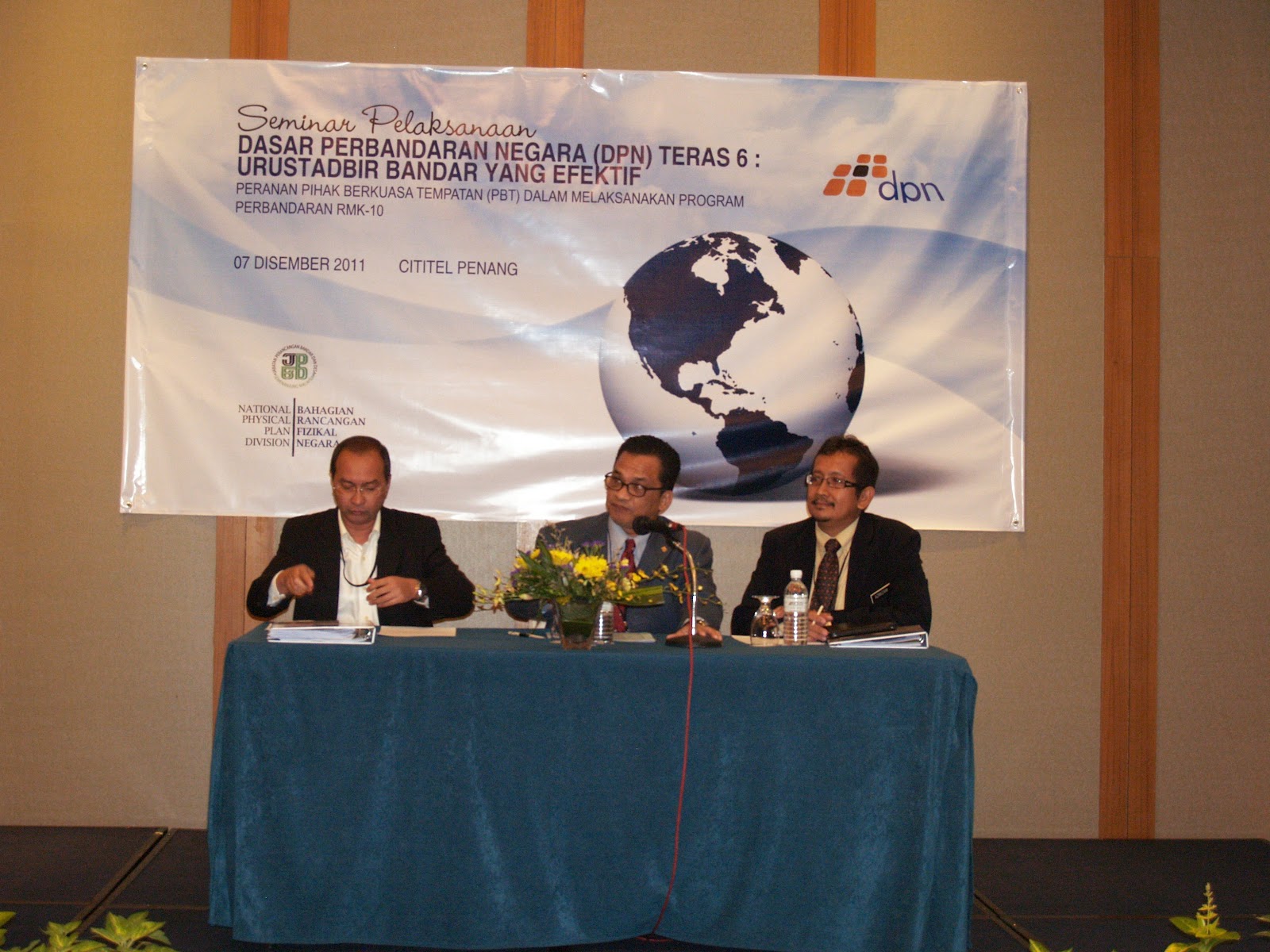
PERSIDANGAN KESIHATAN PERSEKITARAN PIHAK BERKUASA TEMPATAN TAHUN 2015 8-9 SEPTEMBER 2016 DI DEWAN KONVENSYEN UJANA KEWANGAN, LABUAN

ABSTRAK

PEMBANGUNAN BANDAR MAMPAN  KE ARAH
KESIHATAN PERSEKITARAN SEJAHTERA

Dr. Azmizam Abdul Rashid
Bahagian Penyelidikan dan Pembangunan
Jabatan Perancangan Bandar dan Desa
Semenanjung Malaysia


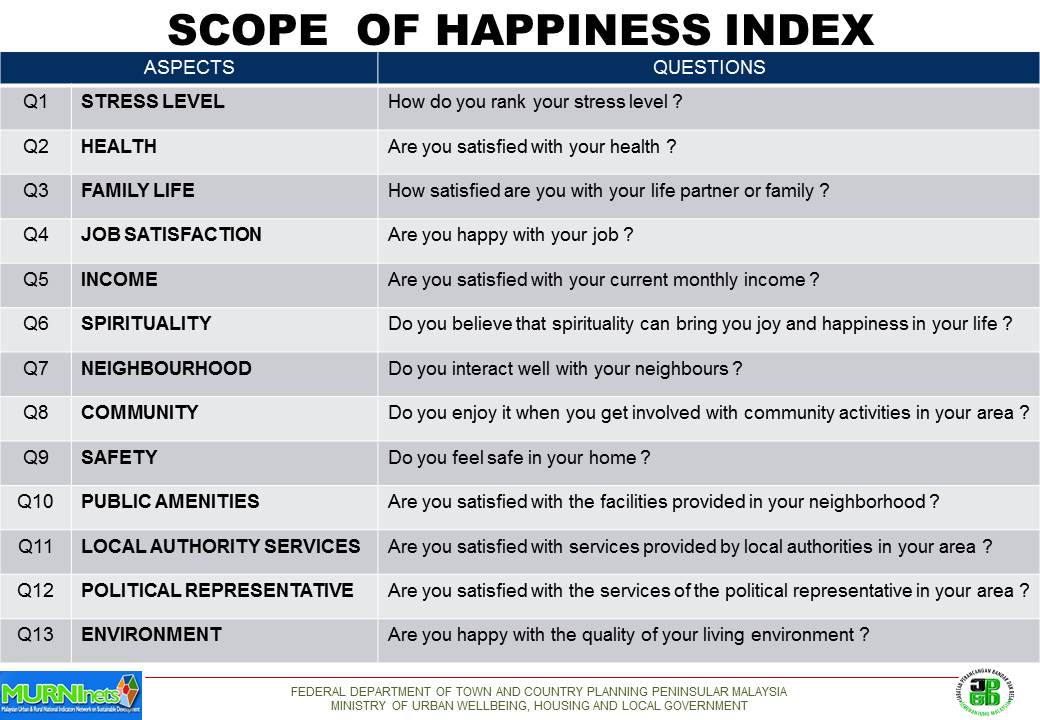
Dasar Kesihatan Negara telah menggariskan panduan untuk mempertingkatkan kualiti dan menyediakan akses sejagat di mana tumpuan diberikan kepada mempertingkatkan penyediaan perkhidmatan penjagaan kesihatan, persekitaran bandar dan memperluaskan kempen gaya hidup sihat  serta aktif. Akta Kerajaan  Tempatan 1976 (Akta 171) iaitu seksyen 72 (1) menjelaskan peranan PBT menyelenggara dan menjalankan perkhidmatan kebersihandan subseksyen (f) menerangkan PBT perlu melindungi dan memajukan kesihatan awam dengan mencegah berlakunya apa-apa penyakit dan bencana. Selain itu, seksyen 73 (1) PBT berhak membuat, meminda atau membatalkan undang-undang kecil seperti menyelenggara dan menguruskan sampah, memelihara tempat awam bagi memastikan keadaan bersih dan bebas dari kotoran. Jabatan Perancangan Bandar dan Desa Semenanjung Malaysia (JPBDSM) adalah antara jabatan yang telah mengambil inisiatif untuk merangka satu sistem yang dapat mengukur tahap kemampanan bandar dan kesejahteraan penduduk melalui Jaringan Penunjuk Pembangunan Mampan Bandar-Luar Bandar Malaysia atau Malaysian Urban Rural National Indicators Network for Sustainable Development (MURNInets).  Ini merupakan satu program yang dapat membantu PBT dalam pengumpulan data dan maklumat serta sebagai satu alat penilaian, penentuan dan pemantauan tahap kemampanan bandar berdasarkan penunjuk-penunjuk yang telah ditetapkan. Melalui program ini, pengurus dan pentadbir bandar dapat memantau, merancang dan mengurus tadbir bandar-bandar secara cekap dan berkesan. Bagi melicinkan pelaksanaan program, aplikasi dan laman web Gerbang MURNInets telah dibangunkan dan diguna pakai untuk mengurus dan merekod pangkalan data penunjuk-penunjuk MURNInets, seterusnya menganalisa dan menjana Indeks Tahap Kemampanan Bandar. PBT membuat pengumpulan data-data dan maklumat-maklumat yang diperlukan dengan bantuan dan pemantauan daripada JPBD Negeri yang bertindak sebagai Pusat Operasi MURNInets Negeri. MURNInets merupakan salah satu pendekatan untuk mengukur tahap kemampanan sesuatu bandar yang mana daripada 36 penunjuk yang diukur, 16 penunjuk adalah berkaitan dengan kebersihan dan kesihatan persekitaran bandar. Antara beberapa petunjuk yang perlu diberi perhatian ialah indeks kebersihan sungai, kualiti udara persekitaran, kes bawaan air dan vektor, penempatan kediaman dengan kemudahan masyarakat, keadaan premis perniagaan makanan, kebersihan tandas awam dan juga sisa pepejal yang perlu dikitar semula. Oleh itu, MURNInets ini dapat menjadi asas bagi melaksanakan kajian projek perintis Healthy City ini sekaligus dapat memperbaiki pencapaian bagi penunjuk-penunjuk tersebut.

Friday, 29 March 2013

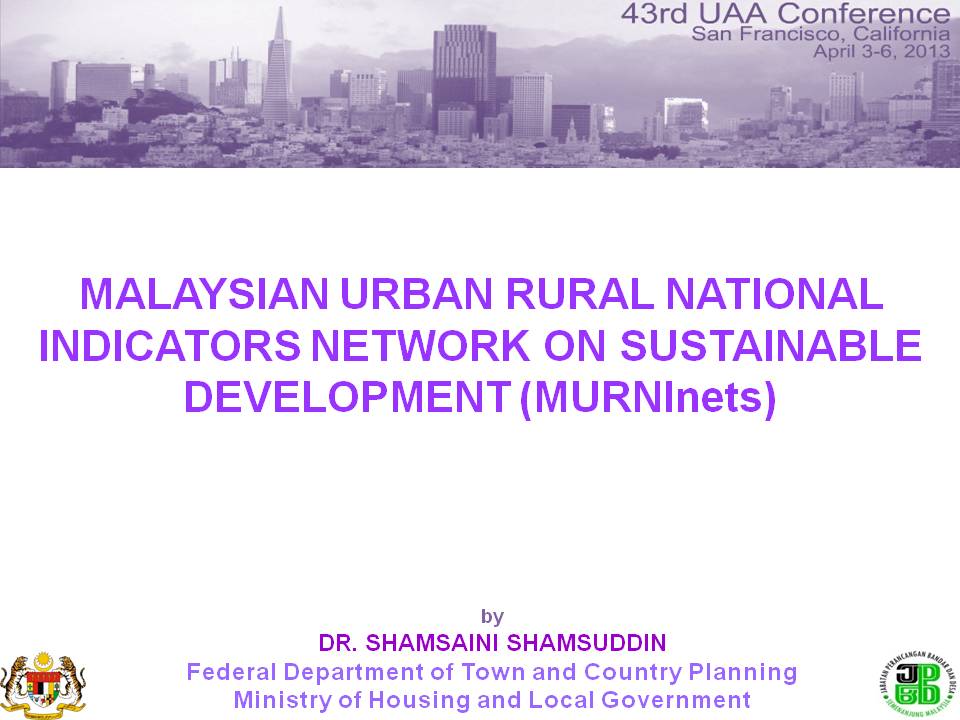
43rd ANNUAL CONFERENCE OF THE URBAN AFFAIRS ASSOCIATION 3-6 APRIL2013


Federal Department of Town and Country Planning (FDTCP) Peninsular Malaysia, Ministry of Housing and Local Government will participate 43rd ANNUAL CONFERENCE OF THE URBAN AFFAIRS ASSOCIATION :Building the 21st Century City: Inclusion, Innovation, and Globalization will be held in San Francisco California United States of America.. 3 papers will be presented by 3 officers from FDTCP.


MALAYSIAN URBAN RURAL NATIONAL INDICATORS NETWORK ON SUSTAINABLE DEVELOPMENT (MURNInets)


by

Shamsaini Shamsuddin

shamsaini.shamsuddin@townplan.gov.my

Azmizam Abdul Rashid


Abstract

The purpose of this article is to promote a set of criteria, indicators and indices for sustainability assessment in major cities of Malaysia. Malaysia Urban Indicators Network (MURNInet) is a programme developed by the Federal Department of Town and Country Planning, Peninsular Malaysia (FDTCP) to assess the performance and levels of sustainability of Malaysian cities. Implemented in 2002, the MURNInet programme was a foundation for Malaysia to measure city development. MURNInet pilot projects were launched in six Malaysian cities namely Georgetown, Johor Bahru, Kuantan, Kuching, Pasir Mas and Batu Pahat. After almost 10 years of implementation, in the year 2011, MURNInet was reviewed and 6 dimensions, 21 themes and 36 indicators are introduced MURNInet is also rebranded as The Malaysian Urban Rural National Indicators Network on Sustainable Development (MURNInets). In search of an adequate set of indicators to develop an index, some existing indicators and indices have been reviewed. This article focuses on the implementation of a new set of indicators to assess urban sustainability in Malaysia. The structural change in population and its distribution or concentration has allows for agglomeration economies that provides greater opportunities for information and knowledge sharing, cultural exchanges and more effective provision of services, particularly health and education. All of these elements are essential for social development, advancement of civil society, well-being, cultural consolidation, change and cosmopolitanism. Function of cities as centres of political power and administration are strengthened. The closer proximity to the seat of power, their higher concentration and better articulation of their demands through civil organisations have meant that urban citizens have greater opportunities to influence policy-making and setting developmental agendas at both local and national levels. The assessments of the sustainability of cities are always relevant and to the selection and application of asset of sustainable development indicators to ensure that city development are directed towards attaining sustainable development.


Keywords : urban sustainability, indicators, network, measurement, local authority


REVITALIZING URBAN DEVELOPMENT IN MALAYSIA THROUGH THE IMPLEMENTATION OF URBAN REGENERATION PROGRAMME


by

Azmizam Abdul Rashid


Abstract

Malaysia’s modern urban growth, development and urbanisation experiences may be conveniently periodised into three major periods, based on the form, structure and functions of the urban centres. . In Malaysia, given the growing conditions of neglect and degradation of the cities centers.  Since most Malaysian city centers are very old historical cities and seem to be rediscovering now the economic value of creative industries and culture. Urban revitalization and regeneration together with the issues of energy sustainability and the need to reduce pollutant emissions, are today the major challenges facing the planning of cities. The concept of urban regeneration in Malaysia’s cities to promote a “return to the city”, revitalise the city centre, restore activity in a fiercely competitive international context, and implement initiatives to improve the quality of the environment operating in a wide sense towards a smart growth.  Urban regeneration is more than just upgrading the physical environment of an area to hopefully spark private investment. However one of most critical issue in urban regeneration is gentrification. This should not be happening in the true spirit of urban revitalization. Instead of displacing the existing community, they should be relocated to the same site. Therefore urban regeneration processes accomplishes the growing importance in literature of concepts like territorial governance, institutional relational density, creativity, social capital, city branding, city image and place marketing. Kuala Lumpur City Hall is among the municipalities practices urban regeneration by recognizing it as one of the strategic directions the city will take in an effort to encourage more sustainable lifestyles.


Keywords : urban revitalization, urban regeneration, gentrification, public participation


Friday, 8 June 2012

SUSTAINABLE CITIES : MAKING REGENERATION HAPPEN IN THE UNITED KINGDOM ORGANISED BY MIPIM 2011


Recent political upheavals have changed the game in UK regeneration. Economic difficulties have meant that funding is difficult to find, and that public money has to go a very long way. At times like these, innovation is key to progress. What can be achieved in the UK, and how? What must cities and towns do to make and how can investors and developers succeed?

Moderator
Jackie Sadek, Chair, UK Regeneration (UK)

Speakers
Sir Howard Bernstein, Chief Executive of Manchester City Council, Manchester City Council (UK)

Neil McLean, Chairman, Leeds City Region Local Enterprise Partnership, Leeds City Region (UK)

Wilfrid Petrie, Executive Vice President GDF Suez Energy Services in charge of BU Int North (France)

Mike Whitby, Leader of the Birmingham City Council, Birmingham City Council (UK)

Monday, 30 April 2012

TEACH-IN PROGRAMME ON MURNInets PORTAL FOR LOCAL AUTHORITIES, STATE PLANNING AND DATA PROVIDERS 17 - 20 APRIL 2012


Further information kindly contact : 
DR. AZMIZAM ABDUL RASHID
 Research and Development Division,
 Federal Department of Town and Country Planning,
 Ministry of Housing and Local Government,
 Unit No. 50-12-2B, & 50-13-1, Wisma UOA Damansara,
 No. 50, Jalan Dungun, Damansara Heights,
 50490 Kuala Lumpur,
 Malaysia
 email address : azmizam@townplan.gov.my or azmizam67@yahoo.co.uk

Monday, 20 February 2012

THE ROLE OF EFFICIENT URBAN GOVERNANCE TO PROMOTE THE INCREASING PUBLIC TRANSPORT UTILISATION

The availability and improvement of public transportation should be looked upon as a consumer right of citizens. Unfortunately, citizens tend to suffer from the uncoordinated, ill planned and profit driven public transport projects that have been developed by private concerns. An example would be the failure to connect the LRT and Monorail lines in KL Sentral itself that brings about such inconvenience to would be users. ‘Sustainability’ is the key word in increasing the utilisation of public transport and this is undertaken by finding out what the general public would like and making sure it is delivered and maintained. The growing success of RAPID Penang has been brought about by its efficiency that encapsulates:
a. Services (affordable, accessible, frequent, conducive, informative with well trained personnel);
b. Enforcement (relevant authorities take responsibility for monitoring and issuing of licences);
c. Hardware (vehicles with good levels of comfort, safety and cleanliness, GPS);
d. Infrastructure (improved road system which includes bus lanes, developing/improving the bus terminals and bus & taxi stops)

The bus operations of most capital cities in developed countries have been reformed via the introduction of the ‘Hub-and-Spoke’ concept which RAPID Penang will emulate once more infrastructure becomes available. The concept entails shortened travelling distances for buses that will increase their frequency and lower the waiting time despite the transfers. RAPID Penang plans to increase the number of buses from 150 to 350 with the goal of achieving a 70:30 (private: public transportation) usage by 2010. As much has been discussed and covered regarding the various problems being faced by Malaysia’s public transport, he concentrated on short and long term recommendations to alleviate and eventually overcome these problems:

The short term steps:
a. Focusing on low/medium income groups and low vehicle ownership settlement corridors to achieve a higher modal split;
b. Lower priority on high-income groups, low density and high vehicle ownership areas as these places would/can be more effectively served by taxis;
c. Choosing suitable vehicles for feeder services with routes penetrating into densely populated settlements;
d. Review and improving the facilities and amenities (bus stop design, waiting comfort, lighting, etc) on priority routes

The long term steps:
a. Policy and strategy in restraining private vehicle usage in the urban centre;
b. Priority on bus operations and enforcement;
c. Balancing land use planning and development

With all the research and recommendations garnered on the issue over the years there should be little or no room for trial and error. An introduction on Department of Railways (DOR) that reports to the Ministry of Transport and is governed by the Railways Act 1991 & Regulations. The duties & functions of the DOR are as follows:
a. Regulating railway operations and services;
b. Prescribing minimal safety standards for railway operations;
c. Prescribing registration/minimal qualification for railway officials;
d. Promoting interest of users of railway facilities/ services (rates, standards, quality, etc);
e. Promoting expansion/improvement of railway systems/facilities/services

In his opinion on the matter on increasing public transport utilisation, there are several ways of achieving this. First and foremost, is to continuously expand the railway network as the backbone of public transport that is complemented with adequate bus line and bus feeder services. The availability of an integrated, accessible and seamless rail network is also needed that possesses a good level of capacity, comfort and reliability. Added to this, will be the need for a common ticketing system and increase in parking space for private vehicle users who would/wish to use public transport like the railway network.

Monday, 30 November 2009

INTERNATIONAL FORUM ON URBANISM 2009 (IFoU) AT DELFT OF UNIVERSITY TECHNOLOGY,THE NETHERLANDS

On 25-28 November 2009, I have a chance to present my PhD research at international conference in Delft University of Technology. I was so honoured to meet Prof Saskia Sassen (The Idea of Global City) from Columbia University, New York and Prof Manuel Castells (The Idea of Network Society) from Professor Emeritus, University of California, Berkeley. Both of them are the main the speakers for the conference. The both icons are among my core research references . So many people want to meet them. During the coffee break I met them and discuss my research framework. The discussion so fruitful with the ideas how to enhance my research. Sassen and Castells suggested to me to search the concept of City for People vs City of People, Complementary City vs Competitive City and Network Society in the City vs Network City for Society. Their supportative and encouragement really boost my motivation to enhance my research. Thanks to my supervisor Assco Prof Dr Hamzah Jusoh, Dr Jalaluddin and Assoc Prof Dr Hazita Azman, Deputy Dean of Faculty of Social Sciences and Humanities, UKM for supporting my research and funding my attendance to the conference.


PEOPLE AROUND ME..FAMILY AND FRIENDS.

PEOPLE AROUND ME..FAMILY AND FRIENDS.
To my Wife, Zulaini, my sons Zulazlan, Zulazman, Zulazmir, Zulazmin dan my daughter, Nuris Zulazlin...I love you all..thank you being with me

CIRCLE OF FRIENDS... KUALA LUMPUR PROJECT OFFICE

CIRCLE OF FRIENDS... KUALA LUMPUR PROJECT OFFICE
Thank you guys...for your support and encouragement

2007 / 2008 METHODOLOGY AND QUALITATIVE RESEARCH COURSE FOR PHD CANDIDATES

2007 / 2008 METHODOLOGY AND QUALITATIVE RESEARCH COURSE FOR PHD CANDIDATES
My new friends during my course in INTAN 9 Jan -2 Mac 2007

KUALA LUMPUR PROJECT OFFICE, JOURNEY TO MOUNT OF KINABALU SABAH 21-22 JANUARY 2006

KUALA LUMPUR PROJECT OFFICE, JOURNEY TO MOUNT OF KINABALU SABAH 21-22 JANUARY 2006
WE CAME, WE SAW, WE CONQUERED 4095.2 METER ABOVE SEA LEVEL

How are you, guys? Where you are now?

FOOD CLOCK