Showing posts with label Sustainability. Show all posts

Monday, 27 June 2016

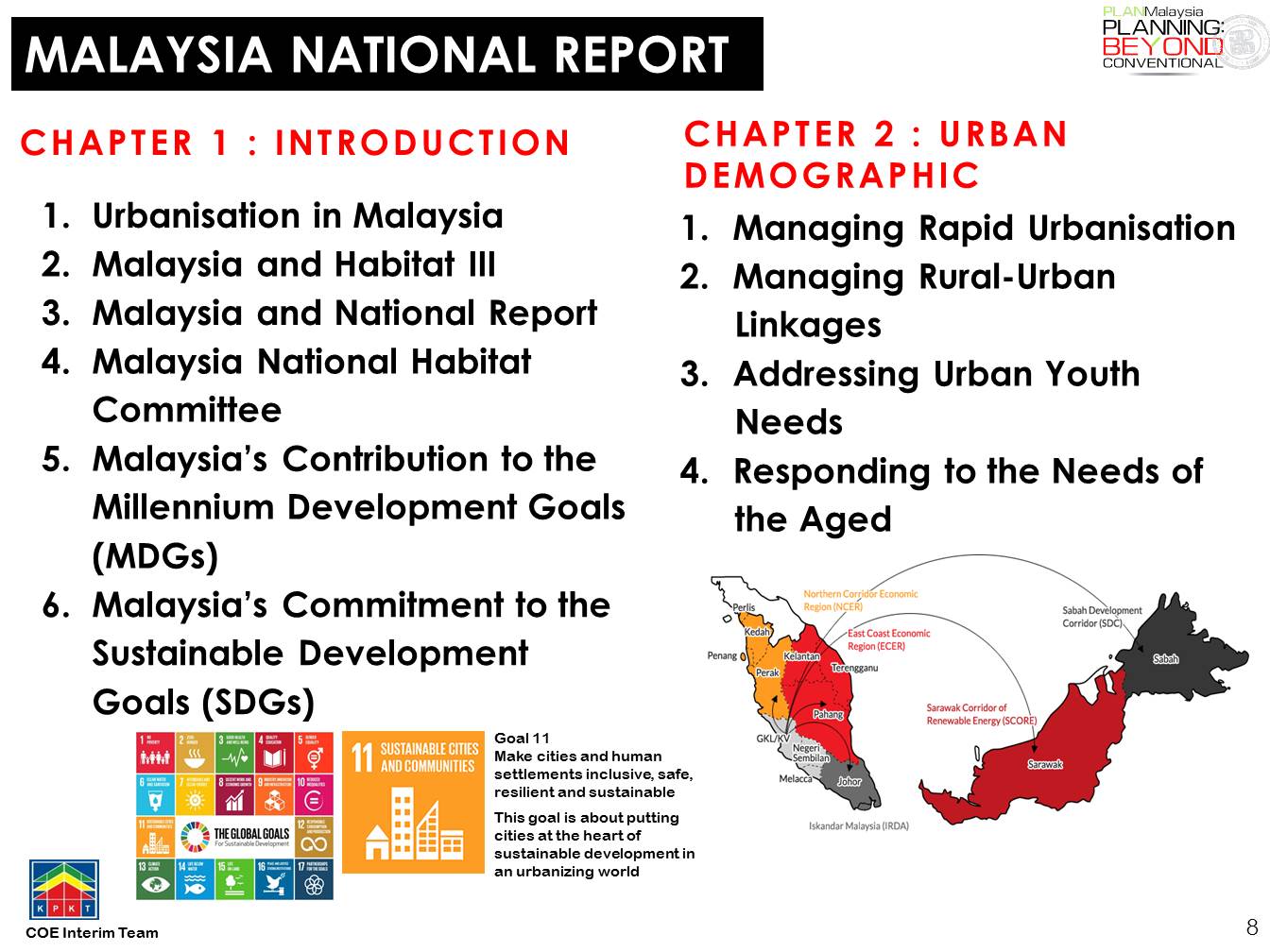
MALAYSIA NATIONAL REPORT FOR THE 3RD UNITED NATIONS CONFERENCE ON HOUSING AND SUSTAINABLE URBAN DEVELOPMENT (HABITAT III)

The world has become more urbanised, generates its own problems and challenges for the future existence of the human settlement. UN Habitat views that the main concern of human settlement for the next two decades is related to urbanisation. “Habitat III” is shorthand for a major global summit, formally known as the United Nations Conference on Housing and Sustainable Urban Development, to be held in Quito, Ecuador, on 17-20 October 2016. The United Nations has called the conference, the third in a series that began in 1976, to “reinvigorate” the global political commitment to the sustainable development of towns, cities and other human settlements, both rural and urban. The product of that reinvigoration, along with pledges and new obligations, is being referred to as the New Urban Agenda. That agenda will set a new global strategy around urbanisation for the next two decades. Member States have been encouraged to prepare a national, evidence-based progress report on the implementation of the 1996 Habitat Agenda and other internationally agreed goals and targets relevant to housing and sustainable urban development. 

The National Reports are key documents for identifying new challenges, emerging trends and a prospective vision for sustainable human settlements and urban development. To date, more than 100 countries have started the preparation of the Habitat III National Reports. As at to date several Member States have submitted their report and have shared with the Secretariat the details of the process of engagement and participation in which they have been elaborated. In line with the UN-Habitat guidelines on the preparation of Habitat III national reports, the Habitat III National Report should focus on demographic issues, national urban policies, urban planning and design, housing, land and security of tenure, urban economy and employment, disasters and resilience, environment and climate change, and any other key issues deemed important within the national context. Towards WUF 9, Malaysia is preparing a draft of the National Report by involving all stakeholders from government, academia, practitioners and non-government organisation. 

This report will be submitted to the United Nations Habitat during the 3rd meeting of the Preparatory Committee (PrepCom 3) Meeting Habitat III in Surabaya on 25 -27 July 2016. Malaysia is also planning to participate in Habitat III conference on 17-20 October 2016 in Quito Ecuador. Therefore, Malaysia will contribute towards strengthening partnerships between various stakeholders in the quest for development of Malaysia Urban Agenda for the next 20 years and beyond. Malaysia National Report will compile relevant information on housing and urban development drawing on the guidelines for the preparation of Habitat III National Reports. This report will be incorporating with functions and responsibilities from various ministries and departments. As demonstrated throughout this report, Malaysia places a high priority on the development of more sustainable and inclusive communities due to our contribution to strengthen the economy, creating good jobs, using energy more efficiently, protecting the natural environment and human health. Through these efforts, Malaysia affirms that the components necessary to ensure the urban future include public-private partnerships, cross-agency and international collaboration, and improved networks across sectors that can help cities mobilize financial and other support for sustainable urban development. Malaysia is committed to participate in Habitat III in order to demonstrate the benefits of a sustainable economic pathway for rapidly urbanising communities.

https://www.habitat3.org/


Monday, 14 March 2016

[DEATH OF DISTANCE + SPATIAL ECONOMIC] x COMPACT CITY - URBAN SPRAWL = SMART CITY ~ SUSTAINABLE CITY


DEATH OF DISTANCE

The communications revolution will have overwhelming and generally benign effects on how businesses function, governments rule, and individuals live their lives. Firms will respond more quickly to market cues, citizens will understand governments better, children will know more about foreign lands. Philosophers and anthropologists may wince in disgust, but it is a faith common among the cyber-elite. The notion of the “death of distance” has gained traction, both in the work of academics but more especially in the popular image of globalisation. Citing radical improvements in the cost and efficacy of long-distance communication and transportation, Cairncross depicts a world marked by the free movement of goods, people, and ideas. Unfortunately, this prognosis has been difficult to identify in present-day trade data. One of the first studies to recognise this was  Leamer and Levinsohn (1995), who write “that the effect of distance on trade patterns is not diminishing over time. Contrary to popular impression, the world is not getting dramatically smaller”.

Taking this view as a starting point, a string of papers has strongly confirmed their initial results. Berthelon and Freund (2008) find corroborating evidence in highly disaggregated trade data. Their main findings are that changes in the composition of trade cannot account for the time-invariant coefficients on distance emerging from gravity equations and that trade in homogeneous products has tended to become more sensitive to distance.

Adding support to this view, Carrère and Schiff (2005) argue that the importance of distance in trade has been on the march in recent times. They make this claim on the basis of a trade-weighted measure of the distance separating trade partners (or distance-of-trade) which has been falling from the 1960s. Additionally, this declining distance-of-trade is observed in the majority of nations, suggesting that the result is not driven by distinctions in the trading relations of rich versus poor countries. Finally, Disdier and Head (2008) collect over 1000 distance coefficients estimated from gravity equations in 78 previous studies and perform a meta-analysis. They find that the estimated distance coefficient has been on the rise from 1950, suggesting that the “death of distance” has been greatly exaggerated.

SPATIAL ECONOMIC

Since 1990 there has been a renaissance of theoretical and empirical work on the spatial aspects of the economy -- that is, where economic activity occurs and why. Using new tools -- in particular, modeling techniques developed to analyse industrial organization, international trade, and economic growth -- this "new economic geography" has emerged as one of the most exciting areas of contemporary economics. Producers and buyers are dispersed in space, and overcoming the distances between them can be costly. Much commercial activity is concerned with “space bridging,” and much ENTREPRENEURSHIP is aimed at making good use of locational opportunities and cutting the costs of transport and communication. Spatial economics is the study of how space (distance) affects economic behaviour. Spatial economic show how a common approach that emphasizes the three-way interaction among increasing returns, transportation costs, and the movement of productive factors can be applied to a wide range of issues in urban, regional, and international economics. This book is the first to provide a sound and unified explanation of the existence of large economic agglomerations at various spatial scales.


URBAN SPRAWL

The issue of urban sprawl, evaluating the claim that the spatial growth of cities is excessive. It has been shown that urban spatial expansion is mainly due to three powerful forces: expansion of urban population, rising incomes, and falling commuting costs. It has been argued that urban growth occurring purely in response to these forces cannot be faulted as socially undesirable. The reason is that the resulting spatial expansion is the outcome of a fair competition for land between real estate developers and agricultural users, whose bids reflect the social value of what they produce. The discussion, however, identifies three market failures that may distort the operation of the fundamental forces, upsetting the allocation of land between agricultural and urban uses and justifying criticism of urban sprawl.

These are failure of market transactions to account for the benefits of open space, excessive commuting because of a failure to account for the social costs of congestion, and failure of local governments to make new development pay for the infrastructure costs it generates. Precise remedies for these market failures are identified, which consist of two types of development taxes along with congestion tolls levied on commuters. Each of these remedies leads to a reduction in the spatial size of the city. When crafting policies to address sprawl, policymakers must recognize that the potential market failures involved in urban expansion are of secondary importance compared to the powerful, fundamental forces that underlie this expansion.

For example, while the failure to fully charge for infrastructure costs may impart a slight upward bias to urban expansion, the bulk of the substantial spatial growth that has occurred across the U.S. cannot be ascribed to such a cause. Instead, this growth mostly reflects fundamentals such as the nation’s growing population and the higher incomes of its citizens. Because of the secondary role of market failure, a draconian attack on urban sprawl is probably not warranted. By greatly restricting urban expansion, such an attack might needlessly limit the consumption of housing space, depressing the standard of living of American consumers. Instead, a more cautious approach, which recognizes the damage done by unwarranted restriction of urban growth, should be adopted.

COMPACT CITY

There is a widespread consensus that progress towards sustainable development is essential. Human activity cannot continue to use resources at the present rate without jeopardizing opportunities for future generations. Cities are the main arena of human activity, but they are also the greatest consumers of natural resources. However, urban sustainability is not just about environmental concerns, it is also about economic viability, liveability and social equity. Recently, much attention has focused on the relationship between urban form and sustainability, the suggestion being that the shape and density of cities can have implications for their future. From this debate, strong arguments are emerging that the compact city is the most sustainable urban form. Compact City is a high density urban settlement that has the following main characteristics: Central area revitalisation, High-density development, Mixed-use development and Services and facilities: hospitals, parks, schools, leisure and fun.

In recent years city planners, developers and policymakers have increasingly looked towards designing a more compact city in order to achieve a more sustainable urban form.  Policies of urban compaction involve the promotion of urban regeneration, the revitalisation of town centers, restraint on development in rural areas, higher densities, mixed-use development, promotion of public transport and the concentration of urban development at public transport nodes. There are many perceived benefits of the compact city over urban sprawl, which include: less car dependency thus lower emissions, reduced energy consumption, better public transport services, increased overall accessibility, the re-use of infrastructure and previously developed land, a regeneration of existing urban areas and urban vitality, a higher quality of life, the preservation of green space, and the creation of a milieu for enhanced business and trading activities. As sustainable development relies upon the combination of economic, social and environmental elements.  The Compact cities are generally attributed with high density urban development having increased socio-economic diversity and improved public realm providing ample opportunities for social interactions and exchanges with pedestrian friendly and closed knit urban form having equitable access to goods, services and facilities thereby minimizing environmental degradation, thus sustainable. But at the same time there are the literatures which point out that high density development have poor quality of life.

SMART CITY

A smart city is a place where the traditional networks and services are made more efficient with the use of digital and telecommunication technologies, for the benefit of its inhabitants and businesses. With this vision in mind, the European Union is investing in ICT research and innovation and developing policies to improve the quality of life of citizens and make cities more sustainable The smart city concept goes beyond the use of ICT for better resource use and less emissions. It means smarter urban transport networks, upgraded water supply and waste disposal facilities, and more efficient ways to light and heat buildings. And it also encompasses a more interactive and responsive city administration, safer public spaces and meeting the needs of an ageing population.

As the global population continues to grow at a steady pace, more and more people are moving to cities every single day. Experts predict the world’s urban population will double by 2050 – which means we’re adding the equivalent of seven New York Cities to the planet every single year. As our planet becomes more urban, our cities need to get smarter. To handle this large-scale urbanization, we’ll need to find new ways to manage complexity, increase efficiency, reduce expenses, and improve quality of life. With this rapid growth ahead of us, imagine if our cities could talk—if they could give us live status updates on traffic patterns, pollution, parking spaces, water, power and light. Imagine how that kind of information could improve the economic and environmental health of the city for residents, merchants, and visitors. Imagine how it could improve working conditions and productivity for the people who maintain the city. Emerging technologies are poised to reshape our urban environments. Using ultra-low power sensors, wireless networks, and web and mobile-based applications, Smart Cities are becoming a reality.

CONCLUSION

Transport costs have always been an important dimension in regional science. It is therefore remarkable that regional science and transport economics have developed in a rather unconnected way. Although being distinct, the routes of the two were parallel, and there are signs that the two fields will get closer to each other. This paper further discusses long run trends in transport costs and the potential spatial consequences. The main conclusion is that although in terms of money and time, the performance of transport has improved enormously, many economic activities have not become footloose to the extent as expressed by the notion of ‘death of distance’. One of the reasons discussed is the role of transaction costs, some being clearly related with distance.


It is clear that the city of the 21st century is no longer the city of the industrial era. Different spatial and temporal organizational principles, communication cultures, modes of economic organization and ways of life coexist in the current city. For urban and spatial planners the ICT related changes pose huge challenges, in the first place because the spatial reach of daily home and work activities and contacts has expanded from the local to the global scale. The consequences of this new spatial reach in the way of organization of the economy, business activities and everyday life have been enormous. On the other hand, the digital technologies that are the material support of the ‘wired new world’ are very dependent on conventional telecommunication infrastructures. These urban networks, deployed within and between cities, are still an understudied field. With very few exceptions the ICT infrastructures have been growing with little or no supervision or even awareness from local authorities. The lack of public authority and responsibility in the telecommunications sector and the discomfort of urban planners and local authorities regarding the technicalities of ICT infrastructures have played a role in the present disregard.

Tuesday, 2 February 2016

ASEAN CITIES DEVELOPMENT AND ASEAN SOCIO-CULTURAL COMMUNITY (ASCC)


ASEAN’s socio-economic progress in these two and a half decades is heralded by remarkable human and sustainable development. At the heart of the ASEAN Socio-Cultural Community (ASCC) is the commitment to lift the quality of life of its peoples through cooperative activities that are people-oriented, people-centred, environmentally friendly, and geared towards the promotion of sustainable development. The ASCC 2025 opens a world of opportunities to collectively deliver and fully realise human development, resiliency and sustainable development as we face new and emerging challenges together.

The ASCC’s strategy and planning mechanism, the ASCC Blueprint, was substantially implemented from 2009 to 2015 and was shown to be effective in developing and strengthening the coherence of policy frameworks and institutions to advance Human Development, Social Justice and Rights, Social Protection and Welfare, Environmental Sustainability, ASEAN Awareness, and Narrowing the Development Gap. More concretely, the ASCC has helped to heighten commitment in the form of policy and legal frameworks, such as the Declaration on Non-Communicable Diseases in ASEAN and the Declaration on Elimination of Violence Against Women and Elimination of Violence Against Children in ASEAN.

The region has also shown collective will, for example, in offering quick, tangible action in humanitarian assistance through the ASEAN Coordinating Centre for Humanitarian Assistance (AHA Centre). Underlying these initiatives are important development outcomes spurring social changes in the region: the proportion of people living on less than USD1.25 per day fell from one in two persons to one in eight persons in the last two decades; the net enrolment rate for children of primary school age rose from 92 percent in 1999 to 94 percent in 2012; proportion of seats held by women in parliaments increased from 12 percent in 2000 to 18.5 percent in 2012; maternal mortality per 100,000 live births fell from 371.2 in 1990 to 103.7 in 2012; and the proportion of urban population living in slums decreased from 40 percent in 2000 to 31 percent in 2012


The ASEAN Socio-Cultural Community (ASCC) Blueprint aims to address the region's aspiration to lift the quality of life of its peoples by setting out concrete and productive actions that are people-centred and socially responsible. Whilst reviewing the progress of the implementation of the blueprint at the ASCC council during the 25th ASEAN Summit held at Bagan, Myanmar on 30 September 2014, it was noted that ‘The primary goal of the ASCC is to contribute to the realisation of the ASEAN Community that is people-centred and socially responsible, with a view to achieving enduring solidarity and unity amongst the nations and peoples of ASEAN, by forging a common identity and building a caring and sharing society which is inclusive and harmonious where the well-being, livelihood, and welfare of the peoples are enhanced.

The ASCC Blueprint has a greater role to play in transforming ASEAN cities into liveable and low-carbon growth centres for the region. These roles would include (i) providing technical, financial, and policy support to improve the transformational capacities of cities, (ii) facilitating the exchange of knowledge and best practices amongst cities, (iii) building institutional capacities of cities to effectively making their journey towards low-carbon development, (iv) increasing the awareness of the city stakeholders about the benefits of green growth without compromising the future economic prosperity, and (v) demonstrating regional leadership in sustainability of cities.


ASCC Blueprint (2009 – 2015)

With a relatively high population of about 580 million people compounded by high rates of rural urban migration, rising affluence and expectations of the people, cities in ASEAN are facing numerous challenges to make them environmentally sustainable and liveable. Various programmes have been implemented by ASEAN cities to tackle those challenges and improve their environmental performance. However, by simply ensuring and maintaining good environmental performance is inadequate. ASEAN cities have to strive to go beyond environmental performance and move towards achieving environmental sustainability. ASEAN commitments to ensure that cities/urban areas in ASEAN are environmentally sustainable, while meeting the social and economic needs of the people are outlined in the ASCC Blueprint (2009 – 2015)

ASEAN Socio-Cultural Community (ASCC) Blueprint 2009-2015
Section D.5: Promoting Quality Living Standards in ASEAN Cities/Urban Areas
Strategic Objective: Ensure cities/urban areas in ASEAN are environmentally sustainable, while meeting the social and economic needs of the people.
Action:
1. Expand the existing work under the ASEAN Initiative on Environmentally Sustainable Cities;
2.       Intensify individual and collective efforts to improve the quality of air and water within ASEAN through regional or national initiatives to reduce industrial and transportation pollutions;
3.       Share experiences, expertise and technology in areas such as urban planning including transportation, green building, water management, urban greenery and urban biodiversity, conservation, sanitation and waste management, 3Rs (Reduce, Reuse and Recycle) and air, noise, water, and land pollution control, through among others twinning cities programme;
4.     Work towards initiatives such as “Low Carbon Society”, “Compact Cities”, “Eco-Cities” and “Environmentally Sustainable Transport”
5.   Develop internationally comparable measures for environmental sustainability for major cities in ASEAN by 2015;
6.    Introduce and implement an ASEAN Environmentally Sustainable Cities (ESC) Award by 2008 as an incentive to promote ESC practices.


ASCC Blueprint 2025


Friday, 29 March 2013

43rd ANNUAL CONFERENCE OF THE URBAN AFFAIRS ASSOCIATION 3-6 APRIL2013


Federal Department of Town and Country Planning (FDTCP) Peninsular Malaysia, Ministry of Housing and Local Government will participate 43rd ANNUAL CONFERENCE OF THE URBAN AFFAIRS ASSOCIATION :Building the 21st Century City: Inclusion, Innovation, and Globalization will be held in San Francisco California United States of America.. 3 papers will be presented by 3 officers from FDTCP.


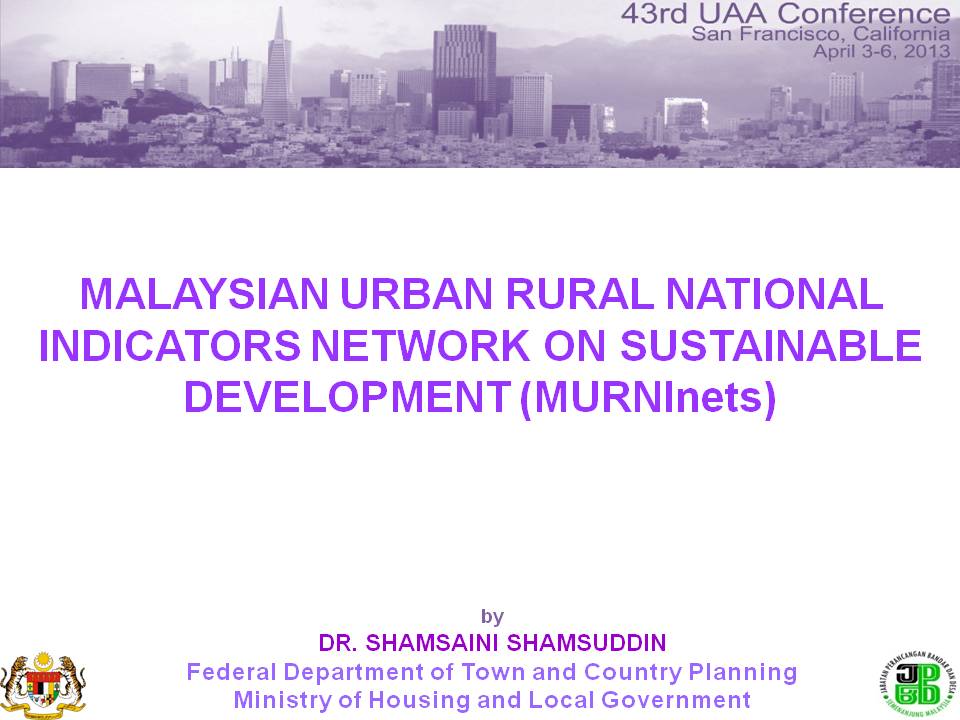
MALAYSIAN URBAN RURAL NATIONAL INDICATORS NETWORK ON SUSTAINABLE DEVELOPMENT (MURNInets)


by

Shamsaini Shamsuddin

shamsaini.shamsuddin@townplan.gov.my

Azmizam Abdul Rashid


Abstract

The purpose of this article is to promote a set of criteria, indicators and indices for sustainability assessment in major cities of Malaysia. Malaysia Urban Indicators Network (MURNInet) is a programme developed by the Federal Department of Town and Country Planning, Peninsular Malaysia (FDTCP) to assess the performance and levels of sustainability of Malaysian cities. Implemented in 2002, the MURNInet programme was a foundation for Malaysia to measure city development. MURNInet pilot projects were launched in six Malaysian cities namely Georgetown, Johor Bahru, Kuantan, Kuching, Pasir Mas and Batu Pahat. After almost 10 years of implementation, in the year 2011, MURNInet was reviewed and 6 dimensions, 21 themes and 36 indicators are introduced MURNInet is also rebranded as The Malaysian Urban Rural National Indicators Network on Sustainable Development (MURNInets). In search of an adequate set of indicators to develop an index, some existing indicators and indices have been reviewed. This article focuses on the implementation of a new set of indicators to assess urban sustainability in Malaysia. The structural change in population and its distribution or concentration has allows for agglomeration economies that provides greater opportunities for information and knowledge sharing, cultural exchanges and more effective provision of services, particularly health and education. All of these elements are essential for social development, advancement of civil society, well-being, cultural consolidation, change and cosmopolitanism. Function of cities as centres of political power and administration are strengthened. The closer proximity to the seat of power, their higher concentration and better articulation of their demands through civil organisations have meant that urban citizens have greater opportunities to influence policy-making and setting developmental agendas at both local and national levels. The assessments of the sustainability of cities are always relevant and to the selection and application of asset of sustainable development indicators to ensure that city development are directed towards attaining sustainable development.


Keywords : urban sustainability, indicators, network, measurement, local authority


REVITALIZING URBAN DEVELOPMENT IN MALAYSIA THROUGH THE IMPLEMENTATION OF URBAN REGENERATION PROGRAMME


by

Azmizam Abdul Rashid


Abstract

Malaysia’s modern urban growth, development and urbanisation experiences may be conveniently periodised into three major periods, based on the form, structure and functions of the urban centres. . In Malaysia, given the growing conditions of neglect and degradation of the cities centers.  Since most Malaysian city centers are very old historical cities and seem to be rediscovering now the economic value of creative industries and culture. Urban revitalization and regeneration together with the issues of energy sustainability and the need to reduce pollutant emissions, are today the major challenges facing the planning of cities. The concept of urban regeneration in Malaysia’s cities to promote a “return to the city”, revitalise the city centre, restore activity in a fiercely competitive international context, and implement initiatives to improve the quality of the environment operating in a wide sense towards a smart growth.  Urban regeneration is more than just upgrading the physical environment of an area to hopefully spark private investment. However one of most critical issue in urban regeneration is gentrification. This should not be happening in the true spirit of urban revitalization. Instead of displacing the existing community, they should be relocated to the same site. Therefore urban regeneration processes accomplishes the growing importance in literature of concepts like territorial governance, institutional relational density, creativity, social capital, city branding, city image and place marketing. Kuala Lumpur City Hall is among the municipalities practices urban regeneration by recognizing it as one of the strategic directions the city will take in an effort to encourage more sustainable lifestyles.


Keywords : urban revitalization, urban regeneration, gentrification, public participation


Saturday, 6 October 2012

SUSTAINABILITY ASSESSMENT FOR REMBAU DISTRICT DRAFT LOCAL PLAN 2025

OVERVIEW
The study is colaboration with Federal Department of Town and Country Planning (FDTCP), State Planning Department of Negeri Sembilan and Southern Zone Project Office. The country’s sustainable development policy and strategy needs a systematic and comprehensive approach to balance physical, economic, environmental and social needs. The preparation of a Development Plan according to the Town and Country Planning Act (Act 172), namely Structural Plan (SP), Local Plan (LP) and Special Area Plan (SAP) are the foundations in achieving sustainable development goals. FDTCP has conducted a Pilot SA Study in 2004 through the Kuala Selangor District Council Local Plan(RTMDKS/MDKSLP). The SA Process in RTMDKS has been improved and used in LP studies under the Ninth Malaysia Plan (9MP). Sustainability Assessment is an assessment method designed to evaluate if a plan, policy or programme can achieve sustainable development objectives. Generally, SA is a good planning practice and supports sustainable development where Malaysia is a signatory to Agenda 21.

FDTCP has practiced the principles of physical planning, economy, environment and social, but conducted each separately by sector. This SA method empowers that practice in an integrated and systematic manner where assessment is documented more effectively. Sustainability issues are matters that were brought up by the target group during the FGD session that was conducted in the early stages of LP preparation. Issues can also be gleaned from discussions with LAs and technical agencies as well as from development planning documents. Sustainability issues of study areas are categorised into social, environmental and economic issues. In the context of SA, an indicator is a sign that can measure the level of sustainability of an area.

A headline indicator can be identified in the beginning of study after identifying sustainability assessment criteria. Indicators can determine early measures to overcome issues to achieve sustainability objectives. Indicators also have targets and can be a tool to monitor of an LP target has been met. Identified indicators must be able to be translated in spatial form. Indicators can be generated from assessment criteria through Study Team discussion or when suited to identified sustainability objectives, MURNInet indicators can be used too. Other sources such as RFN, RSN, Malaysian Life Quality Index (UPE) and indicators modified from foreign SA practices can also be used.

There are many evaluation methods, either qualitative or quantitative. As a pilot initiative, a simple method is used, based on the value gleaned from discussion and open feedback between the core team and technical agency to get a group agreement if a proposal is compatible, not compatible, neutral or irrelevant to sustainability objectives. Evaluation is made based on quality where the results from the discussion is accepted as a group final decision. This is because the agencies present are experts in their respective fields and are able to make good decisions based on the expert judgement method. The evaluation through discussion is a good and effective evaluation method. 


Futher enquiry about this article kindly contact :

DR. AZMIZAM ABDUL RASHID
Research and Development Division,
Federal Department of Town and Country Planning,
Ministry of Housing and Local Government,
Unit No. 50-12-2B, & 50-13-1, Wisma UOA Damansara,
No. 50, Jalan Dungun, Damansara Heights,
50490 Kuala Lumpur,
Malaysia
email address : azmizam@townplan.gov.my

Sunday, 1 April 2012

THE ROLE OF EFFICIENT URBAN GOVERNANCE TO ENHANCE URBAN LIVEABILITY AND ECONOMIC GROWTH

There is no doubt that the lives of cities and of the businesses located in them are inextricably intertwined. But how closely linked are cities' economic growth and their liveability? A survey of urban professionals conducted by the Economist Intelligence Unit shows that the idea of liveability has a number of different components. Jobs and cost of living, public transport and roads, safety and security and culture and nightlife all rank highly among our respondents' list of factors contributing to a city's attractiveness as a place to live and work.

In the first report in this series, we spelled out the strategies policymakers need to adopt in order to maintain and improve liveability for citizens. Some of the key steps include providing a good public transport system, getting a bigger say in planning policy, taking a more sensitive approach to urban design and handing over more control of public services to citizens. This second report explores the relationship between business performance and liveability in cities, and highlights some of the ways in which business and policymakers are working together to make cities more liveable.

Whatever the type of challenge being faced by an individual city, improving liveability can only help to strengthen its attractiveness for residents, workers and potential investors. But coming up with a realistic and effective strategy for boosting economic growth is a hugely difficult challenge, particularly when wider economic forces are working in the opposite direction. History has shown that long-term shifts in patterns of trade across the globe and the introduction of new technologies or production methods can undermine the industries upon which some cities were built. Declining cities in the former manufacturing heartlands of the north of England and in the "rust belt" of the United States provide powerful evidence of this. And, try as they might, policymakers have frequently found it agonisingly difficult to hold back the tide of change.

Even in those cities where economic growth is occurring, the challenge of enabling this can be enormously complex. Often the problem is that those people already living in high growth areas resent the changes associated with it and try to block the developments and investments—in housing and transport, for example—that are needed to facilitate growth. Rather than blocking growth altogether, however, these kinds of obstructions frequently lead to congestion and affordability problems as more and more people and businesses try to cram into houses, offices and trains that were simply not designed to meet such high levels of demand.

It is important to look at liveability—a misunderstood and often misused term—but equally important to understand that for citizens and companies, there is a clear hierarchy of needs. What is clear from our research is that what business primarily wants from city leadership is policy that helps to stimulate job creation, followed by basic liveability factors such as good infrastructure, schools and so on.Mayors and civic leaders can occasionally be beguiled by the "softer" aspects of liveability. Opera houses, parks and other assets associated with liveability are all important components of great cities' brands, but getting the basics right first helps cities to compete globally on a more equal footing. Among the key findings of our research are:

Jobs take precedence over liveability when people are choosing where to locate. Our survey shows that the main reason for urban professionals to move to a city is its jobs market and cost of living. Moreover, respondents say that their organisation's main benefit in being located in their city is its access to talent and labour. But with workforces increasingly prepared to relocate for the best opportunities, there is a question mark over policymakers' ability to develop local skill levels and encourage skilled workers to remain in their city.

Deliver the housing needed to meet demand. As we spelled out in our first report, rising house prices are often seen as a sign of a city's economic success. One important challenge for policymakers who are looking for ways to help maintain their city's economic growth is to make sure that there is enough housing to meet demand in economically dynamic areas. Failure to do so can result in housing affordability problems, dissuading talent from moving from low-performing to high-performing areas. This is not simply an issue for policymakers. As Todd Sinai of the University of Pennsylvania's Wharton School of Business points out, "in a city that's more expensive, the first thing that has to happen is that workers need to get paid more".

Open the door to foreign investment. In difficult economic times, policymakers are often pressured into favouring support for local businesses over foreign companies. But such strategies are not necessarily the right way forward, according to our survey—only 15% of respondents see that as a priority for their civic leaders, as opposed to almost one-third who would prefer it if multinationals were encouraged to set up shop in their city, in order to make it more competitive for business. The presence of multinational companies in a city can raise its image elsewhere, and branding can play a big role in the business life of a city. More than one-half of respondents regard their city's international profile and good reputation as important benefits to their organisation's decision to locate there, and nearly three-quarters believe their city's image helps it to attract important industries.

Enlist the help of the commercial sector. Respondents to our survey consider that it is the public sector that should shoulder most responsibility for services such as public transport and the maintenance of parks and schools. But the business sector already plays a key role in developing cities' liveability, supporting culture, sporting events, healthcare facilities, transport infrastructure and environmental initiatives. As civic leaders face tighter budgets they should be prepared to take the initiative in asking business for more help. The cost to the city of London's ambitious cycle hire scheme, for example, would have been far greater without a substantial investment from Barclays, a bank. Of course, in engaging in philanthropic endeavours an organisation's ambition may largely be to generate brand awareness. But Londoners, for their part, have shown that they are prepared to become two-wheeled advertisements for Barclays in exchange for a more convenient journey around town.

Focus on the basics of urban life – transport, roads, houses, schools and safety. When a city secures a major sporting event such as the Olympic Games, is it a boon for business? Urban professionals don't think so. They think it is far more important to get the basics right by improving public transport and roads, providing better schools and improving safety. CEOs such as FedEx's Fred Smith agree. "Ultimately, you have to have both good economics and good quality of life—they feed each other," he says.

PEOPLE AROUND ME..FAMILY AND FRIENDS.

PEOPLE AROUND ME..FAMILY AND FRIENDS.
To my Wife, Zulaini, my sons Zulazlan, Zulazman, Zulazmir, Zulazmin dan my daughter, Nuris Zulazlin...I love you all..thank you being with me

CIRCLE OF FRIENDS... KUALA LUMPUR PROJECT OFFICE

CIRCLE OF FRIENDS... KUALA LUMPUR PROJECT OFFICE
Thank you guys...for your support and encouragement

2007 / 2008 METHODOLOGY AND QUALITATIVE RESEARCH COURSE FOR PHD CANDIDATES

2007 / 2008 METHODOLOGY AND QUALITATIVE RESEARCH COURSE FOR PHD CANDIDATES
My new friends during my course in INTAN 9 Jan -2 Mac 2007

KUALA LUMPUR PROJECT OFFICE, JOURNEY TO MOUNT OF KINABALU SABAH 21-22 JANUARY 2006

KUALA LUMPUR PROJECT OFFICE, JOURNEY TO MOUNT OF KINABALU SABAH 21-22 JANUARY 2006
WE CAME, WE SAW, WE CONQUERED 4095.2 METER ABOVE SEA LEVEL

How are you, guys? Where you are now?

FOOD CLOCK