Showing posts with label Happiness Index. Show all posts

Thursday, 31 March 2016

BOOK REVIEW….AND THE PURSUIT OF HAPPINESS - WELLBEING AND THE ROLE OF GOVERNMENT by Philip Booth

Philip Booth is Editorial and Program Director of the Institute of Economic Affairs and Professor of Insurance and Risk Management at Cass Business School, City University. He has written extensively on regulation, social insurance and Catholic social teaching. He is a Fellow of the Institute of Actuaries and of the Royal Statistical Society and associate editor of Actuarial Annals and the British Actuarial Journal. He has also advised the Bank of England on financial stability issues (1998–2002) and has been a visiting Fellow at Blackfriars Hall, Oxford University (2010/11). The idea put forward by the British government that economists and politicians pursue policies directed towards maximising GDP is a ‘straw man’. Government has always had a multitude of different objectives and government policy would be very different today if economic growth were the single priority. 

1.   In spite of general reductions in government spending, the prime minister has found room in the government’s budget to spend money on a major survey of what makes the British people happy. This will be used, in the prime minister’s own words, to guide government policy towards improvements in general wellbeing rather than improvements in national income.

2.         However, it is it really true that government policy has always been orientated towards maximising GDP? Is it true that wellbeing does not increase as income increases? Is it true that more equal societies are happier societies? Can we really improve wellbeing through workplace legislation? Is it right to orientate government policy towards the single aim of increasing aggregate wellbeing across society as a whole?

3.          These questions and many more are tackled by some of the leading intellectuals in the field. Overall, this monograph provides a substantial challenge to those who want to put the explicit pursuit of wellbeing at the heart of government policy.

4.         Explicit attempts by government to control GDP, or rapidly increase GDP growth, have normally failed. Such a target driven mentality is part of the conceit of central planning. Attempts to centrally direct policy towards improving general wellbeing will also fail.

5.         Contrary to popular perception, new statistical work suggests that happiness is related to income. This relationship holds between countries, within countries and over time. The relationship is robust and also holds at higher levels of income as well as at lower levels of income. This calls into question the assertion that people are on a ‘hedonic treadmill’ that prevents them becoming happier as their income rises beyond a certain level of income.

6.         This new work, using a data set of 126 countries, shows that the correlation between life satisfaction and the log of permanent income within a given country lies between 0.3 and 0.5. There is a similar correlation between growth in life satisfaction and growth in income.

7.         There is no evidence that equality is related to happiness. Indeed, the proponents of greater income equality admit that they are unable to cite such evidence and instead rely on very unsatisfactory forms of indirect inference. The clearest determinants of wellbeing would seem to be employment, marriage, religious belief and avoiding poverty. None of these is obviously correlated with income equality.

8.         The government is under pressure to bring in further legislation to promote ‘wellbeing at work’. This includes, for example, legislation on parental leave. The theoretical and empirical case for such legislation is weak.

9.         There is no relationship between objective measures of wellbeing at work and the extent of employment protection legislation, unionisation, and so on. Given the relationship between wellbeing and employment, any form of employment protection legislation that led to more temporary employment or reduced employment would be detrimental to wellbeing.

10.     A comparison across 74 countries finds that government final consumption negatively affects happiness levels and that the negative influence occurs regardless of how effective government bureaucracy is or how democratic the country is. Increasing government spending by about a third would cause a direct reduction in happiness of about 5 to 6 per cent. Centralising government decision-making is likely to lead to more intrusive government and lower wellbeing.

11.     If people wish to maximise their wellbeing and are the best judges of their own wellbeing they will take decisions about how to use their economic resources to pursue their own goals. We should allow people’s preferences for wellbeing to be revealed by their own actions rather than through surveys of what people say they prefer.

12.     Happiness measures are short-term, transient and shallow measures of people’s genuine wellbeing.

13.     Those who wish to use happiness economics in public policy have no effective way of determining whether an increase in wellbeing should be traded against justice, moral values or a decrease in freedom. It is a utilitarian philosophy which applies a principle that many might use in their own lives to the organisation of society as a whole. Applying such an overarching principle to the organisation of society as a whole is very dangerous.

14.     In conclusion, it is to be hoped that, when the Office for National Statistics concludes its studies, it will set great store by Bjørnskov’s empirical conclusions – backed up in less direct ways by the authors of other chapters in this monograph. Countries that inhibit the freedom of their citizens to a lesser degree have happier citizens. Paradoxically, therefore, wellbeing may be maximised if the government does not consciously try to pursue that objective specifically.

15.     This should not be surprising. The wellbeing policy activists accuse economists of focusing too much on the maximisation of national income as a government policy objective. This is a false accusation, but a lesson can be drawn from attempts by government to increase national income.

16.     It also happens to be the case that economic growth is higher when governments do not specifically plan for that end. In other words, the central planning of a society to achieve a particular desired end is likely to fail to meet that end, as well as changing completely the nature of the society.

17.     This is not to say that some useful policy advice cannot be found from the empirical work on happiness economics. It can tell us, for example – though we probably knew already – that policies that impede employment seriously affect wellbeing. Those authors whose chapters deal with the normative issues, however, make a very strong case in this monograph that government policy should not promote wellbeing explicitly.

Saturday, 4 January 2014

THE SCIENCE OF HAPPINESS : WHAT DATA & BIOLOGY REVEAL ABOUT OUR MOOD?

Science of Happiness
Graphic by WebpageFX

In terms of brain chemistry, the neurotransmitters dopamine and serotonin play a large part in how happy, affectionate and positive you feel. Eating foods like fish, bananas and poultry help boost your dopamine levels, while foods like turkey have been suggested to boost serotonin levels. Therefore, eating foods like these can help you improve and maintain happy feelings and a positive outlook.
 
How to Avoid Negative Feelings? One of the best ways to keep a bad mood at bay is to get your 8 hours of sleep each night. Studies show that sleep-deprived people have a harder time remembering positive ideas and, instead, focus on the negative. By keeping your mind and body well-rested you’ll help the positive ideas flow and keep the negative ideas away. One final tip for staying happy: don’t isolate yourself. We get so caught up in the business of our day-to-day schedules and routines that we often forget to make time for our neighbors and community members. Yet, research shows that two huge factors that contribute to happiness are a sense of community and frequent celebrations with that community. Don’t be afraid to reach out to your neighbors and peers. Not only will communal bonds make you feel happier, they’ll make your neighbors feel happier too!
 
How happy would you say you are? If you feel less than stellar on a day-to-day basis I have good news for you! There are a ton of things that influence your levels of happiness and positivity. In The Science of Happiness infographic from WebpageFX, you can learn about all of them. You might not be able to directly control all of these factors, but by being aware of them all you can engage in activities that will boost your happiness meter.
 
What You Can Do To Be Happier? Did you know that spending 20 minutes outside in good weather each day can improve your memory, broaden your thinking and help maintain a positive mood? It can! Participating in activities like exercising is another way that you can boost your happiness. Walking for just 20 minutes releases endorphins and proteins that make your brain more active, keeping you happier. Why not take a 20 minute walk on your lunch break? It’ll keep you feeling energized and positive throughout the day.

Wednesday, 20 March 2013

20 MARCH 2013 THE INTERNATIONAL DAY OF HAPPINESS: MALAYSIA’S INITIATIVE TO ENHANCE HAPPINESS OF THE PEOPLE IN THE CITY


Malaysia is committed to ensure a high quality of life (QoL) and well-being in its urban and rural areas. The Federal Department of Town and Country Planning (FDTCP) being the focal point for developing and coordinating the overall framework on Sustainable Development Indicators for local authorities through MURNInets (Malaysian Urban-Rural National Indicators Network for Sustainable Development) has now incorporated Happiness Index into the framework. Conceived in late 2010, the Happiness Index was based on international trends which gave special focus on happiness in the context of the Government's effort in improving the well-being of communities. This is in line with the Department’s vision to be a “Leader in Town and Country Planning towards achieving a Quality and Sustainable Living Environment by 2020”, FDTCP’s Universal Planning and Development Doctrine produced in 1998 and the Ministry of Housing and Local Government’s commitment in promoting Sustainable Communities.
World Happiness Report 2012 Malaysia was in a commendable 51st position among 156 countries by virtue of our country’s economic performance where the happiness factor was measured in terms of gross national product or gross domestic product. Malaysia will be eyeing to chalk up its ranking in the world and Asia Happiness Index besides aiming for higher economic growth by the year 2020.  This is in line with the national transformation agenda which aims to turn Malaysia into a high-income economy that considers happiness ranking.
Our Prime Minister is very serious in providing infrastructure and financial aids to raise Malaysia's ranking in the happiness index under the Economic Transformation Programme . Happiness Index has been incorporated in MURNInets sustainable community's dimension that include community vitality, cultural diversity and resilience, health, education, ecological diversity, quality of life and efficiency of governance. Happiness Index Study (HIS) in MURNInets contains findings from primary data collection jointly administered between local authorities and residents. This study  highlights the state of happiness in the context of community and governance. A good physical and happy environment provides the foundation for successful sustainable communities. 
In 2012, the United Nations (UN) declared March 20 to be observed as the International Day of Happiness. The  day recognises that happiness is a fundamental human goal, and calls upon countries to approach public policies in ways that improve the well-being of all people. By designating a special day for happiness, the UN aims to focus world attention on the idea that economic growth must be inclusive, equitable, and balanced, such that it promotes sustainable development and alleviates poverty. Additionally the UN acknowledges that in order to attain global happiness, economic development must be accompanied by social and environmental well-being.The initiative to declare a day of happiness came from Bhutan – a country whose citizens are considered to be some of the happiest people in the world. The Himalayan Kingdom has championed an alternative measure of national and societal prosperity, called the Gross National Happiness Index (GNH). The GNH rejects the sole use of economic and material wealth as an indicator of development, and instead adopts a more holistic outlook, where spiritual well-being of citizens and communities is given as much importance as their material well-being.
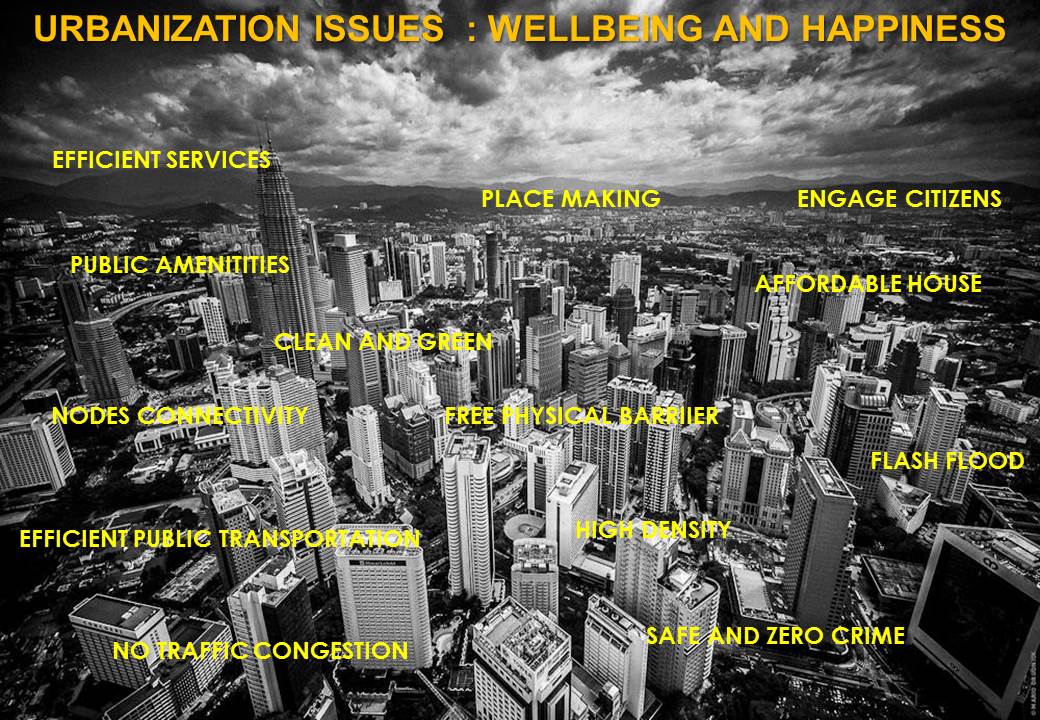
A good physical environment provides the foundation for a well-ordered city that can cater to the material and post-material needs of its citizens—the necessary conditions, in other words, for physical and economic vibrancy.  Most people tend to associate happiness with feeling good, that is, with a life that offers a variety of pleasure and comfort.  Happiness index of the people is a framework for decision-making and policy development. It provides guidance to local authorities interested in improving the level of well-being of its communities. The challenge for us now is to overcome our constraints and expand the mental and cultural space that we have. So anyone who wishes to  keep themselves engaged and energetic in their work and their community, could contribute better towards creating a livable and  vibrant city.

PEOPLE AROUND ME..FAMILY AND FRIENDS.

PEOPLE AROUND ME..FAMILY AND FRIENDS.
To my Wife, Zulaini, my sons Zulazlan, Zulazman, Zulazmir, Zulazmin dan my daughter, Nuris Zulazlin...I love you all..thank you being with me

CIRCLE OF FRIENDS... KUALA LUMPUR PROJECT OFFICE

CIRCLE OF FRIENDS... KUALA LUMPUR PROJECT OFFICE
Thank you guys...for your support and encouragement

2007 / 2008 METHODOLOGY AND QUALITATIVE RESEARCH COURSE FOR PHD CANDIDATES

2007 / 2008 METHODOLOGY AND QUALITATIVE RESEARCH COURSE FOR PHD CANDIDATES
My new friends during my course in INTAN 9 Jan -2 Mac 2007

KUALA LUMPUR PROJECT OFFICE, JOURNEY TO MOUNT OF KINABALU SABAH 21-22 JANUARY 2006

KUALA LUMPUR PROJECT OFFICE, JOURNEY TO MOUNT OF KINABALU SABAH 21-22 JANUARY 2006
WE CAME, WE SAW, WE CONQUERED 4095.2 METER ABOVE SEA LEVEL

How are you, guys? Where you are now?

FOOD CLOCK