Showing posts with label Efficient. Show all posts

Saturday, 17 December 2011

EFFICIENT URBAN GOVERNANCE: A WAY FORWARD TO HUMAN WELL-BEING

Urban governance is a very important factor for economic development, political and social. Things can be done through the role of central government, state and local. At the same time, this role is formed as a result of the cooperation of governments, private sector and NGOs to ensure that development in the economic, political, and social security. Progressive city does not only focus to economic development alone, but also good governance factors contribute to the smooth progress of development in a country and a social focal point. To establish good governance are several methods used, the involvement of all, responsible, honest, efficient, fair, Effective & Efficient, and systems in accordance with the rules. For example, Malaysia introduced the 9 th Malaysia plan that outlines several methods for establishing good governance, the national integrity plan that led to five things that anti-corruption, improve the delivery of information systems, corporate governance & business ethic, the family institution and the quality of life.

The 9th and 10th Malaysia Plan is the basis of the federal government can act to change the management system of governance that will be running smoothly and is believed by stakeholders. Therefore, we can see not only economic development but through a process of urban governance is actually able to develop a city and a focal point for socializing. This is due to a planned governance will have a positive impact in the development of some sectors for economic growth, such as industrial, telecommunications, shopping malls, education, health, business, administrative and transportation center. This is an important facility to help improve the city's economic growth and help improve the quality of life.

The nearest example we can see is the city of Kuala Lumpur with a variety of equipment and facilities of a sophisticated system established by the local government for social focus to meet their needs and requirements. Indirectly when upgrading occurs, then we will find that the entry or migration of the population will increase because of the career opportunities and facilities for their comfort and quality, the role of central government policy managed by the state and implemented by local governments. If we look at career opportunities is one form that can create the culture and lifestyles of our diverse communities. When development in a town that implemented by local governments with the developer of the project, it will be of cultural assimilation. Income of the population will increase and this can change their lifestyles. Indirectly, it can help in the economic growth of a city.

In the aspects of health, the role of the federal government to ensure a lifetime of life through the RMK-9 has to be more proactive as a result of cooperation of the private sector and NGOs. Government has ensured that health law and medical facility equipment such as screening for the disease, early diagnosis. Increase preventive vaccines for diseases such as influenza B, measles and Rubella. These plan also provides provisions for adding new hospitals and renovation and upgrading of existing hospitals. This role is highlighted in order to benefit the city's drive towards a more robust economic growth on the efforts of good health governance in order to produce a community with high quality and standard of living can contribute to accelerate the growth of the urban economy.

The development of good health will form the entry and social focus of the city has the ability level of comprehensive health services. The place is in the Crown Medical Center Hospital of focus people in Indonesia, Singapore and domestic use such services. Melaka's economic growth is also based on the development of the role of health and good governance. Development of education in a city also influence factors of good governance and the social focal point. This can be seen around town in Kuala Lumpur, which has 100 centers of higher education and private sectors. Higher education ministry's policy role that Malaysia would like to upgrade the university to the University of Premier and International by bringing in foreign students from foreign countries such as Yemeni, Nigeria, Pakistan, Iran, Iraq, China, Laos and Japan. University located in the center of Kuala Lumpur has received a lot of foreigners to improve the quality of education at the international level.
The role of local authorities such as City Hall through higher economic growth through the "Kuala Lumpur City Plan 2020, identified that the mall has a good potential to the economic and social growth as the standard of living of the rising. City Hall has given a number of shopping division is the main shopping precinct such as KLCC, Berjaya Times Square, Pavilion, Mid Valley, Garden City and the River Fund. The main sub areas such as Jalan Tuanku Abdul Rahman, Chow Kit Road, Petaling Jaya and Jalan Pasar. This growth will be the center of local and international social growth in the form of recreation and entertainment and a wide range of job opportunities. Good urban governance, the role of all parties such as government, private sector and NGOs is needed to further promote economic and social growth that a city can be developed rapidly in terms of infrastructure, education, health, and tourism.

Urban Governance & Disabled People

In the aspect of public transport system is actually able to ensure the efficient activity in the country. Public transport is also the heart of the development of a country. If we look at developed countries like Japan and the United States, we can see how a well-developed efficient public transportation system. See also how our public transport system developed today than ten years ago. Now in Malaysia there is the Light Transportation System (LRT) and Monorail a lot of help in our public transport services today. However , what means all this progress should not be shared with those who are not able to enjoy it.

The group that is none other than the class of persons with disabilities (PWDs). According to the Disabled Persons Act 2007, "Persons with Disabilities" (disabled) means "People who have long term physical, mental, intellectual or sensory impairments which in interaction with various barriers may hinder their full and effective participation in society". According to statistics provided by the Department of Social Welfare of the number of registered people with disabilities has increased by 12 percent in 2007 (220.250 people) compared to 2006 (197.519 people).

Groups of disabled people in wheelchairs, was a priority in public transport facilities. They needed a mechanism that can move as well as in relation to the outside world and the public. Imagine if they did not have family members who were willing to take them out, can they move or enjoy the world. Can they ride the LRT or commuter our cutting-edge? We are air-conditioned bus with comfortable seats that are hovering in the city and grand taxis either normal or a luxury? If they use public transport, most likely they are injured and may be dangerous for their lives or they may not be used directly due to obstruction from the use of a wheelchair.

There is no doubt that there are efforts from companies that provide public transport facilities to ensure that disabled-friendly services. There are buses that putting a wheel chair to show they are disabled-friendly buses. But today we can see that it is not perfect, marks his wheelchair just decorative. However, good faith efforts and the bus companies should be emulated, but its effectiveness should be reviewed. Is it because our society or the operators themselves? However, efforts should be made step by step. when viewed between public transport services in our country and countries like the United States, is still too much effort should be enhanced.
Social Welfare Department has always encouraged transport companies to provide fare concessions to people with disabilities. To date there are several transportation companies have been providing incentives to encourage transport to disabled people. Among them are Malaysia Airlines (MAS) to provide low-cost up to 50% for domestic flights, Malayan Railway (KTM) to provide concessionary fares up to 50% of all trips for all classes, transnational bus company provides 50% of concession fares and Rapid KL provides free air fares to the disabled.

According to a study conducted by the Department of Social Welfare, public transport is urgently needed by the disabled is a public vehicle that could deliver them from the point of origin to destination, for example taxi service can help them socialize and work. In 2002 there were 72.361 of taxis in Malaysia.

Unfortunately most of the taxis in our country is not the type of disabled-friendly. Sometimes they do not want to take disabled passengers because it is inconvenient but they are also a handful of to taxi driver who was kind enough to take wheelchair clients. Sometimes because of the taxi they use Proton Iswara example cause they do not want passengers in a wheelchair because of boot capacity. If the view is now different types and forms of taxis we see in the streets. Luxury cars are also made by some of the taxi fare was less than the normal taxi, with reasons for a convenient to passengers.

Unfortunately compared to the amount of money invested to buy luxury cars for executive taxi is more appropriate if the money used to buy or renovate a normal taxi wheelchair accessible (wheelchair Accessible Taxi) as found in the United Kingdom and the United States. Concerns of the taxi company operator will help the disabled who use wheelchairs. In addition there are some taxi drivers who feel the disabled is difficult. This behavior may occur due to lack of concern by the public transport operators themselves. This depends on the attitude of the driver that the passenger feels very cumbersome wheelchair for example that disabled people in wheelchairs do need others to help them enter into the wheelchair into the boot of their car..

But some, taxi drivers felt the disabled will only cause problems for them. There is also a wheelchair passenger feels inconvenience and delay. Most taxi drivers racing against time. For those with more time they have, the more passengers they can take. Particularly in the Klang Valley, the majority of taxi use NGV as fuel gas for cheaper than petrol. The gas tank or container installed in the car bonnet, given the relatively large size of the tank so there is no space to include a wheelchair.

In an effort to help the disabled, the public transport operators and government must work together in a effort to help those less fortunate this. Besides, it also can make our country a country concerned and caring. Consequently, the operators also need to see that public transport services as a social responsibility, not only concerned with bottom-line profitability. As members of society do we need to understand the needs of disabled people. It is not appropriate for us to isolate and segregate them because of the lack of it has. There are also some less responsible members of society and selfish to use the facilities provided for disabled people, for example car parks, toilets and seating.

For example, the CEO of AirAsia, which Dato'Tony Fernandes he improve aviation services after receiving protests from disabled associations due to AirAsia's services are not disabled-friendly. In a very short time he was improving services to disabled-friendly AirAsia despite huge cost. This attitude should be an example to us all. This shows a view of disabled people taken care of and respected even if there is a lack in them. Be a responsible member of society help those with disabilities. Together we build towards the social well-being of society.

Monday, 30 November 2009

INTERNATIONAL FORUM ON URBANISM 2009 (IFoU) AT DELFT OF UNIVERSITY TECHNOLOGY,THE NETHERLANDS

On 25-28 November 2009, I have a chance to present my PhD research at international conference in Delft University of Technology. I was so honoured to meet Prof Saskia Sassen (The Idea of Global City) from Columbia University, New York and Prof Manuel Castells (The Idea of Network Society) from Professor Emeritus, University of California, Berkeley. Both of them are the main the speakers for the conference. The both icons are among my core research references . So many people want to meet them. During the coffee break I met them and discuss my research framework. The discussion so fruitful with the ideas how to enhance my research. Sassen and Castells suggested to me to search the concept of City for People vs City of People, Complementary City vs Competitive City and Network Society in the City vs Network City for Society. Their supportative and encouragement really boost my motivation to enhance my research. Thanks to my supervisor Assco Prof Dr Hamzah Jusoh, Dr Jalaluddin and Assoc Prof Dr Hazita Azman, Deputy Dean of Faculty of Social Sciences and Humanities, UKM for supporting my research and funding my attendance to the conference.


Wednesday, 1 April 2009

THE MEANING OF EFFICIENCY IN GOVERNMENT SECTORS

The issue of efficiency in the use of resources is a critical factor for the whole of the public sector. As a considerable portion of national expenditure goes to the development and maintenance of the armed forces, it is only fair that citizens demand and expect the highest level of integrity within the military organisation. It is thus necessary to ensure that the allocated funds are used in a transparent, ethical and efficient manner. In this there can be no compromise. The government must ensure the highest level of integrity when utilising its financial provisions for its development and operations. As indicated earlier, integrity encompasses all processes and procedures. Careful planning and good governance is necessary in the procurement of military hardware and weaponry systems that may require long term funding commitments. The Government has the right to demand value-for-money.

There should be no repeat of the incidences of highly questionable procurement and maintenance contracts. The use of public funds within the context of a democratic platform demands that the necessary oversight and control mechanisms are put in place and are seen to be effective. Government must ensure systematic assessment of its programmes and projects to ensure results and cost-effectiveness. Maintenance and battle readiness of military equipment also require critical attention. We are referring here to the highly sophisticated and expensive equipment including fleet management. Naturally all of these call for a maintenance culture of the highest order encompassing systems, processes and people. When we do not pay sufficient attention to maintenance schedules, do not ensure personnel are trained on the correct use of equipment or are lackadaisical in the safe storage of equipment, it reflects an institutional environment that does not place enough emphasis on integrity.

All, regardless of whether in the government departments, need to consistently build the necessary support infrastructure for a maintenance culture that works with clockwork precision. In the constrained financial times that we are facing now, it is even more imperative that upkeep and maintenance be given priority to mitigate the difficulty in procuring new resources. Another area of importance is in the implementation of development projects. Our performance on the execution of development projects is often used as a yardstick to evaluate and measure the effectiveness and efficiency of the Government’s service delivery system. Issues such as project delays, cost over-runs and substandard quality of work are often cited when assessing the implementation of development projects.

The mechanisms for monitoring and control are in place. Rules and regulations have been prescribed. Personnel have been trained and exposed to good project management practices. Yet often the results show otherwise. In many cases they point to weak implementation and supervision. We need to be serious about monitoring and supervision. If we are not thorough and lack the stamina to follow through on agreed timelines and deadlines, it means that we have failed the integrity test yet again. Inculcating values, attitudes and behaviours based on the principles of integrity and justice is arguably the most important element in the fight against corruption. Values and attitudes are shaped by an individual's upbringing and his or her life experiences. In organisations, whether private or public or the military, leaders must be at the forefront against corrupt practices. They lead honest lives based on principles of justice and integrity, and in so doing lead by example.

Tuesday, 3 March 2009

EFFICIENT GOVERNANCE: GEARING TOWARDS BEING WORLD CLASS

The effectiveness and efficiency of the public service as well as its facilitating role has helped the country's economic development. This we have accomplished through the introduction of numerous administrative measures which are designed to provide high quality services to the private sector and the society at large. To be world class, and at par with the best, we have to continue the quality revolution in the public service. In fact I would suggest we think of two Qs: Quality and Quickness. One of the important attributes of quality is to be responsive to customer needs and this means Quickness of Response. Members of the public want speedy approvals of their house plans, certificates of fitness for occupation of their newly-built houses, quick service at the immigration counters, at hospital dispensaries etc. The business community want quick approvals for company incorporation, trade licences, manufacturing licences, duty drawbacks, patent rights, approval of industrial premises, crucial market information on their products and services, etc.

If speed is the essence in doing business, then systems and procedures, particularly those that ensure accuracy, reliability, consistency and simplicity will have to be put in place. The public service will be implementing ISO 9000 very soon. Malaysia will be the first country that will adopt ISO 9000 in its entire public service. Gearing ourselves to world class means that we will gear ourselves to implementing ISO 9000. Training of public servants should emphasise the sharpening of core competencies covering the three broad areas of conceptual, technical and interpersonal skills. However, the emphasis will vary depending on whether the officer is in the upper, middle or lower levels of management. The conceptual skills are skills related to `higher order activity' more relevant to the upper level management where the need is to see issues, recognise problems, strategise, and think systems.

The middle level management needs a balance of both the conceptual and the technical skills as they act as the interface between the top level management and the lower level of management. However, across all levels of management is the requirement for interpersonal skills. No one works alone in any organization; people will have to network and build relationships at all levels of management vertically as well as horizontally. As such, training programs in public sector training institutions particularly INTAN will have to take into consideration these aspects of skills development focussing on core competency areas. World class also means the ability to command resources and operate beyond borders. In this regard, our public service should have the ability to support our private sector to effectively operate beyond our shores. There are many ways in which this can be done.

Firstly, in business, the question of integrity and image are very critical elements. In this connection, besides facilitating the business sector through enhancing the administrative processes, the public service must see itself as the custodian of Malaysia's good image overseas, and assist in the conduct of business with good ethics, to see that our businessmen conduct dealings with reputable partners overseas; secondly, the public service has to focus on establishing connections and networking; examine investment opportunities and facilitate the entry of Malaysian products and services to new markets. The country should never be allowed to suffer from a deep crisis of faith in the public service; the people must not criticise us as a faceless bureaucracy that is unable to accurately meet personalized services; the people must not be allowed to spend their precious time finding answers to their questions, after being bounced from department to department. The new information technology appears to be the key enabler of public service transformation.

Monday, 1 December 2008

MINDSET FOR THE 21ST CENTURY IN PUBLIC SERVICE....ARE WE READY????

No meaningful results can be achieved if the implementers do not have the appropriate work values and ethics. While value espouses the beliefs of an individual or culture, work ethics on the other hand, reflect a set of values based on the virtues of hard work and diligence. Hence, the combination of these two elements should mould the mindset for the public service in the 21st century. While we acknowledged that this is not an easy task to achieve nevertheless, the public service leadership should set the right climate for its people to embrace positive values and work ethics and it should be an explicit not implicit component in public institutions. Public service officials must truly embrace the notion that they are bearers of the image of Malaysia globally. We have a duty of ensuring and more importantly recognising that consequences of your actions as public officials, no matter how trivial, have a compounded impact on our nation and future generations. This is a fundamental mindset and attitudinal change which public officials must endear.

Public officials too need to take pride in their duties as this is crucial to build a sense of performing one’s job to the highest standard. This certainly needs strong commitment and discipline. It is only when the gravitas of the role is tacitly recognised and understood, the willingness to listen and engage the customers, will drastically change. The attentiveness to details of perfection for service delivery will also command greater focus. The readiness to learn, and learn from mistakes will be more prevalent. Consequently, the discharge of the level of service will go beyond just doing a mundane 9-5 job regardless of where you are in the stack of ranks. However, the satisfaction from performing excellent job is immense and the greatest reward is through gaining public confidence in the public service. The culture of innovation, creativity and continuous improvements should be adopted as a work culture at all levels of the organisation. We cannot afford to sit and wait, and then react to the continuously changing environment. To instill this culture, leadership however must allow some calculated risk-taking, experimentations and encourage their officials to constantly think of new ways of doing things rather than stick to the same old ways.

Sunday, 23 November 2008

DID MALAYSIA IMPROVES RANKING ON THE EASE OF DOING BUSINESS BY ENCHANCING IN EFFICIENCY URBAN GOVERNANCE?

Malaysia improved four ranks to 20th in the World Bank’s Ease of Doing Business Survey 2009, from 24th in 2008 and 25th in 2007. Malaysia has improved in its ranking throughout the 3 years, considering that the total number of countries being ranked has increased to 181 in 2009 from 178 in 2008 and 175 in 2007. Tan Sri Mohd Sidek Hassan, Chief Secretary to the Government and the Co-Chairman of PEMUDAH, the country’s special task force to improve Malaysia’s business competitiveness, said that he was encouraged by Malaysia’s improved ranking in this survey. But stressed that there was much more work to be done if Malaysia is to move into the top 10 in the near future.

PEMUDAH was set up on 7 February 2007, in part as a response to the less than stellar ranking in this survey in the past years. Since its establishment 19 months ago PEMUDAH has succeeded in reducing, if not totally removing, various impediments in the business environment. It worked with the public sector in a number of areas, and was able to among others:
· Reduce the time taken for clearance of exports undertaken to facilitate trade;
· Reduce the time taken for property registration through improvement of processes and enabling on line applications for property registration;
· Ease and refine tax matters;
· Reduce time and costs as well as increase the rate of recovery in closing a business in Malaysia; and
· facilitate e-payment;
· established one-stop centre to expedite incorporation of companies; and
· improve the processes for employing expatriates and skilled workers;

The World Bank’s Ease of Doing Business Survey 2009 is the sixth in a series of annual reports co-published by the World Bank and the International Financial Cooperation. The report investigates the regulations that enhance business activities and those that constrain them. Rankings on the ease of doing business do not tell the whole story about an economy's business environment. The rankings also do not account for all factors important for doing business for example, macroeconomic conditions, infrastructure, workforce skills or security. But improvement in an economy's ranking does indicate that its Government is creating a regulatory environment conducive to operating a business.

Regulations affecting ten areas of daily business are measured:

· Starting a business;
· Dealing with permits;
· Employing workers;
· Registering property;
· Getting credit;
· Protecting investors;
· Paying taxes;
· Trading across borders;
· Enforcing contracts; and
· Closing a business.

Malaysia improved its rankings in 4 of the 10 indicators, namely:

· Getting credit , to 1 in 2009 from 3 in 2008;
· Dealing with construction permits, to 104 in 2009 from 105 in 2008;
· Paying taxes, to 21 in 2009 from 56 in 2008;
· Enforcing contracts, to 59 in 2009 from 63 in 2008.

Sidek reassured that PEMUDAH would continue with the agenda of improving the quality of service at all levels, especially that of local government. PEMUDAH will continue to promote a conducive environment for doing business in the country through the following measures:

· streamlining and speeding up Government Agencies and Departments’ processes;
· encouraging on-line applications;
· enhancing transparency and accountability of the Public Sector; and
· continuous monitoring of initiatives already undertaken.

Tuesday, 18 November 2008

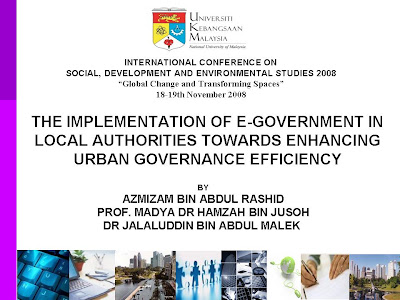
18 -19 th NOVEMBER 2008 - INTERNATIONAL CONFERENCE ON SOCIAL, DEVELOPMENT AND ENVIRONMENTAL STUDIES 2008


INTERNATIONAL CONFERENCE ON
SOCIAL, DEVELOPMENT AND ENVIRONMENTAL STUDIES 2008
“Global Change and Transforming Spaces”
18-19th November 2008


Contemporary global forces have devastating impact on local spaces. The intensification of the capitalistic forces, couched with market ideological impetus has transformed spaces in both the developed and developing world. These forces have created fragmented and unequal spaces and can be observed in several spheres: environment, economy, social, cultural, political and discourse. By bringing together scholars from various disciplines to deliberate these issues at the global, regional and local level, this conference hopes to act as a multidisciplinary platform for intellectual and policy discourse as well as a ground for regional networking comprising academics, researchers, policy and decision makers, government officials and non- governmental organizations.

How these cascading global forces impinge on the local spaces in various spheres of life becomes a critical issue that warrants further inquiry? How different countries strategize, form alliance and situate in this globalizing world becomes a key question? How do micro-spaces and marginal spaces and actors respond to this avalanche? By bringing together scholars from various disciplines to deliberate these issues at the global, regional and local level, this conference hopes to act as a multidisciplinary platform for intellectual and policy discourse as well as a ground for regional networking comprising academics, researchers, policy and decision makers, government officials and non-governmental organizations.


Add Image


THE IMPLEMENTATION OF E-GOVERNMENT IN LOCAL AUTHORITIES TOWARDS ENHANCING URBAN GOVERNANCE EFFICIENCY


BY
AZMIZAM BIN ABDUL RASHID
PROF. MADYA DR HAMZAH BIN JUSOH
DR JALALUDDIN BIN ABDUL MALEK

ABSTRACT

Over the past decade many governments have conceived and implemented programmes intended to launch the government into the digital realm. The Electronic Government (E-Government) initiative in Malaysia was launched to lead the country into the Information Age. It has improved both how the government operates internally as well as how it deliver services to the people of Malaysia. It seeks to improve the convenience, accessibility and quality of interactions with citizens and businesses; simultaneously, it will improve information flows and processes within government to improve the speed and quality of policy development, coordination and enforcement. The vision of E-Government is a vision for government and businesses people working together for the benefit of Malaysia and all of its citizens. The proposed of this paper to study the implementation of E-Government in Local Authorities in order to enhance effectiveness and efficiency in deliver services. Majlis Perbandaran Subang Jaya (MPSJ) has been chosen in the study. The focus of study is how MPSJ implement the E-Government not only transparency and accountability, but also creates an opportunity for community to assess MPSJ performance and delivery of services and promises. An efficient public service is a key factor in ensuring a conducive environment to attract private investment.

Sunday, 16 November 2008

EFFICIENCY IN URBAN GOVERNANCE...MYTH OR REALITY?

Of late we are seeing a movement to make local government more efficient. While at first glance this seems like a logical idea to better local government, there are many questions that need to be answered before embarking on such an endeavor and several concerns and cautions that need to be recognized. Asking the right questions, seeking the right information, using realistic performance criteria, and considering all possible outcomes are essential to ensure the efforts of the local governmental body do not end up as nothing more than a report collecting dust on a shelf or, worse yet, the results of the efforts prove not only disappointing but may even worsen the situation. One of the most common comments heard when local governments begin considering efficiency efforts is “We need to run our county/city/village like a business!” While on the surface this would appear to be a positive idea, there are issues that must be considered before embarking on such a quest.

First, government provides services that cannot be offered in a manner similar to a for profit business. If all government services could be provided by private business at a profit, private business would certainly be providing those services. The fact that most government services cannot be provided in a profitable or even self sustaining manner means that government cannot be run like a business. All one has to do is try to envision police or fire departments being operated in a for-profit business manner to see why this concept is unworkable.

Second, private businesses are not subject to the public scrutiny, regulations, or management options that local governments are. A business can write off a group of difficult customers; government cannot. All citizens, no matter how disagreeable or problematic are entitled to services.

Third, government does not have a monopoly on inefficiency. Businesses have the ability to cover mistakes and inefficiencies while increasing prices to cover the costs of mistakes. Local government does not have this luxury as everything it does is subject to public scrutiny.

Saturday, 15 November 2008

MUSLIM WORLD, GOVERNANCE AND GLOBAL COMPETITIVENESS

The Muslim world is rich in human capital as well as physical resources and has immense potential for growth, progress and prosperity. We constitute one-fifth of humanity and our people are intelligent, industrious and enterprising. Nature has blessed us with vast natural resources which include 70% of the world's hydrocarbon reserves. The Muslim world is spread over a vast geographical expanse extending from Morocco to Indonesia and has a rich diversity of races, languages, cultures and people. Counter-pointing the richness and diversity of our resource base is an economic performance which is not commensurate with our true potential. There is no doubt that some of the Muslim countries have made impressive progress. However, a vast majority of Muslims live in poverty and backwardness. Nearly 39% of the world's Muslim population lives below the poverty line. We make up 19% of the world's population but only 6% of its income. Our share in global trade is barely 7 - 8%, while only 13% of our total trade is amongst us. No Muslim nation is among the group of developed industrialized countries.

Instead of breaking into a litany of noble intents and declarations, which is a customary way of starting such a speech, we have deliberately chosen to go straight to facts and figures which bring into sharp relief the true dilemmas and challenges facing us. Our sole objective here is to set in motion a train of thought that helps us identify the root-causes of our malaise. We in the Muslim world need to look inwards, get into a mode of self-analysis, identify our strengths and weaknesses and chart a clear and well-defined course of action. First of all, we should be very clear about the kind of world that we live in today. The world of today is radically and profoundly different from the world of yesterday. We are living in an age of globalisation where no nation can afford to live in isolation. We have, therefore, to begin our quest for economic revival by identifying the challenges and opportunities that the current global environment presents.

The new world order is characterized by economic integration, technological advancement, predominance of knowledge economy, and diffusion of democratic ideas. Broadly speaking, this process has brought about three fundamental changes. Firstly, a new governance paradigm is emerging whereby the private sector is leading the process of economic growth and governments are assuming the role of policy-maker, facilitator, regulator and enabler. Secondly, supra- national institutions are laying the rules of the game and nation-states. are called upon to operate within that framework. Lastly, and perhaps most importantly, buoyant expansion of global trade and capital flows as well as freer exchange of ideas and technology across the world provide vast opportunities for growth but at the same time pose serious challenges in terms of achieving better governance, higher efficiency and greater competitiveness.

This is the kind of global environment in which we in the Muslim world have to position ourselves in our pursuit of economic resurgence. The sooner we adjust to the ground realities of the new global order, the brighter our prospects of success would be. The way forward in this highly competitive and inter-dependent world is through improved governance and reform within individual Muslim states on the one hand and by exploring new avenues of mutual cooperation based on commonality of interest on the other. The second biggest challenge facing the Muslim world is on account of insecurity emanating from disunity and dissentions within our own ranks. Such conflicts and disputes are not only sapping our energies and resources but also undermining our prospects of meaningful cooperation. Within Muslim countries, vertical divisions by way of social inequities are nursing a sense of deprivation, while horizontal cleavages along ethnic, tribal and linguistic lines are a source of unrest. There is a need for unity within and amongst ourselves in order to move forward and harness our economic potential.

The growing divide between the Muslim world and the West, wrongly projected by some as a clash of civilizations, is another important challenge facing us. Public opinion in the western world is gripped by misperceptions about our faith. Meanwhile, Muslims in Iraq, Afghanistan, Palestine, Lebanon and Kashmir continue to face insecurity, death and destruction. Such is the nature and magnitude of the challenges facing the Muslim world in recent times. The most important response required of us at this critical juncture is to project the true spirit of the Islamic faith and to remove the cobwebs of prejudice and misperceptions which hang around it. Islam as a way of life enshrines the values of moderation, tolerance, justice and interfaith harmony.

In conclusion, the Muslim world is faced with serious and multiple challenges. A lot of progress has been made in many areas but a lot more needs to be done. It requires clarity of thought, will to change, and determined and concerted action by all of us individually and collectively. It is a difficult and arduous journey. It is a constant and unrelenting struggle. The Muslim world, with its rich resources, vibrant energies and unflagging determination, will overcome these challenges and open new avenues of progress and prosperity not only for Muslims but for entire humanity. Islam promises universal peace, progress and prosperity and so should our endeavours aim at and contribute to make a better world for all mankind.

Tuesday, 11 November 2008

WILL THE NEW POLITIC SCENARIO IN MALAYSIA ENCHANCE EFFICIENT URBAN GOVERNANCE?

Since the advent of New Public Management (NPM), public service innovations and policy transfers have become increasingly popular around the world as a strategy for improving governance and scaling up service quality. The Malaysian government has also shown considerable interests in policy learning and consequently introduced important innovations and reforms akin to those introduced in other contexts. This major innovations and changes that the Malaysian public service has witnessed since the early 1980sand comments on their impact. Although public service innovations and reforms have been quite comprehensive and generally, viewed favourably, they have so far produced positive but yet limited impact. Despite gains in several areas as a result of innovations and changes public governance, Malaysia continues to suffer from a number of problems and challenges including high incidence of corruption, inefficiency, procedural complications/delays in service provision and lack of professionalism.

Though the term ‘governance’ has gained currency fairly recently, attempts at improving governance are by no means new. As the public bureaucracy has generally attracted increasing criticisms for poor performance and failure on its part to meet the rising expectations of the citizenry, government leaders have always sought to address such situations by devising and introducing innovative policy measures. In this respect, they have also shown growing interests in learning from other contexts and in imitating policy models that have apparently produced better results. Thus administrative innovations and policy learning and/or transfers have been a key feature of drives for upgrading the quality of governance in both developed and developing countries. In recent years, such drives seem to have received fresh impetus especially since the advent of the NPM as a model of public sector governance.

The NPM refers to a range of reforms in the public sector aimed at making it more efficient, economic and effective. At the heart of these reforms is the shift from government by control to government by contract, which typically involves the introduction of market logic in the government, changes in organisational structures and redefinition of the government’s roles and functions in the society. Since the NPM has offered better solutions to many of the perennial problems of the public sector, the new model has soon become widely popular. By early 1990s it has assumed a global character and ignited the process of radical transformation of the public service around the world. The countries in the Asia Pacific region are no exceptions to this world-wide trend. During the past decades, political and administrative leaders of this region have demonstrated growing interests in the idea of governance innovation and introduced major reforms in an attempt to streamline the management of the public sector.

Broadly aimed at improving governance, these reforms are largely consistent with those introduced elsewhere, although there are significant variations between individual countries in terms of the levels of implementation and the strategies involved. Consequently, the countries have recorded varied experiences with reforms initiated and results achieved. In Malaysia, the government has introduced a wide range of reforms especially since the 1980s in order to upgrade governance and the quality of services provided to its citizens. The recent reforms represent a major departure in that they are far more significant and comprehensive in both depth and coverage than those introduced in the past. Taken together, they have brought about profound changes in the public service and the way it operates in providing goods and services to the people. The present paper provides an overview of public service reform in Malaysia focussing on aspects of innovation and policy transfer. It begins with the identification of some key factors that have provided the impetus for reforms and innovations. Then it outlines some of the contemporary reform initiatives and assesses their impacts on public governance in general.

Sunday, 2 November 2008

GEOHAZARD MAPS AND URBAN PLANNING.... NEW TASK FOR FEDERAL DEPARTMENT TOWN AND COUNTRY PLANNING PENINSULAR MALAYSIA

Q: You said at a recent climate change conference that before 2004, planners lived in a comfort zone. Why is that?
A: Before 2004, it was difficult to compare our country with others like the Philippines where they have strong typhoons. We have our fair share of disasters but not like the floods in Bangladesh. Ours are smaller, or flash floods. We are in a sheltered platform.

Q: Planners always said these were one-off things. Why should we pay attention to them?
A: We went to Aceh after the tsunami. It made us wonder if it could have happened to Malaysia. Sure, about 200,000 people died in Aceh and only 68 in Malaysia, but a life is a life. We have to do something. We've addressed floods to some extent in our planning but have never gone into detail like drawing up flood-risk maps. Then comes climate change and everything goes haywire, like the floods in Johor. With that awareness, we started Lupar (land-use planning for assessment of risk) which was designed to raise awareness among planners and get them to include risk management in their planning. As a result, two new local plans which are coming out soon will be more specialised.

Q: What's different about these plans?
A: The local plans for Kota Kuala Muda in Kedah and Kota Tinggi in Johor will each have a chapter on geo-hazards, with risk maps included. . The Kuala Muda plan will be up for public viewing early next year while the Kota Tinggi plan will be out before year end. We will look at all the measurements of the physical and biological impact of the tsunami and the areas it inundated, and categorise the areas according to the acuity of these risks. For the first time in a local plan, we will have areas marked high, medium or low risk in relation to a hazard. This is required under the Hyogo Framework of Action, of which Malaysia is a signatory. It requires member countries to make disaster planning a concern and to spell out measures to address disasters.

Q: What other new information will the plans have?
A: There are modelling and simulation to see which areas will be affected by floods and the extent of the damage. We don't have much to spend on modelling so we're recommending that this portion be taken up by technical agencies with the expertise and money. Modelling is expensive. It runs into millions. Consultants are now doing it for us, but we feel that isn't the way forward. For these two plans, we've also had focus group discussions with local communities to fill in information gaps, like which areas were inundated during the tsunami or floods and how high the water rose. We ask whether they think their house should be relocated and if yes, where, or where do they think their reban (chicken coop) should be placed? If they want to stay in the area in spite of the risks, then we have to think of other measures to deal with the hazards. In Kota Tinggi, we are proposing that on flood-prone lands committed to development, developers must raise buildings and make the ground level free of obstacles. Like a kampung house on stilts, the building is raised and cars can park underneath. If they can't do it, they have to be relocated. But this has financial and social costs so we suggest alternatives. All this will be built into our policies and plans and made public, which will make things more accountable. Everyone will know where the risk areas are and can comment on or object to them.

Q: Will there be repercussions for this?
A: Some repercussions may be a drop in land value but, overseas, people are told which areas are flood prone so that they can control development.

Q: Will these new aspects become a feature of all new local plans?
A: Yes. We are hoping these will become the templates for other local plans. Under the 10th Malaysia Plan, we hope to review all existing local plans and put in the measures for geo-hazards.

Q: How many local plans would you be reviewing?
A: About 140. But this will be done gradually. We have to work this out with the Department of Irrigation and Drain-age (DID) because it is studying the impact of climate change on flooding. We are working with it and the National Hydraulic Research Institute (Nahrim). They will pass their findings to us and we will convert that into land-use policies. That way, we don't have to spend thousands collecting our own information. They are the experts with the technology. We don't have that level of expertise.

Q: How will these plans help local authorities? What should they do with this information?
A: The local plans are not just legal documents but also public documents. The local authorities which previously may not have had guidance will now have, for the first time, a document that tells them which areas to develop, which areas should have less development and which are no-go areas.

Q: Is there enough information for us to do hazard maps and models for all local authority areas?
A: No. To simulate a flood situation, you need very accurate basic data. We need high-resolution contour maps. To get that, we need special satellite images. We've also conducted a geo-hazard study in land-use planning. We're coming out with development guidelines for areas susceptible to floods, fires and landslides first. When the study is finalised next June, it will tell local councils how to categorise hazards and how to identify areas that are prone to these problems. It will give them some measures according to the level of danger, for instance, in Category 1, what kind of development is recommended and what measures to take if they want to develop there. This will be fed into local plans. The local authorities will have a good guide on how to apply this information. We need Nahrim, Akademi Sains Malaysia, universities and other agencies to give their input.

Q: Will these two new plans be easy to understand for residents ?
A: Yes. The approach now is for user-friendly plans. If you have a piece of land in the district, you can look at the plan and it can tell you what the risks are.

Q: But the climate is unpredictable. After the guidelines are issued, how regularly will the information be updated?
A: The department will do this. If there is a request from the state, we will look at it. A review request can even come from the National Physical Planning Council chaired by the prime minister, or even from the cabinet if it sees that the situation on the ground has changed enough for a review. We will also listen to public feedback. In any case, we will review the plan every five years.

Q: This kind of information will affect land prices. If a direction for a review can come from the top, isn't there room for abuse? A politician who wants to jack up the value of an area might skew the review in his favour.
A: The information will be made public and people can question us on the categories. Probably the first question people will ask is: how sure are you that my land is Category 1 for floods? We will explain that the potential of it being flooded every five years is there. The checks and balances will come from the people. When we put up these documents for public views and objections, we're giving land-owners the chance to ask us. People may not want it to be so but if the government feels it is for their safety, then the land should be designated as such. The other thing we're looking into is the role of the insurance sector. If you still want to develop projects in these flood-prone areas, you'll have to pay higher premiums. If you look at other countries, geo-hazard areas are declared and gazetted. Anyone who wants to develop the area has to pay a higher premium that will compensate for when hazards occur or serve as a deterrent to building in a dangerous area. We could also add stringent measures for building in the area.

Q: When you start reviewing all existing local plans, you might find areas where there shouldn't have been any development, right?
A: Once an area is designated as a geo-hazard risk, then we'll consider options. If we want to build, should we raise the level of buildings? Or should we buy back the land and turn it into a park like they've done in Hawaii? Or should we relocate everyone? What will the costs be? It's really a question of whether we want to pay less now and more in the long run or the other way round.

Q: What if the review finds a neighbourhood that is prone to disasters?
A: They may have to relocate or we could take mitigative action action or realign the development. There are many measures but, in the worst-case scenario, people may have to move. Whatever the recommendation, it will be specific to the location. You can't have one plan to fit all areas.

Q: You've been talking mostly about floods. What about preparing for other disasters like earthquakes?
A: Yes, we will be looking at those in the 10th Malaysia Plan. Right now, we're only looking at floods, landslides and fires. Next, we'll look at earthquakes, tsunami and industrial disasters.

Q: Will the geo-hazard mapping also look at things like the many developments on reclaimed lands?
A: The National Physical Plan (NPP) doesn't encourage it but some states still go ahead and do it. Our policy still stands: reclamation should be the last resort. The NPP discourages high-density development on reclaimed land.

Q: Will the department also look into the ability of structures to withstand some of these geo-hazards that you are identifying?
A: We'll have to work with the Public Works Department (PWD) on that because it has a structural unit that looks at the effects of landslides, earthquakes, flood and wind resistance on structures.

Q: How will you convince state and local governments that this is important and that they have to follow it?
A: We're planning to present it at the National Physical Planning Council, which is chaired by the prime minister. All the chiefs of states and heads of departments will be there. This is something that we have to follow and we'd get their commitment. Then we'll monitor, check the developments, build public awareness and have periodic reporting on compliance levels.

Q: If there's non-compliance?
A: Then the states have got to tell us why.

Q: And by that time the public will know where development is ill-advised?
A: That, too. This is our new baby and we're excited. We don't know yet how the states are going to react. But I think after seeing what happened in Kota Tinggi, they'll all be for it. We hope that it'll even come to the stage where they'll be the ones advising us on where the evacuation routes should be if a tsunami came.

Q: Are we planning too far ahead? Some people say climate change and the extreme weather it promises will only be a problem 100 years from now.
A: We are actually way, way behind. In terms of disaster planning, we're behind Sri Lanka and the Philippines. They even have disaster-enactment scenarios.

Q: We're talking about things that are natural hazards, but what about man-made hazards?
A: That's why we must have an integrated way of doing things. Let's say if I'm building a building now, what're the effects of it downstream? Will it cause floods? Where? Through modelling, you can find out the level of density of development allowed. You'll have to run your land- use proposal, your density through a model to figure out the impact of it downstream. It's basically calibrating your development plan. It's not mandatory to do that now, but we must have that. We might, together with DID, develop such a system, so that it can be made mandatory for all future development proposals. So when you submit your development plan to the local or city council, the council and DID will run it through the model to see how it will impact the environment. We also have to change our procedures of planning approval. We're suggesting that all applications be submitted together with a history of floods in that area. And the local authority is encouraged to establish a databank that collects information on previous disasters in their area. Our culture of documentation is so low. We have to develop that.

Q: If my house is in a high-risk landslide category, but the council comes and does mitigation work, will my house be re-categorised?
A: Yes. We will review the categories from time to time.

Q: What other areas will you look at after Kota Tinggi and Kota Kuala Muda?
A: We will give priority to flood-prone areas, like Segamat, for instance. Landslide-prone areas are next on our list. The PWD has put together a unit that identifies vulnerable slopes along highways. We just need them to expand that to include other potential vulnerable areas, like settlements and areas around rivers.

SOURCE : NEW STRAITS TIME 2 NOV 2008

Thursday, 30 October 2008

ENHANCING URBAN GOVERNANCE EFFICIENCY IN MANAGING GLOBAL FINANCIAL CRISIS

The world bank estimated that there were 45 serious financial crises that erupted throughout the world in the 1980's, but this had increased by almost one and a half times to 65 crises recorded in the 1990's. Furthermore, due to the effects of contagion, a financial crisis in one remote part of the world will probably affect our nation more than it did before. As such, besides taking action on the domestic front, we must continue to press for reforms of the international financial architecture, even though it may no longer be fashionable to do so.

Geo-political developments will also affect the global economy in a more pronounced fashion in the future. Since the end of the cold war, and now with the impetus of the new war on terror, we have begun to witness the unilateral designs of one superpower to dominate the world. The war in Iraq and the harsh polemic directed towards Syria and Iran are instances of this. When you add the other skirmishes taking place in the world - such as the flare up in Aceh and the Palestinian-Israeli conflict - then you have a world full of potential flashpoints that could cause much uncertainty and disruption to the global economy. Natural disasters and other unexpected shocks can also wreak havoc on the economy. The recent phenomenon of Severe Acute Respiratory Syndrome (S.A.R.S.) Affected Asian economies more starkly than the war in Iraq. Planes were grounded and hotel bookings were cancelled, as the fear of S.A.R.S. brought travel and tourism almost to a halt. Thankfully, this virus seems to have been brought under control, but we must be alert to any possible relapse and be ready to deal with any eventuality.

A key aspect of competitiveness relates to the efficiency and effectiveness of the public service delivery system and urban governance. In fact, in the first meeting of the cabinet committee on national competitiveness (of which I am the chairman), this delivery system was identified for further enhancement in our quest to improve national competitiveness. True, the private sector acts as the engine of growth, but this engine cannot run in a vacuum. The speed, efficiency and effectiveness with which the public sector serves the private sector determines the speed, efficiency and effectiveness of our corporations. Besides enhancing our competitiveness, we must improve our urban governance and public service delivery system simply because our citizens demand it. As the nation develops, and as our citizens become more affluent and sophisticated, more and more will be required of the government and civil service. I remember when we had to be absent from the office a good part of a day just to get our driver's license renewed. Now, not only does it take a mere five minutes, we need not go to the road transport department anymore; we can renew it even at the post office.

Furthermore, a conducive business environment is dependent not only on the relevant rules and regulations, but also on the services provided by the public sector. As taxpayers, individual citizens are also constantly looking for high quality services. In this case, how can the government respond to calls for an enhanced public service delivery system?. By no means an exhaustive list, I would like to offer five guiding principles for civil servants to consider in raising their overall efficiency and effectiveness. Corruption itself is symptomatic of a flaw in the delivery system. We must realise that people fall into the trap of corruption when customers seek to circumvent a complicated and cumbersome delivery system. If agencies make their delivery systems transparent and user-friendly, cut the red tape, add checks and balances to the system, and severely punish those who betray the public trust, then we would have already won half the battle against corruption.

Furthermore, the government has chartered new strategies to enhance the nation's resilience and competitiveness. These strategies include a focus on developing the services sector (including financial services, tourism, education, health and others), our foray into new areas such bio-technology, and intense efforts to further diversify our exports and to seek new markets for our goods and services.

Saturday, 18 October 2008

THE TOOL OF URBAN GOVERNANCE EFFICENCY

Land use control mechanism is a tool to guide and control land use development activities mainly in town planning process. In Malaysia, The Town and Country Planning Act 1976 (Act 172) states that there must be a development plan system to act as a mechanism to control land use. The development plan system consists of a District Local Plan (DLP) which has the functions of planning, controlling and guiding land development at the district level. Studies done in DLP consists all the sectors in land development including housing. Thus, all parties in land development process, especially the developers must refer to DLP as to refer on land availability for future housing development. However, the effectiveness of the information on land availability stated in the DLP has always being questioned. Thus, the aim of this thesis is to study and improve the effectiveness of DLP in stating the level of land availability for housing development in urban area. A study is done based on literature study on the importance of housing in an urban system and reviews on the factors relating to housing in DLP. The Malaysia Government's strategy for promoting sustainable development identifies an important role for the town and country planning system. The system is to be a key instrument in delivering land use and development objectives that are compatible with the aims of sustainable development. The recent amendment to the planning legislation indicates the concern for better environmental management both at development plan level and development control. For development control purposes, the local planning authority is empowered to grant planning permissions subject to conditions related to resource conservation and measures which enhance environmental quality of the development.

Monday, 29 September 2008

EFFICIENCY IN URBAN GOVERNANCE THROUGH INNOVATION AND PARTNERSHIPS

The rapid urbanization, globalization, information and communications revolution and the increasing complexity of our societies are reshaping the roles and functions of our local governments. Increasingly local governments are no longer confined to their traditional roles of providing sanitation and waste disposal services. There is the pressing need for local governments to further expand their roles and functions to include economic and social development.However, as local governments in many countries lack the budget, expertise and resources to embank on these increased roles and functions, there is a need to form partnerships to satisfy the increasing demands of the people. As such partnership with the private sector or NGO’s or another public sector organisation seems to be the best alternative to enhance economic and social developments in local governments.

In Malaysia, the adoption of the Malaysia Incorporated Policy in the 80’s has inspired many local governments to form joint-venture partnerships with private sector or NGO’s in housing and the provision of urban services. These partnerships have improved the quality of life and standard of living of its people, besides addressing social problems like poverty and squatters. These partnerships have also generated much needed revenue to the local government that can be used to further improve its services. Malaysia enjoys a three-tiered system of government comprising the Federal Administration, State and Local Government level of administration. At its apex, is a constitutional monarchy. Its parliamentary democracy allows the citizenry to participate in national elections since its independence attained in August, 1957. The founding fathers of this country saw it fit to put in place a Constitution which guarantees and safeguards ethnic, social, religious, and cultural rights and fundamental liberties given the diverse multi ethnic background of the populace.


Following Independence, Malaysia’s economic landscape transformed from a largely agriculture export-based economy to a manufacturing hub for Asia by the 80’s. Further to that dream, Malaysia’s aspiration to become a fully developed country by year 2020 presupposes the nurturing of an excellent civil force of public employees of commendable attitude to bring about a more efficient delivery system. Steps are already afoot to transform public employees into k-workers who are customer-focused, results and performance driven, responsive, accountable and innovative. Human capital development and human resource training for capability and capacity building can be seen as complementing the Malaysian government’s conscious efforts towards an E-government.

Likewise, the exploitation of smart partnerships and strategic alliances between local governments (G to G); between local governments and non-governmental organizations/service clubs are attributes of successful partnerships for basic services such as water, education, electricity, health and transport. Throughout these partnerships opportunities are made available for sharing knowledge, best practices, technologies, information exchange and networking for more smart partnerships. Innovative thinking on the part of the Malaysian government has fast tracked the forging of partnerships with the private sector in the disposal of wastes and sewerage treatment.


The Local Agenda 21 Petaling Jaya - a three year project on Lake and River Rehabilitation Programme initiated in 2002, jointly undertaken by The Municipal Council of Petaling Jaya, the Global Environment Centre (GEC) and Malaysian Anglers Association. Funded by the UNDP – GEC Small Grant Fund, this project focuses on rehabilitating and sustaining the management of lakes within Kelana Jaya. As a result of innovative thinking and smart partnership, these lakes which were formerly waste dumpsites, have been transformed into public parks, walkways, leisure and recreation spots for the local community to engage in healthy outdoor family activities. In view of global concerns regarding environment, Malaysia shares the views of those developed nations regarding ecologically sustainable development. The impact of global warming is a clear and potent threat. It is noteworthy that as senior local government policy-makers and practitioners, we are duty bound in our commitment to continually plan initiatives and provide better local government services and delivery through innovation and partnerships so as to confer lasting benefits on the local communities.

PEOPLE AROUND ME..FAMILY AND FRIENDS.

PEOPLE AROUND ME..FAMILY AND FRIENDS.
To my Wife, Zulaini, my sons Zulazlan, Zulazman, Zulazmir, Zulazmin dan my daughter, Nuris Zulazlin...I love you all..thank you being with me

CIRCLE OF FRIENDS... KUALA LUMPUR PROJECT OFFICE

CIRCLE OF FRIENDS... KUALA LUMPUR PROJECT OFFICE
Thank you guys...for your support and encouragement

2007 / 2008 METHODOLOGY AND QUALITATIVE RESEARCH COURSE FOR PHD CANDIDATES

2007 / 2008 METHODOLOGY AND QUALITATIVE RESEARCH COURSE FOR PHD CANDIDATES
My new friends during my course in INTAN 9 Jan -2 Mac 2007

KUALA LUMPUR PROJECT OFFICE, JOURNEY TO MOUNT OF KINABALU SABAH 21-22 JANUARY 2006

KUALA LUMPUR PROJECT OFFICE, JOURNEY TO MOUNT OF KINABALU SABAH 21-22 JANUARY 2006
WE CAME, WE SAW, WE CONQUERED 4095.2 METER ABOVE SEA LEVEL

How are you, guys? Where you are now?

FOOD CLOCK