Finally I managed to complete my first draft...but still lot of changes, organizing data, collabration finding with research question and analysis of literature review.... Lot of things need to be done....
Since December 2007, I created this research blog to facilitate me to do my PhD. I completed my research in December 2010 and I want to keep this blog. Its allow me to continue writing and sharing my views on urban and regional planning. This blog will create a new networking among researchers and give me a confidence but never allowed me to become complacent...DR. AZMIZAM ABDUL RASHID
Thursday, 30 September 2010
Monday, 27 September 2010
THE SUBMISSION OF NOTICE THESIS ABSTRACT TO PPSPP AND FSSK OFFICE
In order to fulfill faculty requirement, I need to submit my notice thesis abstract to PPSPP's office and faculty 's office three months before my final thesis submission. This will expidite faculty to appoint external and internal examiners to approve and justify my thesis. Who are they? Professor from USM, UIAM, UTM, UiTM or UM.........??????
KEEFISIENAN GOVERNANS BANDAR DALAM MENINGKATKAN DAYA PERSAINGAN EKONOMI WILAYAH-BANDAR RAYA KUALA LUMPUR
AZMIZAM BIN ABDUL RASHID (P 43282)
ABSTRAK
ABSTRAK
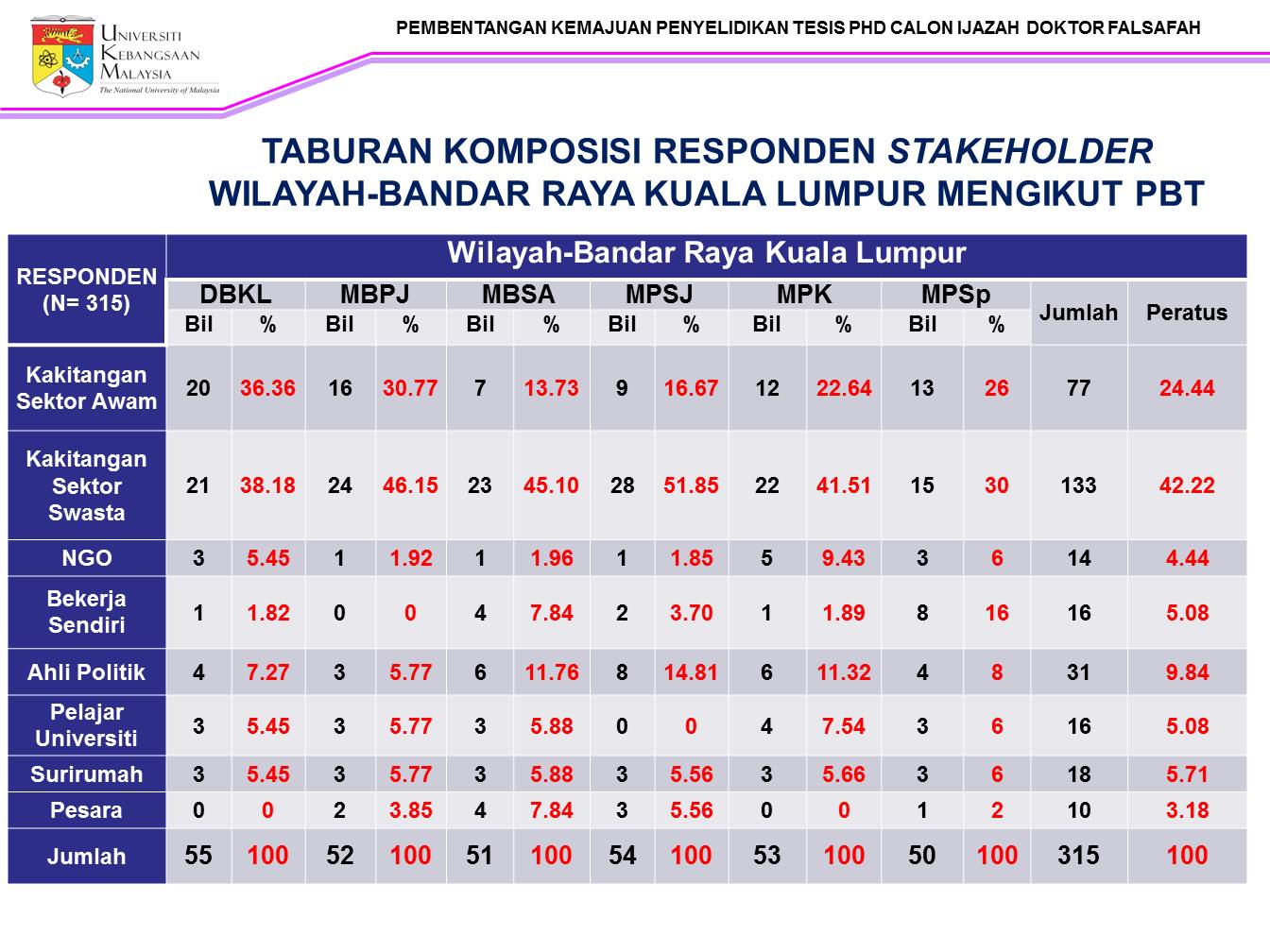
Dalam menghadapi proses globalisasi, governans bandar berdepan dengan pelbagai cabaran yang semakin kompleks. Pihak Berkuasa Tempatan (PBT) merupakan institusi governans yang tidak terlepas daripada isu ketidakefisienan apabila berurusan dengan stakeholders. Berdasarkan peranan PBT yang semakin mencabar, institusi ini sentiasa dikaitkan dengan pelbagai karenah birokrasi, yang menimbulkan pelbagai masalah kepada orang ramai dan penyediaan perkhidmatan yang tidak efisien. Isu ini menjadi persoalan kajian dalam tesis ini. Ketidakefisienan governans bandar boleh menjejaskan daya saing sesebuah wilayah-bandar raya, terutama sekali dalam konteks globalisasi. Sejauhmanakah elemen keefisienan governans bandar (KGB) mempengaruhi daya persaingan ekonomi (DPE) sesebuah wilayah-bandar raya dan elemen manakah yang mempengaruhinya? Berdasarkan kes wilayah-bandar raya Kuala Lumpur, kajian ini juga akan menilai PBT manakah yang mempunyai kedudukan KGB yang paling baik? Kajian ini bertujuan membentuk satu pemahaman yang jelas berkenaan KGB, dan hubungkaitnya dengan peningkatan DPE wilayah-bandar raya. Kajian ini melibatkan 6 PBT utama di wilayah-bandar raya Kuala Lumpur iaitu DBKL, MBPJ, MBSA, MPSJ, MPK dan MPSp melibatkan 315 responden yang mewakili beberapa stakeholders. KGB sebagai pembolehubah bebas dan DPE sebagai pembolehubah bersandar telah digunakan untuk menilai hubungan antara KGB dan DPE melalui ujian analisis regresi pelbagai. Antara penemuan utama kajian, 10 elemen KGB menyumbang sebanyak 89.6 peratus kepada DPE wilayah-bandar raya Kuala Lumpur Ini menunjukkan terdapat hubungan signifikan antara KGB dengan DPE wilayah-bandar raya Kuala Lumpur. Namun begitu hanya 5 elemen sahaja yang menjadi peramal terbaik kepada DPE wilayah-bandar raya Kuala Lumpur iaitu keberkesanan pentadbiran dan perkhidmatan PBT, maklumbalas awam, wawasan strategik, ketelusan dan kesamarataan. Analisis indeks penunjuk pengukuran KGB PBT di wilayah-bandar raya Kuala Lumpur menunjukkan MBPJ mencapai skor tertinggi iaitu 0.75 berbanding dengan lima PBT yang lain. Kesimpulan kajian mendapati peranan PBT tidak lagi dianggap sebagai badan kerajaan yang memberi perkhidmatan dan menyediakan infrastruktur semata-mata. PBT sepatutnya lebih memberi tumpuan meningkatkan KGB dalam memberi perkhidmatan kepada stakeholders. Secara langsung, DPE sesebuah wilayah-bandar raya dapat dipertingkatkan.
EFFICIENT URBAN GOVERNANCE TOWARDS ENHANCING ECONOMY COMPETITIVENESS IN KUALA LUMPUR CITY-REGION
AZMIZAM BIN ABDUL RASHID (P 43282)
ABSTRACT
With the advent of globalization, urban governance is increasingly faced with complex challenges. The Local Authority (LA) as the governance institution is not spared from the issues of inefficiency in dealing with stakeholders. Inefficient urban governance can affect the economic competitiveness in the city-region, especially in the context of globalization. As the LA is ensconced in bureaucracy, this thesis investigates the extent how elements of efficient urban governance (EUG) can contribute to the enhancement of economic competitiveness in city-region (ECCR) and which of these elements can affect ECCR. In the case of Kuala Lumpur city-region, the studies also investigate which LA has achieved the EUG? This study aims to develop a clear understanding of the role of EUG, and its relationship with the ECCR. The study involved six main LAs in the Kuala Lumpur city-region such as DBKL, MBPJ, MBSA, MPSJ, MPK and MPSP involving 315 respondents representing various stakeholders. Element of EUG has been used as independent variables and ECCR as dependent variables in order to investigate their relationship by using multiple regression analysis. One of the findings shows that 10 elements of EUG contributed 89.6 percent to the enhancement of ECCR. There is a significant relationship between EUG with economic competitiveness in Kuala Lumpur city-region. However, only five elements are the best predictors to the ECCR such as administration and the effectiveness of LA services, public feedback, a strategic vision, transparency and equality. Meanwhile, analysis of the indicators measuring EUG in local authority areas shows that MBPJ achieved the highest score of 0.75 compared with five other LAs. The results indicate that the role of LA is no longer considered a government body providing services and infrastructure only but should focus more on urban governance to improve efficiency in providing services to stakeholders which can directly enhance the economic competitiveness in city-region.
Saturday, 11 September 2010
Thursday, 26 August 2010
Thursday, 15 April 2010
Monday, 12 April 2010
CIVIL SOCIETY IN THE CONTEXT OF URBAN REGIME THEORY
But what, actually, we mean by the urban regime? According to Stone (1989), the regime is an informal yet relatively stable group with access to institutional resources, and which has a significant impact on urban policy and management. It is not a coherent organisation or association, but an informal group of influential persons who derive their power from different sources, who share some policy objectives like that of promoting the growth in their city, and who can gain some economic, political or social rewards from their involvement. The regime is formed as an informal basis for coordination and without an all encompassing structure of command. (Stoker 1995, 59; Anttiroiko 1996a, 66)
An important point to be made here is the view that the politics in different cities seem to be dominated by various types of governing coalitions or regimes. There are pluralist regimes in which strong political leaders bring together a mixed set of private actors. Elitist regimes are run primarily by cohesive business elite. Corporatist regimes, which we may assume to be relevant in the context of Northern countries, combine both strong political leaders and a relatively unified business elite. And lastly, there is a category labelled as the hyperpluralist regime in which any governing coalitions can hardly be identified. One assumption is, that the direction of change within urban governance is towards more pluralist models, though new elites which are able to manage with the informational mode of development may emerge. (Stoker 1995, 62)
The social complexity is central to this perspective. The urban policy is dependent on institutional arrangements, business interest mediation, and some degree of popular control. What is essential is the fact that all the key institutions and actors are involved in an extremely complex web of relationships. The social control and effective management is limited to particular aspects of local development and policy choices. This, in turn, limits the capacity of local government as an agency of authority at local level. Other kinds of limits are determined by the higher levels of government. This is to say that the autonomy of Finnish cities is constrained by two principal factors, those of limited economic resources and local economic conditions, on the one hand, and the political control of the state authorities and European Union, on the other hand. (cf. Gurr & King 1987, 56) This makes it easier to understand why in most of the western countries there can be said to be two groups which dominate the urban regimes, the business elite provided it has structured itself to have a single voice, and the political force which operates within wider institutional and corporatist setting (cf. Stoker 1995, 63). The social complexity, thus, shapes not only local authorities and city management but also the governing coalitions within the urban setting.
Friday, 9 April 2010
IS URBAN GOVERNANCE ORIGINALLY FROM URBAN REGIME THEORY?
The study of urban regimes brings to center stage the issue of how to think about power. In Regime Politics (1989), I drew the distinction between "power over" and "power to" as a way of differentiating a social-production model of power from a social-control model. Over the past few years, as I have sought to understand the politics of social reform in the U.S., reform in urban education in particular, that distinction continues to strike me as critical. Yet, to make such a distinction is not a matter of endorsing one conception of power over the other, but of understanding how each fits into a larger political picture. It is important to see that in everyday political reality the two understandings of power are intertwined. Though conceptually different from "power over," for reasons spelled out below, "power to" has a domination or "over" aspect that should not be ignored in the study of urban regimes. After all, regimes are not neutral mechanisms through which policy is made. Instead, they are arrangements that facilitate action on some issues more readily than upon others
Originally urban regime theory focused on urban politics abstracted from historical epochs connected to changes in the structure of the world economic system. The theory appears to have gained a dominant position in the American literature on local politics precisely because it dispenses with the stalled debates on conventionally conceptualised tensions like those between elite hegemony and pluralist interest group politics, between economic determinism and political machination, and between structural determinants and local choices. It provides a conceptual framework that views these, on the one hand, as false dualisms and, on the other hand, as theoretically driven historical and/or empirical questions. Urban growth coalitions are viewed as only one of the political coalitions that may arise in cities. In addition, it is assumed that they need to be hegemonic for an extended period of time to be considered a corporate controlled regime. Respectively, entrepreneurialism is viewed as only one of the possible leadership approaches that local politicians and government bureaucracies can pursue. Thus, regime theory asks how and under what conditions do different types of governing coalitions emerge, consolidate and become hegemonic, and how they devolve and transform. The recent transference of urban regime theory to contexts outside of the United States as well as its use in comparative cross-national research attests to its dominant position in urban political scholarship. (Lauria 1995) Our primary intention is to apply this theory to the urban governance in the context of restructuring the corporatist 'post-welfare society'. This is a significant aspect to be taken into account when applying the theory to the Nordic cities and their governance relations.
According to Stoker (1995, 54), regime theory holds substantial promise for understanding variety of responses to urban change. It emphasizes the interdependence of governmental and non-governmental forces in meeting economic and social challenges. This is why it pays attention to the problem of cooperation and co-ordination between government, business community, and the third sector or civil society. Some regime theorists, Clarence Stone (1989) in particular, argue that cities are able to accomplish important public purposes by assembling coalitions of political, business and community elites. This has some important implications. It questions the elitist argument that if actual decision-making appears to be democratic, important issues will be effectively kept off the agenda by the real wielders of community power (Wolman 1996, 168-169). It may, indeed, be said that local politics has its relevance and that it can make a difference, though many academics who have studied the impacts of global economic restructuring and the changes in urban governments are pessimist about the ability of local government to shape its own destiny in the face of sweeping changes. (Wolman 1996, 172) In this the regime theory differs from elite theory: any group is unlikely to be able to exercise comprehensive control in a complex world (Stoker 1995, 59).
One of the attractive features of regime theory is that it addresses the questions which are widely discussed within more conventional approaches such as neo-pluralism. In short, the regime theory tries to shed light to following type of questions (Stoker 1995, 57):
1. What are the implications of social complexity for local politics?
2. What does the systemic advantage of certain interests imply for the nature of urban politics and policy?
3. What forms of power dominate modern systems of urban governance?
4. What roles are there for democratic politics and, for example, disadvantaged groups?
Wednesday, 7 April 2010
APRIL 2010 - MY PHD THESIS PROPOSED PROGRESS CHART
NOTES
One segment of the pie chart represent 1 hour
Red colour - sleeping / resting hour
Yellow colour - time spend for my family
Green colour - time spend for my research
Purple colour - public holiday
Sunday, 7 March 2010
ARE WE ABSORBED TO ICT FACILITIES OR ICT FACILITIES ABSORBED US?
Last Thursday, I read a few PhD theses, not a recent theses but theses wrote in 15 - 20 years ago. I wondered how they are managed and searched for the latest information. I imagined how they used typewriter and hand writing to keep their information in their note books (I mean not a laptop). However they can complete their thesis on time.
Today in the world of IT, we are as a PhD student has an advanced facility to search latest information related to our research and managed your information. I noticed every university students, undergraduate and postgraduate have laptop or desktop. There are so many search engine such as Yahoo, Google etc to assist us to search and download information on university, government and company website, latest journals, book review, newspaper online and etc. However why we cannot complete our thesis on time. Is it the research methodology is too complicated or there are so many university's requirement to fulfill? ICT should expedite our research not make our research difficult to complete.
Furthermore, ICT also absorbed us to spend more time to search and download irrelevant information to our research. I used a word absorbed because we spend so much time unnecessary to :
a) searching information for entertainment... gossip, films, song, movie stars etc;
b) reply email;
c) Yahoo messenger (YM)
c) read, update and reply facebook;
d) read and update blog;
e) read and update twitter;
f) You Tube;
g) Download movies and songs; etc
One of my friends said.. facebook make our networking widen and meet new friends. Did I need this? You tube..you will not miss anything, watching video etc. Email...exchange information so easily. The above entertainment and social websites really attracted us until we forget that we have more important thing to do. How much we spend our time to update our facebook or reply our email or download movies or song in laptop? What ever it is...up to you to assess which one good and bad. We should wisely think which one more important...complete our research or entertain ourself....
Friday, 5 March 2010
Tuesday, 2 March 2010
HOW MUCH DID I SPEND MY TIME FOR MY PHD RESEARCH?
Last week I and a few friends discussed about our research progress. One of my friends asked me, in a day how much did I spend my time on my research. When I look my daily timetable and calendar dairy for February 2010, I summarised under one table. And I found out that I spend about 11 - 12 hours a day for my research. Figure below shows the result of daily activities for February 2010. Did I spend my time more to family or less to my research? Should I balance my time for my family and research? How much I spend my time on research for coming month...Mac, April, May...etc? Should I sleep less than 5 hours, so I can spend my time on my phd research. However my brain need rest. I need to complete my phd research on time....
One segment of the pie chart represent 1 hour
Red colour - sleeping / resting hour
Yellow colour - time spend for my family
Green colour - time spend for my research
Purple colour - public holiday
Sunday, 28 February 2010
POSITIONING KUALA LUMPUR CITY REGION IN THE GLOBAL CITIES NETWORK: ANALYSING MALAYSIAN URBAN GOVERNANCE STRATEGIES IN THE MILLENNIUM ERA
In the age of globalization, it was argued that major cities in the region should be positioned in the global city system, in order for these cities and their immediate regions are effectively developed. As the urban and regional economic prospects increase reliance on the participation in the fast moving international and global economy, cities that are unable to adapt to these globalchanges and requirements would be marginalized. The marginalisation of major cities from the mainstream of global development will affect their progress and in most cases be determined by exogenous forces. At the same time, the emergence of new global economic and informational societies has created a new form of spatial development, the global cities. Such status was achieved only when a city and its region becomes a major center of international finance, transnational corporate headquarters, related high-level and specialized services, information processing and advanced telecommunications, a city with an international command and control functions (Sassen, 1991).
To what extend the above criteria and indicators really described the position of cities in underdeveloped and developing economies? It is the intention of the paper to deal with such a question, with particular reference to the city of Kuala Lumpur. Although Kuala Lumpur has substantially part of the international economy for the past three decades, it was argued that the city exercises little of the global or even regional control functions that world cities proposes. For this reason, the authors argued that Kuala Lumpur and possibly other cities in the rapidly developing economies be positioned in a different setting, and with different criteria and indicators, as compared to the existing global cities. Regional disparity has long been recognized in Malaysian development scenario, particularly between the more-developed western region and the less-developed eastern and northern regions in Peninsular Malaysia.
All the Five Year Malaysia Plans, starting from the Third Malaysia Plan (1976-1980) have placed special emphasis on the objectives and strategies of regional development. However in the decade of nineties, in conjunction with globalisation era, the direction of Malaysian development plans have been changed, towards becoming more competitive in the global economy. To some extend after 30 years, the issue of regional disparity is remains unsolved, and yet new emphasis on global competition has been dominated in development strategies and plans. However, analysing from the current achievement of national development, the position of Kuala Lumpur in the global cities network still unsignificant, reflecting the uneffectiveness of the strategies toward strengthening Malaysian competitivenes in global era.
Malaysian's Development Vision, particularly toward achieving the status of developed country in the year 2020. Affirmative action as a policy response to ethnic riots is a fairly unusual, indeed unfashionable, policy response, partly because inequality and conflict have a complex and much debated relationship. General vertical income inequality, measured as the gap between poor and rich, has not been found to have a statistically significant relationship with the onset of civil unrest or conflict (Collier & Hoeffler, 2000; Fearon & Laitin, 2003). And yet, an accumulating body of evidence suggests that horizontal inequality, inequalities between identity or ascriptive groups on the multiple and inter-related planes of the political, the socio-economic, and the cultural, may be politically explosive (Stewart, 2001).
These links between ethnicity, inequality and conflict among ethnic groups using a multidimensional approach, with a view to identifying those policies which might work in other situations of ethnic conflict. Taking Malaysia as the model for my research, I investigate and measure to what extent inequalities between ascriptive groups have fallen in that country between 1970 and 2000, a period during which various affirmative action policies were applied in fields ranging from education and government employment to business. Horizontal inequality in the key indicator of income is re-assessed. In addition, changes in access by ethnic group to educational opportunities; the distribution of employment by sector and by occupation; urbanisation and housing distribuition; ownership of household assets such as houses and cars; and infant, toddler and maternal mortality rates are all considered individually, while a multi-dimensional index of socio-economic inequality is subsequently constructed for comparison purposes.
To what extend the above criteria and indicators really described the position of cities in underdeveloped and developing economies? It is the intention of the paper to deal with such a question, with particular reference to the city of Kuala Lumpur. Although Kuala Lumpur has substantially part of the international economy for the past three decades, it was argued that the city exercises little of the global or even regional control functions that world cities proposes. For this reason, the authors argued that Kuala Lumpur and possibly other cities in the rapidly developing economies be positioned in a different setting, and with different criteria and indicators, as compared to the existing global cities. Regional disparity has long been recognized in Malaysian development scenario, particularly between the more-developed western region and the less-developed eastern and northern regions in Peninsular Malaysia.
All the Five Year Malaysia Plans, starting from the Third Malaysia Plan (1976-1980) have placed special emphasis on the objectives and strategies of regional development. However in the decade of nineties, in conjunction with globalisation era, the direction of Malaysian development plans have been changed, towards becoming more competitive in the global economy. To some extend after 30 years, the issue of regional disparity is remains unsolved, and yet new emphasis on global competition has been dominated in development strategies and plans. However, analysing from the current achievement of national development, the position of Kuala Lumpur in the global cities network still unsignificant, reflecting the uneffectiveness of the strategies toward strengthening Malaysian competitivenes in global era.
Malaysian's Development Vision, particularly toward achieving the status of developed country in the year 2020. Affirmative action as a policy response to ethnic riots is a fairly unusual, indeed unfashionable, policy response, partly because inequality and conflict have a complex and much debated relationship. General vertical income inequality, measured as the gap between poor and rich, has not been found to have a statistically significant relationship with the onset of civil unrest or conflict (Collier & Hoeffler, 2000; Fearon & Laitin, 2003). And yet, an accumulating body of evidence suggests that horizontal inequality, inequalities between identity or ascriptive groups on the multiple and inter-related planes of the political, the socio-economic, and the cultural, may be politically explosive (Stewart, 2001).
These links between ethnicity, inequality and conflict among ethnic groups using a multidimensional approach, with a view to identifying those policies which might work in other situations of ethnic conflict. Taking Malaysia as the model for my research, I investigate and measure to what extent inequalities between ascriptive groups have fallen in that country between 1970 and 2000, a period during which various affirmative action policies were applied in fields ranging from education and government employment to business. Horizontal inequality in the key indicator of income is re-assessed. In addition, changes in access by ethnic group to educational opportunities; the distribution of employment by sector and by occupation; urbanisation and housing distribuition; ownership of household assets such as houses and cars; and infant, toddler and maternal mortality rates are all considered individually, while a multi-dimensional index of socio-economic inequality is subsequently constructed for comparison purposes.
Sunday, 21 February 2010
CONGRATULATION TO MY FRIENDS WHO ARE HONOURED WITH PHD DEGREE 2009-2010
While I am in Loughborough University, I have met a few Malaysian students who pursue their PhD in the Loughborough University. Last year in 2009, Najib Salleh had completed his PhD. This year I had received a good news that Farrie Akma Othman also completed her PhD. The completion of their journey in discovering a new knowledge had inspired and motivated me to keep going with my research. CONGRATULATION TO DR NAJIB SALLEH AND DR FARRIE AKMA OTHMAN....Thank you to your lovely family and friends for their support and encouragement...
DR FARRIE AKMA OTHMAN

DR NAJIB SALLEH
Subscribe to:
Posts (Atom)
PEOPLE AROUND ME..FAMILY AND FRIENDS.
To my Wife, Zulaini, my sons Zulazlan, Zulazman, Zulazmir, Zulazmin dan my daughter, Nuris Zulazlin...I love you all..thank you being with me
CIRCLE OF FRIENDS... KUALA LUMPUR PROJECT OFFICE
Thank you guys...for your support and encouragement
2007 / 2008 METHODOLOGY AND QUALITATIVE RESEARCH COURSE FOR PHD CANDIDATES
My new friends during my course in INTAN 9 Jan -2 Mac 2007
KUALA LUMPUR PROJECT OFFICE, JOURNEY TO MOUNT OF KINABALU SABAH 21-22 JANUARY 2006
WE CAME, WE SAW, WE CONQUERED 4095.2 METER ABOVE SEA LEVEL
How are you, guys? Where you are now?