Thursday, 16 December 2010
Malaysian Publications: Azmizam Abdul Rashid, JPBD - The Efficient Urban G...
Kindly please visit this blog to read the collection of my published articles journal since 2009....Malaysian Publications: Azmizam Abdul Rashid, JPBD - The Efficient Urban G...: "AZMIZAM ABDUL RASHID, HAMZAH JUSOH, HABIBAH AHMAD (2010) The Efficient Urban Governance In Managing And Enhancing Competitiveness Of Property Market in Kuala Lumpur City-Region..."


WHY GREATER KUALA LUMPUR NOT KUALA LUMPUR CITY-REGION?
The aspiration for Greater Kuala Lumpur/Klang Valley (Greater KL/KV) is to drive rapid growth parallel with upgrading the city's liveability, according to the Economic Transformation Programme (ETP)'s A Roadmap for Malaysia. For this National Key Economic Area (NKEA), the Greater KL/KV extends beyond the boundaries of Kuala Lumpur. It is defined as an area covered by 10 municipalities, each governed by local authorities - Kuala Lumpur City Council (DBKL), Perbadanan Putrajaya, Shah Alam City Council (MBSA), Petaling Jaya City Council (MBPJ), Klang Municipal Council (MPK), Kajang Municipal Council, Subang Jaya Municipal Council (MPSJ), Selayang Municipal Council, Ampang Jaya Municipal Council (MPAJ) and Sepang District Council.
In 2010, the Greater KL/KV population was estimated at six million and it contributed about RM263 billion to the nation's Gross National Income (GNI), proving that Greater KL/KV was indeed the engine of the nation's economic growth and hence designated as a NKEA. Greater KL/KV is a unique NKEA as it has a geographical focus rather than the industry focus of the other 11 NKEA's. According to the ETP, Greater KL/KV was selected as a NKEA to reflect four important dynamics, the first one -- that urbanization is a driver of GNI growth, where urbanization was one of the most important drivers of economic growth in any country.
Secondly, the Primary City Matters Most -- that Greater KL/KV dominates Malaysia's urban economy and by a large margin and over the next decade, Greater KL/KV was targeted to grow in population by five percent per year and achieve GNI growth of 10 per cent a year. The third dynamics is that Urban Productivity Does Matter -- that the challenge for Greater KL/KV was to harness the power of urbanization while shaping it to maximise urban productivity to simultaneously pursue efficiency and liveability. Finally a great city needs to be a liveable city -- because while urbanising intensively, Greater KL/KV must also focus on improving liveability and among challenges for Greater KL/KV according to the ETP are stiff competition from neighbouring cities because liveability lags compared to many other Asian cities, public transport remains inadequate and natural assets remain untapped.
ETP has also outlined nine Entry Point Projects (EPP) as pivotal towards achieving the aspiration by 2020 and the economic aspirations for Greater KL/KV was to raise its GNI contribution by 2.5 times, from RM258 billion to approximately RM650 billion per year. The EPP's aim is to attract 100 of the world's most dynamic companies within priority sectors, attracting the right mix of internal and external talent and connecting to Singapore via a high speed rail system. Other EPP are to build an integrated urban mass rapid transit system, revitalizing the Klang River into a heritage and commercial centre, greening greater KL/KV to ensure every resident enjoys sufficient green space, creating iconic places and attractions, creating a comprehensive pedestrian network and developing an efficient solid waste management ecosystem.The successful implementation of the nine EPP will lead to additional business opportunities within Greater KL/KV that will continue to enhance Greater KL/KV's liveability and generate incremental GNI.
Greater KL/KV will need to house one million new residents by 2020, and the current projected housing supply was expected to be sufficient to meet demand.Since the challenge of Greater KL/KV NKEA is a monumental one, it will require a significant amount of funding and that will be achieved via a public-private partnership model. Across the 12 NKEA, Greater KL/KV has the largest public sector funding requirement of RM58 billion or 34 per cent of the total investment requirement and for all the nine EPP, a detailed implementation plan has been developed. There are only three roles above the EPP, the Prime Minister as ultimate sponsor, a Greater KL/KV Steering Committee and a Greater KL/KV Corporation that would act as Secretariat to the Steering Committee. The Greater KL/KV aspiration can be summarized as 20-20 by 2020 --- that is, to be the only city that simultaneously achieves a top 20 ranking in city economic growth as defined by city gross domestic product growth rates while being among the global top-20 most liveable cities by 2020. The KL/KV will pursue both growth and liveability
sources : Economic Transformation Programme Report by Performance Management and Delivery Unit (PEMANDU), Prime Minister's Department, 2010 and BERNAMA, 2010
Comments :
In my opinion the terminology of Greater Kuala Lumpur has been adopted from the term of Greater London which had been used well before 1965. Particularly to refer to the area covered by the Metropolitan Police District (such as in the 1901 census), the area of the Metropolitan Water Board (favoured by the London County Council for statistics), the London Passenger Transport Area. The area defined by the Registrar General as the Greater London Conurbation. The administrative area was officially created in 1965 and covers the City of London, including Middle Temple and Inner Temple, and the 32 London boroughs (including the City of Westminster). It covers 1572 km2 (607 square miles) and had a 2006 mid-year estimated population of 7,512,400.
According to Tewdwr-Jones and McNeill (2000), the term ‘city-region’ has been in use since about 1950 by urbanists, economists and landuse planners and refers to a strategic and political level of administration and policy-making, extending beyond the administrative boundaries of single urban local government authorities to include urban and/or semi-urban hinterlands. This definition includes a range of institutions and agencies representing local and regional governance that possess an interest in urban and/or economic development matters that, together form a strategic level of policy-making intended to formulate or implement policies on a broader metropolitan scale.
In 1996 , The New Local Government Network (NLGN) in United Kingdom also proposed the creation of city- regions as part of on-going reform efforts, while a report released by the Institute for Public Policy Research’s (IPPR) Centre for Cities proposed the creation of four large city-regions based on Birmingham, Leeds, Liverpool and Greater Manchester. Edinburgh and it's hinterland strong economy (Forth Valley, Fife, West Lothian, Midlothian and East Lothian) means it has been named a one of Europe's fasting growing city-regions.
Furthermore in 2001, the term of city-region has been used concurrent with the era of globalization. Allen J. Scott (ed.) (2001) with his book Global City-Regions: Trends, Theory Policy has gave a new meaning of City-region as a function of command and control centers of the global economy. City-region is a nodal points that function as organizing centers for the inter dependent skein of material, financial, and cultural flows that together sustain contemporary globalization. Research on city-region is founded on two key observations. First, the worldwide distribution of economic activity necessitates strategic control functions that are found in a limited number of locations: globalization in its various guises has led to increased geographical complexity, which calls for some control points to ensure the smooth functioning of the global system. In other words, city-region contain a disproportionate quantity of strategic agents in the global system (e.g., headquarters of multinational corporations and international institutions, and specialized and inter nationalized business firms), and this functional concentration mirrors the deepening of processes of global integration and interdependence.
Second, the exercise of this strategic control is ac complished through the capacity of these world/global city agents to network across space. From the 1970s on ward, two distinct advanced technologies, computers and communications, combined to create a new enabling infrastructure for global organization. As it became more pervasive and sophisticated, this global infrastructure implied that spatial organization became increasingly conceptualized through networks (in which interaction is defined by simultaneity) to the detriment of territoriality (in which interaction is defined by proximity). Envisaging city-region in the context of a ‘network society’ particularly gained momentum in the 1990s, when in fluential authors like Manuel Castells asserted that globalization processes are basically all about transnational processes operating through numerous networks.
In 2006, the Organisation for Economic Co-operation and Development (OECD) published a number of studies on city-regions, including an assessment profile of the Newcastle-Gateshead city region and a review of numerous city regions across the world. Therefore, there are many reasons why city-region could become a valuable alternative in stead of Greater Kuala Lumpur to the current system and why Kuala Lumpur city-region worth a closer and further examination, including:
• New Localism: devolution of power to a more appropriate level
• The economic case: Kuala Lumpur city-region in the context of global competitiveness and regional disparities
• Urban governance system works for Kuala Lumpur city-region , why not elsewhere?
• Continuing issue of democratic deficit at regional level
• Low levels of public engagement
• Efficiency - Need for more strategic service delivery solutions in planning, transport,
waste, housing etc.
Tuesday, 14 December 2010
13 DAYS MORE TO GO......BYE !!! BYE UKM THANK YOU
ALWAYS THE END OF A JOURNEY, A NEW JOURNEY WILL BEGIN....I will finish my PhD research soon but there is (may be) a new chapter of my career. Alhamdulliah, thank you to Allah, I'm managed to complete my research in 3 years since Dec 2007. Thank you to Assoc Prof Dr Hamzah Jusoh and Assoc Prof Dr Jalaluddin Abdul Malek to assist and encourage me to complete this research. I faced a various colours and challenged experiences in my battle to discover a new knowledge on urban planning. Thank you to my wife and my 5 loving children who always understand and support me from the beginning I commence my PhD research.
Now I have to think new planning and strategies to build up my career in the future. I will use my previous experiences and knowledge to share with my friends. I hope will sit my viva presentation in February 2011.
Sunday, 12 December 2010
MY ABSTRACT ARTICLE FOR INTERNATIONAL GEOGRAPHY UNION (IGU) BOOK 2009
I am submitted my draft article with a title of THE EFFICIENT URBAN GOVERNANCE IN MANAGING MARGINALIZED SOCIETY WITHIN KUALA LUMPUR CITY-REGION to Assoc Prof Dr Jamalunlaili Abdullah from UiTM and Emeritus Professor Walter Leimgruber from University of Fribourg Switzerland, book editors of PLANNING FOR CHANGE: RESPONSES TO SOCIO-ECONOMIC MARGINALIZATION. This book will be published and lauched in May 2011.
The publication of the book is conjuction with the International Geography Union (IGU) Conference 2009 with the theme of Critical Issues of Marginalization in A Globalising World and in The South in Particular which held in Faculty of Architecture, Planning and Surveying UiTM 6-8 July 2009 . Below is my draft abstract for the above article.
ABSTRACT
This paper discusses on the preliminary study on the concept of efficient urban governance (EUG) in managing marginalized society within city-region. The analysis of marginalized areas and peoples demonstrates that as a consequence of global, regional and localized forces marginal regions worldwide are under-going significant changes due to the volatility of external and internal political, social and economic processes which impact on them. The process of globalization is having profound positive and negative effects, on nations, regions, localities, people and communities. Development equality has been a major issue in the country’s latest development agenda. The issue is more obvious in city-region due to its role as an engine of growth economy development. Now, with its sights set on attaining the economic level of a fully developed nation by 2020, Malaysia must focus on securing a credible share of the lead sectors of the globalised economy. Kuala Lumpur city-region (KLCR), which is the most developed region in the country and an important catalyst towards national economic growth. How well do urban governance responsible to efficiency and effectiveness of local authorities in city-region? What kind of EUG is required to achieve equal and earning opportunities among marginalized society within city-region? The world today needs a new, comprehensive and holistic model of urban governance that involves all sectors (government, business, civil and other marginalized societies) as equal partners in development. EUG which integrates all sectors including public, private and other social organizations in a participatory decision making. EUG is characterized by sustainability, subsidiarity, equity, transparency and accountability, civic engagement and citizenship and security. In line with this, the importance EUG would make Malaysia more sustainable and well-being to facilitate the achievement of the nation’s development goals. Therefore, KLCR will manage and govern efficiently.
Keywords: Development equality, sustainable, efficient urban governance, marginalized society
Friday, 10 December 2010
MY NEW RESEARCH MANAGEMENT SOFTWARE
Mendeley Desktop is a free reference management tool for my desktop and the web that can help dramatically increase my research productivity, collaborate with others online, and discover the latest research.

Tuesday, 23 November 2010
CRACK MY HEAD TO THINK AND WRITE

Try hard beyond my limit to write an article with 5,000 words for the book PLANNING FOR CHANGE: RESPONSES TO SOCIO-ECONOMIC MARGINALIZATION under International Geographical Union (IGU). The book will be published under UiTM and will be ready in the market early March 2011. The topic for the article is THE EFFICIENT URBAN GOVERNANCE IN MANAGING MARGINALIZED SOCIETY OF KUALA LUMPUR CITY-REGION. My dateline submission to Dr Jamal before 10 December 2010. However need to submit to my co-author Associate Prof Dr Hamzah Jusoh before 5 December 2010. Think....think.. how to make the article interesting to read....!!!!!!
Related site : http://www.conferencealerts.com/seeconf.mv?q=ca1m0ihh

2nd Article
The dateline to submit an abstract to WORLD PLANNING SCHOOLS CONGRESS 2011 is 30th November 2010. My topic is THE CONTRIBUTION OF EFFICIENT URBAN GOVERNANCE INDEX TO ENHANCE DEVELOPMENT EQUALITY IN KUALA LUMPUR CITY-REGION. However need to submit to my co-author Associate Prof Dr Hamzah Jusoh before 29 November 2010. Prior to that in March 2010, I had to prepare for the full article for submission to WPSC 2011 committee. Think....think.. how to make the article and the concept of efficient urban governance can contribute to urban planning knowledge. Hello!! Perth Here We Come!!!!!!!!!!!
Related site : http://www.wpsc2011.com.au/index.html
Thursday, 18 November 2010


MY NEW JOURNAL PUBLICATION....E-BANGI JOURNAL OF FSSK, UKM 18 NOVEMBER 2010

JILID 5, BILANGAN 1, 116-131, 2010.ISBN: 1823-884x
THE EFFICIENT URBAN GOVERNANCE IN MANAGING AND ENHANCING COMPETITIVENESS OF PROPERTY MARKETS IN KUALA LUMPUR CITY-REGION
(Keefisienan Governans Bandar Dalam Mengurus dan Memperkasakan Daya Persaingan Pasaran Hartanah di Wilayah-Bandar Raya Kuala Lumpur) Azmizam Abdul Rashid, Hamzah Jusoh & Habibah Ahmad
ABSTRACT
This article discusses on the preliminary study of efficient urban governance (EUG) towards enhancing competitiveness of the property market especially shopping complexes and office sectors in city-region economy. City-region competitiveness has been a major issue in the country’s latest development agenda. The study was carried out in 2009 and based on latest information Kuala Lumpur Cily Plan 2020 and National Property Information Centre (NAPIC) 2009. The issue is more obvious in city-region due to its role as an engine of growth economy development. Now, with its sights set on attaining the economic level of a fully developed nation by 2020, Malaysia must focus on securing a credible share of the lead sectors of the globalised economy. Kuala Lumpur city-region (KLCR) is the most developed region in the country and an important catalyst towards national economic growth. How well do urban governance responsible to efficiency of local authorities (LAs) in city-region? Did EUG can enhance competitiveness property market within city-region? The main challenge of enhancing competitiveness of property sector in city-region is the implementation of efficient urban governance by LAs. The world today needs a new, comprehensive and holistic model of urban governance that involves all sectors (government, business and the civil society) as equal partners in development. Urban governance which integrates all sectors including public, private and other social organisations in participatory decision making. EUG is characterized by sustainability, subsidiarity, equity, transparency and accountability, civic engagement and citizenship and security. In line with this, the importance EUG would make property market more competitive and attractive to investors and facilitate the achievement of the nation’s development goals.
Keywords: efficient urban governance, competitiveness, property market, city-region
ABSTRAK
Artikel ini membahas tentang kajian awal keefisienan governans bandar (KGB) terhadap pemerkasaan daya persaingan pasaran hartanah khususnya sektor bangunan pusat membeli-belah dan pejabat dalam ekonomi wilayah-bandar raya. Persaingan wilayah-bandar raya telah menjadi isu utama dalam agenda pembangunan terkini negara. Kajian ini telah dijalankan pada tahun 2009 dan berdasarkan kepada analisis laporan Pelan Tempatan Bandar Raya Kuala Lumpur 2020 dan Pusat Maklumat Hartanah Negara 2009 (NAPIC). Isu ini lebih jelas di wilayah-bandar raya kerana peranannya sebagai enjin pembangunan pertumbuhan ekonomi. Pada masa kini, dengan dasar yang ditetapkan untuk pencapaian tahap ekonomi sepenuhnya menjelang tahun 2020, Malaysia perlu memberi fokus dalam sektor-sektor utama ekonomi global. Wilayah-bandar raya Kuala Lumpur (WBKL) adalah wilayah yang paling membangunkan dan pemangkin penting kepada pertumbuhan ekonomi negara. Bagaimana governans bandar menentukan keefisienan pihak berkuasa tempatan (PBT) di wilayah-bandar raya? Adakah KGB mampu meningkatkan daya persaingan pasaran hartanah di dalam wilayah-bandar raya? Cabaran utama dalam meningkatkan daya persaingan sektor hartanah di WBKL adalah perlaksanaan KGB oleh PBT. Dunia hari ini memerlukan model baru, komprehensif dan holistik governans yang melibatkan semua sektor (kerajaan, perniagaan dan masyarakat sivil) sebagai rakan setara dalam pembangunan. Governans bandar yang mengintegrasikan semua sektor termasuk organisasi sosial masyarakat, swasta dan lain-lain dalam membuat keputusan bersama. KGB selaras dengan kemapanan, subsidiari, keadilan, ketelusan, akauntabiliti, penglibatan awam, kewarganegaraan dan keselamatan. Seiring dengan hal ini, pentingnya KGB akan membuat pasaran hartanah lebih berdaya saing dan menarik bagi pelabur dan memudahkan pencapaian tujuan pembangunan negara.
Katakunci: Keefisienan governans bandar, daya persaingan, pasaran hartanah, wilayah-bandar raya
Full Article : http://pkukmweb.ukm.my/e-bangi/papers/2010/hamzah010.pdf
Full Article : http://pkukmweb.ukm.my/e-bangi/papers/2010/hamzah010.pdf
Monday, 15 November 2010

Friday, 15 October 2010
MY SECOND DRAFT PHD THESIS......AFTER REVIEWED BY FIRST DRAFT


Tuesday, 5 October 2010


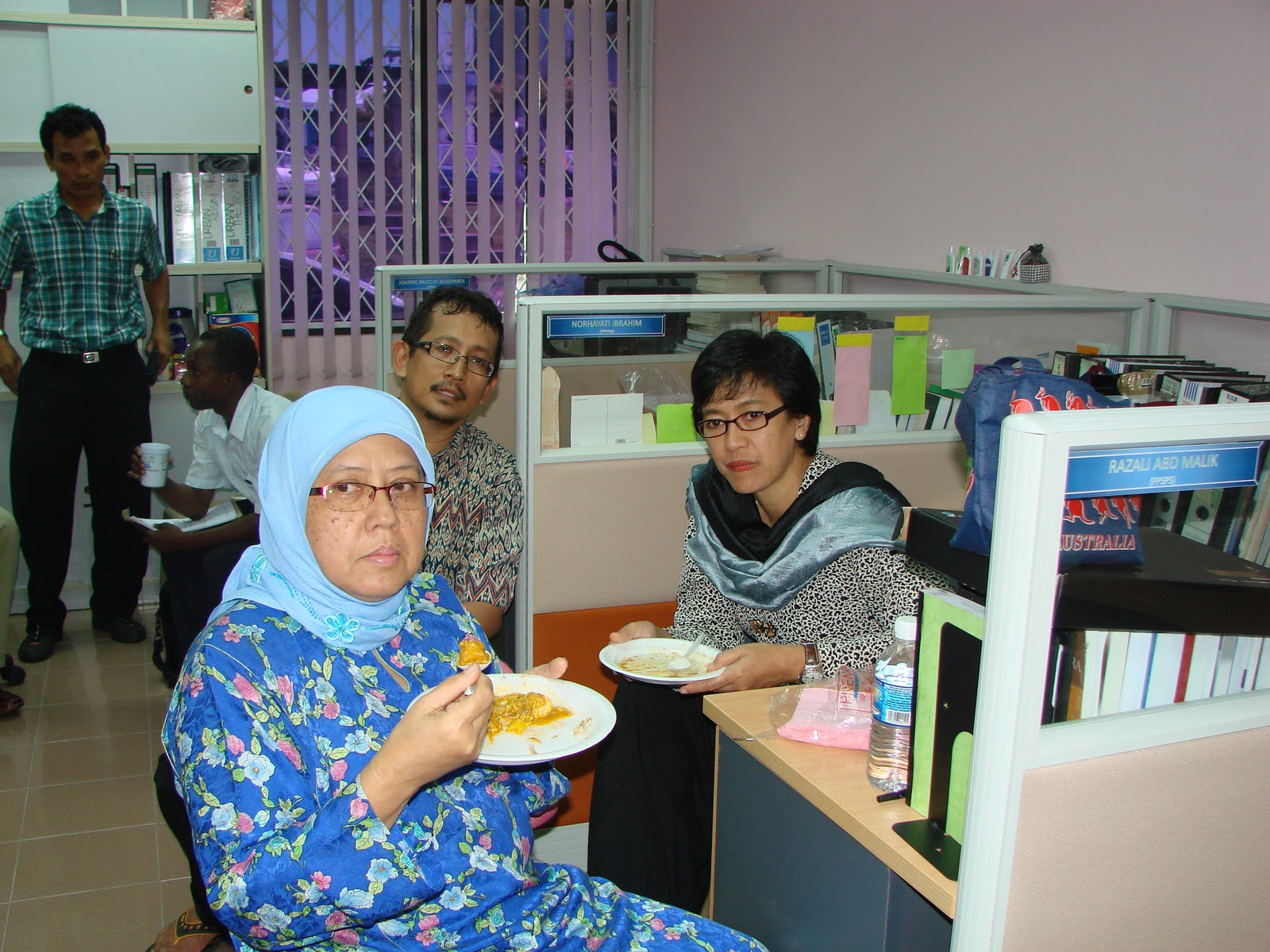
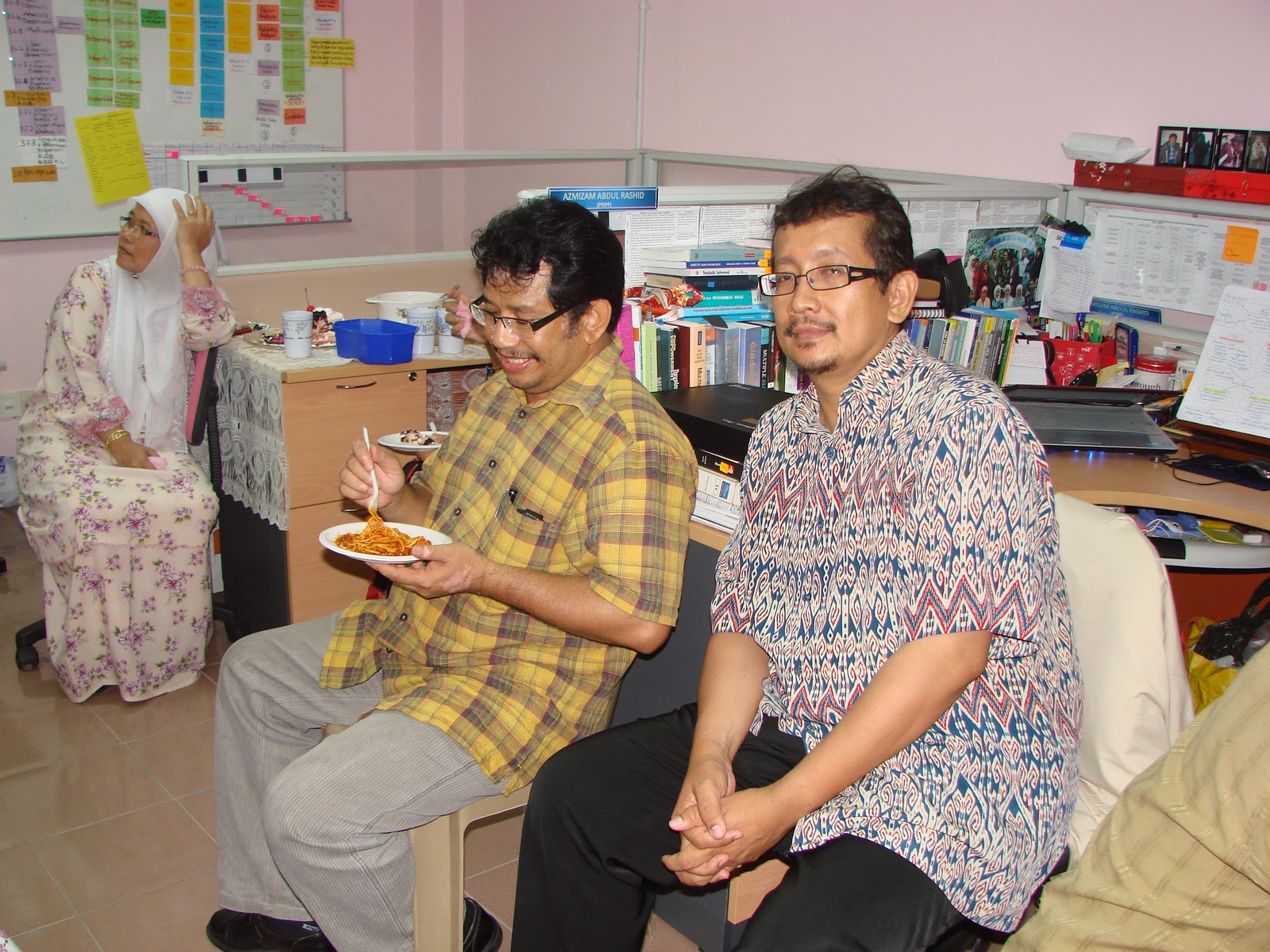

Thursday, 30 September 2010
MY FIRST DRAFT PHD THESIS.....COMBINED THE WHOLE CHAPTER TO SEE THEIR RELATIONSHIP
Finally I managed to complete my first draft...but still lot of changes, organizing data, collabration finding with research question and analysis of literature review.... Lot of things need to be done....


Monday, 27 September 2010
THE SUBMISSION OF NOTICE THESIS ABSTRACT TO PPSPP AND FSSK OFFICE
In order to fulfill faculty requirement, I need to submit my notice thesis abstract to PPSPP's office and faculty 's office three months before my final thesis submission. This will expidite faculty to appoint external and internal examiners to approve and justify my thesis. Who are they? Professor from USM, UIAM, UTM, UiTM or UM.........??????
KEEFISIENAN GOVERNANS BANDAR DALAM MENINGKATKAN DAYA PERSAINGAN EKONOMI WILAYAH-BANDAR RAYA KUALA LUMPUR
AZMIZAM BIN ABDUL RASHID (P 43282)
ABSTRAK
ABSTRAK
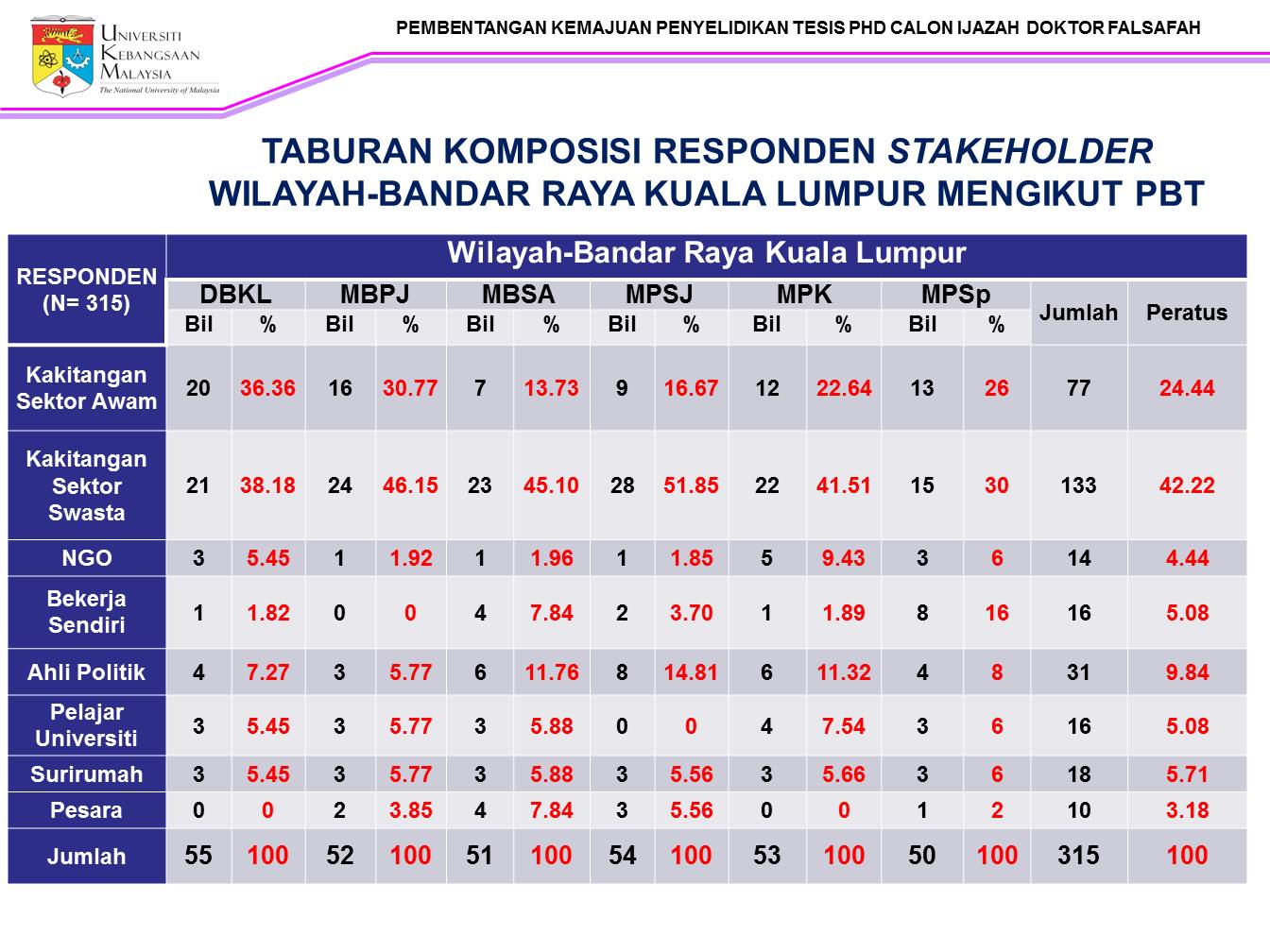
Dalam menghadapi proses globalisasi, governans bandar berdepan dengan pelbagai cabaran yang semakin kompleks. Pihak Berkuasa Tempatan (PBT) merupakan institusi governans yang tidak terlepas daripada isu ketidakefisienan apabila berurusan dengan stakeholders. Berdasarkan peranan PBT yang semakin mencabar, institusi ini sentiasa dikaitkan dengan pelbagai karenah birokrasi, yang menimbulkan pelbagai masalah kepada orang ramai dan penyediaan perkhidmatan yang tidak efisien. Isu ini menjadi persoalan kajian dalam tesis ini. Ketidakefisienan governans bandar boleh menjejaskan daya saing sesebuah wilayah-bandar raya, terutama sekali dalam konteks globalisasi. Sejauhmanakah elemen keefisienan governans bandar (KGB) mempengaruhi daya persaingan ekonomi (DPE) sesebuah wilayah-bandar raya dan elemen manakah yang mempengaruhinya? Berdasarkan kes wilayah-bandar raya Kuala Lumpur, kajian ini juga akan menilai PBT manakah yang mempunyai kedudukan KGB yang paling baik? Kajian ini bertujuan membentuk satu pemahaman yang jelas berkenaan KGB, dan hubungkaitnya dengan peningkatan DPE wilayah-bandar raya. Kajian ini melibatkan 6 PBT utama di wilayah-bandar raya Kuala Lumpur iaitu DBKL, MBPJ, MBSA, MPSJ, MPK dan MPSp melibatkan 315 responden yang mewakili beberapa stakeholders. KGB sebagai pembolehubah bebas dan DPE sebagai pembolehubah bersandar telah digunakan untuk menilai hubungan antara KGB dan DPE melalui ujian analisis regresi pelbagai. Antara penemuan utama kajian, 10 elemen KGB menyumbang sebanyak 89.6 peratus kepada DPE wilayah-bandar raya Kuala Lumpur Ini menunjukkan terdapat hubungan signifikan antara KGB dengan DPE wilayah-bandar raya Kuala Lumpur. Namun begitu hanya 5 elemen sahaja yang menjadi peramal terbaik kepada DPE wilayah-bandar raya Kuala Lumpur iaitu keberkesanan pentadbiran dan perkhidmatan PBT, maklumbalas awam, wawasan strategik, ketelusan dan kesamarataan. Analisis indeks penunjuk pengukuran KGB PBT di wilayah-bandar raya Kuala Lumpur menunjukkan MBPJ mencapai skor tertinggi iaitu 0.75 berbanding dengan lima PBT yang lain. Kesimpulan kajian mendapati peranan PBT tidak lagi dianggap sebagai badan kerajaan yang memberi perkhidmatan dan menyediakan infrastruktur semata-mata. PBT sepatutnya lebih memberi tumpuan meningkatkan KGB dalam memberi perkhidmatan kepada stakeholders. Secara langsung, DPE sesebuah wilayah-bandar raya dapat dipertingkatkan.
EFFICIENT URBAN GOVERNANCE TOWARDS ENHANCING ECONOMY COMPETITIVENESS IN KUALA LUMPUR CITY-REGION
AZMIZAM BIN ABDUL RASHID (P 43282)
ABSTRACT
With the advent of globalization, urban governance is increasingly faced with complex challenges. The Local Authority (LA) as the governance institution is not spared from the issues of inefficiency in dealing with stakeholders. Inefficient urban governance can affect the economic competitiveness in the city-region, especially in the context of globalization. As the LA is ensconced in bureaucracy, this thesis investigates the extent how elements of efficient urban governance (EUG) can contribute to the enhancement of economic competitiveness in city-region (ECCR) and which of these elements can affect ECCR. In the case of Kuala Lumpur city-region, the studies also investigate which LA has achieved the EUG? This study aims to develop a clear understanding of the role of EUG, and its relationship with the ECCR. The study involved six main LAs in the Kuala Lumpur city-region such as DBKL, MBPJ, MBSA, MPSJ, MPK and MPSP involving 315 respondents representing various stakeholders. Element of EUG has been used as independent variables and ECCR as dependent variables in order to investigate their relationship by using multiple regression analysis. One of the findings shows that 10 elements of EUG contributed 89.6 percent to the enhancement of ECCR. There is a significant relationship between EUG with economic competitiveness in Kuala Lumpur city-region. However, only five elements are the best predictors to the ECCR such as administration and the effectiveness of LA services, public feedback, a strategic vision, transparency and equality. Meanwhile, analysis of the indicators measuring EUG in local authority areas shows that MBPJ achieved the highest score of 0.75 compared with five other LAs. The results indicate that the role of LA is no longer considered a government body providing services and infrastructure only but should focus more on urban governance to improve efficiency in providing services to stakeholders which can directly enhance the economic competitiveness in city-region.
Saturday, 11 September 2010


Thursday, 26 August 2010




Subscribe to:
Posts (Atom)
PEOPLE AROUND ME..FAMILY AND FRIENDS.

To my Wife, Zulaini, my sons Zulazlan, Zulazman, Zulazmir, Zulazmin dan my daughter, Nuris Zulazlin...I love you all..thank you being with me
CIRCLE OF FRIENDS... KUALA LUMPUR PROJECT OFFICE

Thank you guys...for your support and encouragement
2007 / 2008 METHODOLOGY AND QUALITATIVE RESEARCH COURSE FOR PHD CANDIDATES

My new friends during my course in INTAN 9 Jan -2 Mac 2007
KUALA LUMPUR PROJECT OFFICE, JOURNEY TO MOUNT OF KINABALU SABAH 21-22 JANUARY 2006

WE CAME, WE SAW, WE CONQUERED 4095.2 METER ABOVE SEA LEVEL

How are you, guys? Where you are now?