The quality of life (QoL) for Malaysians improved through better access to healthcare, public
transport, electricity and water. Measures were also taken to create a caring
society and promote community well-being. Economic development was based on
sustainability principles to ensure that the environment and natural resources
are preserved so that growth will not come at a cost to future generations. The current challenging
economic time is a good time for reflection and we should not waste the
opportunity to take stock of where we are heading as a people and a nation. Going
by the adage that life begins at 50, Malaysia is still a fairly young nation
and adopting more inclusive policies that mobilise the country's rich human and
natural resources will be able to cushion the country from any adverse external
shocks. In its place is the emphasis on personal virtues and wholesome values
of integrity, honesty, generosity and empathy for other people. We believe the
promoting of such values will set the foundation for wholesome community and
nation building for our country. The
Bhutan story must have prompted many of us to start reflecting on our journey
of life, and how we have fared in terms of the happiness index.
Come to
think of it, since the world economy is on the verge of a double-dip scenario
and there will be very low or no growth in most nations, some tweaking in
national policies and priorities may be what Malaysia needs to see our country
and the people through the challenging time?
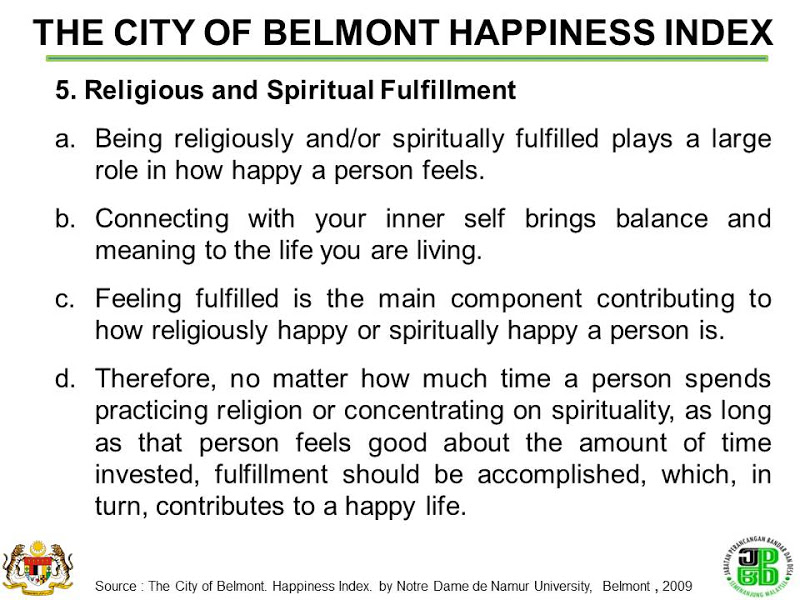
It may be a good idea for us to draw up a Malaysian Happiness Index to
measure how our people are faring against the rest of the world. In Malaysia's
case, the need for concerted efforts to build adequate public infrastructure
and housing cannot be over-emphasised as the on-going efforts are still quite
fragmented. Instead of involving so many agencies in the execution process,
having a dedicated agency as the master planner to oversee the overall planning
and execution of the projects will ensure a higher rate of success to benefit
more people.
Providing
enough public housing and other social amenities should be accorded one of the
top priorities along with the other economic-based initiatives under the
government's Economic Transformation Programme (ETP). The sharp increase in
prices of goods and services, including that of property, meant people have
less disposable income and spending power. These projects will be able to wipe
out the many squatters and slumps, and rejuvenate our cities. Focusing on
public housing can also provide a cushion for the property market from
stagnating during troubling economic times.If happiness could be measured via a country's
economic performance in gross national product or gross domestic product, then
Malaysia would be the world's 51st happiest country. In Malaysia's case, there
were a number of factors that led to its 51st ranking. Materialistic prosperity
of individuals may have been one thing but wealth, usually an indicator of a
person's material well-being, was not the only crucial factor in this
determination.
There were factors
such as a person's general disposition, the level of contentment with basic
aspirations which were also taken into account.
However, Malaysia was ranked 2nd in Southeast Asia, behind Singapore
which emerged as the happiest in the region. On a worldwide basis, the island
was ranked 33rd out of the 156 countries. Thailand was ranked 52nd, Myanmar
landed at 74th position and Indonesia was 83rd.The report will also allow politicians—as well as the public—to assess the
effectiveness of the government’s policies in terms that really matter to
people. The ultimate aim of most policy is to improve lives, but without
proper measures of well-being it can be difficult to assess whether this is
being achieved. The success of this measurement program depends a lot on
exactly how the information is attained and then used, but this announcement
may have signaled the start of a Malaysia government agenda which puts
well-being, rather than economic growth, at the heart of its public policy.
The QoL for Malaysians improved through better
access to healthcare, public transport, electricity and water. Measures were
also taken to create a caring society and promote community well-being.
Economic development was based on sustainability principles to ensure that the
environment and natural resources are preserved so that growth will not come at
a cost to future generations.
Prime Minister Datuk Seri
Najib Tun Razak made the announcement that the Government needs to work at not
only increasing the people's earning capacity, but also on making sure that
they are happy. He said that two yardsticks would be used to measure national development
the conventional method of looking at the per capita income, and the happiness
index of people as well.
The
Federal Department of Town and Country Planning (FDTCP) is undertaking a study
in happiness indicators within Malaysia and the Economic Planning Unit (EPU)
produces the Malaysian Quality of Life Index. Whether we focus on happiness or
not, the most important thing is to continue and enhance efforts that can
provide a real understanding of what we value most as Malaysians, and find
metrics that can best measure what we ourselves define as progress. On top of
that, we also have to ensure we choose a path that will provide sustained
progress to preserve and enhance the ability of our current and future
generations to pursue our path towards happiness.
Futher enquiry about this article kindly contact :
DR. AZMIZAM ABDUL RASHID
Research and Development Division,
Federal Department of Town and Country Planning,
Ministry of Housing and Local Government,
Unit No. 50-12-2B, & 50-13-1, Wisma UOA Damansara,
No. 50, Jalan Dungun, Damansara Heights,
50490 Kuala Lumpur,
Malaysia
email address : azmizam@townplan.gov.my