Friday, 5 December 2008

GLOBAL CITY IN THE GLOBAL FINANCIAL CRISIS

Globalization generally implies decentralization and denationalization. But in international financial markets, something quite different is happening. Although market activity is spreading to new corners of the world, a powerful process of centralization is reinforcing the traditional dominance of financial capitals, led by London and New York. Battered by the Asian economic crisis, Tokyo and Hong Kong could become leading financial centers again if they open up to the world and continue to let investors snap up Asian assets at bargain prices. Even after globalization, markets will still be based in cities, not computers.
The transformation of global capital markets into a new supranational order is continuing apace despite the current market crisis. Nationally based financial operations are shrinking and internationally oriented operations are taking their place. Globalization usually implies decentralization. But while the international network of financial centers is indeed expanding, a leaner system dominated by a handful of strategic cities is evolving. As financial operations disperse around the world, only a few cities will have the resources to be dominant. First among them are London and New York, with their enormous concentrations of resources and talent. These two will conduct the most critical and complex financial operations of the future. A secondary network of smaller economic capitals will be headed by Frankfurt, boosted by Europe's economic and monetary union. The ultimate status of battered Hong Kong and Tokyo remains murky as markets wait to see what will be left in the wake of the Asian crisis. Although Singapore and Sydney are strengthening their positions, it is difficult to imagine them replacing Tokyo's resources and Hong Kong's expertise.

The emerging financial system will sharply differ from earlier versions, which were strings of closed domestic markets with a few scattered global centers such as the offshore markets and Swiss international banking. Traditionally, each national center duplicated all financial functions for its own economy, and collaboration between national markets was crude and rare. Today, however, cooperation is on the rise. Leading financial services firms are now setting up operations across the globe while traditional national centers are becoming home to foreign firms with global operations. Leading cities like London and New York are executing complex operations for firms and governments from myriad countries, packaging capital in innovative ways while working with secondary cities through affiliates and direct exports of financial services. In contrast, other cities in the global network are playing "gateway" roles, such as monitoring capital flows or issuing bonds. One example is Argentina's $1 billion government bond in November, the largest emerging market bond since the market turmoil last August. Although the bond was issued in Argentina, its lead managers were J. P. Morgan and Germany's Deutsche Bank and most of its buyers were U.S. institutional investors.

What turns an ordinary city into a global financial center? Although many factors can boost a city's status, two elements stand out. The first is national consolidation, which favors cities with major institutional equity holdings. In the past, a nation's financial activity was often scattered among several major cities; today, most countries have one dominant national center of operations. Today, a city lacking a major stock exchange can participate in the global market if it has banks and investment houses holding significant amounts of equity. Second, new financial capitals have appeared in emerging markets that have taken the plunge into market liberalization -- a trend that will continue despite the current financial turmoil.

PHOTOS OF 2nd ICBEDC 2008 IN UNIVERSITI SAINS MALAYSIA (USM) PENANG 3-5 DECEMBER 2008


KEYNOTE SPEAKER DR TAKASHI AKINOMOTO, SHIBAURA INSTITUTE OF TECHNOLOGY, TOKYO JAPAN - TITLE DESIGNING AN ASSESSMENT SYSTEM OF BUILDING FOR ALL LIFECYCLE STAGES BASED ON THE ECO-EFFICIENCY


KEYNOTE SPEAKER Y BHG DATUK IR HAMZAH HASAN, CHIEF EXECUTIVE, CIDB, MALAYSIA - TITLE ISSUES REGARDING THE MALAYSIAN CONSRUCTION INDUSTRY


WITH MY FORMER LECTURER ASSOC. PROF. DR HAFAZAH ABDUL KARIM FROM DEPARTMENT OF TOWN AND REGIONAL PLANNING, FACULTY OF ARCHITECTURE, PLANNING AND SURVEYING UNIVERSITI TEKNOLOGI MARA (UiTM), SHAH ALAM


WITH KEY NOTE SPEAKER DR TAKASHI AKIMOTO FROM DEPARTMENT OF ARCHITECTURE AND BUILDING ENGINEERING, SHIBAURA INSTITUTE OF TECHNOLOGY, TOKYO JAPAN

Wednesday, 3 December 2008

3rd - 5th DECEMBER 2008 - 2ND INTERNATIONAL CONFERENCE ON BUILT ENVIRONMENT IN DEVELOPING COUNTRIES 2008

The inaugural International Conference on Built Environment in Developing Countries (ICBEDC 2007) which was held in December 3rd-4th, 2007 at Universiti Sains Malaysia, had attracted 125 papers from all over the world, mainly researchers and academia from Developing Countries such as Myanmar, Thailand, Republic of Iran, Indonesia, Oman, Yemen, Saudi Arabia, Nigeria, Vietnam, Japan, Australia, Holland and many more. The conference was organized in 6 parallel sessions of specific sub-themes for the duration of the 2 days.

Following the outstanding success of the 1st ICBEDC2007, we, the organizers, the School of Housing , Building and Planning, Universiti Sains Malaysia , is organizing a higher impact follow-up conference. The theme of the 2nd ICBEDC2008 is “Sustainable Built Environment: Bridging Theory and Practice”. By adopting this theme, we are reinforcing our commitment in promoting sustainable practices in the development of the built environment in developing countries as we are still very much in the process of seriously adopting and implementing the prophesy of a truly sustainable environment. Issues on global warming, growing scarcity of non-renewable energy resources, loss of biodiversity, shortage of water supply and the long term degradation of the ecosystem along with health and poverty problems are among the most important issues which represent a growing and escalating risk for human societies and their economy.

I and Assoc Prof Dr Hamzah bin Jusoh are going to present a paper with title EFFICIENT URBAN GOVERNANCE IN ENHANCING COMPETITIVENESS OF CITY REGION. Abstract of the paper is :

This paper discusses on the preliminary study on efficiency in urban governance towards enhancing competitiveness of the city. The focus of this paper is to analyse the literature review on the concept of efficiency in urban governance. Preliminary discuss with selected local authorities in Klang Valley has been carried out to gain their understanding on the efficient urban governance. Malaysia has successfully applied economic planning to guide the development of the country from an economy of agriculture and mining to a largely industrialised one. Now, with its sights set on attaining the economic level of a fully developed nation by 2020, the planning system must be made even more efficient and focused. The country must focus on securing a credible share of the lead sectors of the globalised economy. The country must also be fully aware of the enormous competition it faces in a region with rapidly expanding and modernising economies, all contending for the same pool of potential international investments. The urban sector is an important catalyst towards national economic growth and a vital investment centre for the nation. Efficient urban governance is characterized by sustainability, subsidiarity, equity, efficiency, transparency and accountability, civic engagement and citizenship, and security. In line with this, the importance of efficient urban governance is eminent in administration of developing city like Kuala Lumpur City Region. Efficient urban governance is also fundamental issue in development.


Monday, 1 December 2008

MINDSET FOR THE 21ST CENTURY IN PUBLIC SERVICE....ARE WE READY????

No meaningful results can be achieved if the implementers do not have the appropriate work values and ethics. While value espouses the beliefs of an individual or culture, work ethics on the other hand, reflect a set of values based on the virtues of hard work and diligence. Hence, the combination of these two elements should mould the mindset for the public service in the 21st century. While we acknowledged that this is not an easy task to achieve nevertheless, the public service leadership should set the right climate for its people to embrace positive values and work ethics and it should be an explicit not implicit component in public institutions. Public service officials must truly embrace the notion that they are bearers of the image of Malaysia globally. We have a duty of ensuring and more importantly recognising that consequences of your actions as public officials, no matter how trivial, have a compounded impact on our nation and future generations. This is a fundamental mindset and attitudinal change which public officials must endear.

Public officials too need to take pride in their duties as this is crucial to build a sense of performing one’s job to the highest standard. This certainly needs strong commitment and discipline. It is only when the gravitas of the role is tacitly recognised and understood, the willingness to listen and engage the customers, will drastically change. The attentiveness to details of perfection for service delivery will also command greater focus. The readiness to learn, and learn from mistakes will be more prevalent. Consequently, the discharge of the level of service will go beyond just doing a mundane 9-5 job regardless of where you are in the stack of ranks. However, the satisfaction from performing excellent job is immense and the greatest reward is through gaining public confidence in the public service. The culture of innovation, creativity and continuous improvements should be adopted as a work culture at all levels of the organisation. We cannot afford to sit and wait, and then react to the continuously changing environment. To instill this culture, leadership however must allow some calculated risk-taking, experimentations and encourage their officials to constantly think of new ways of doing things rather than stick to the same old ways.

Friday, 28 November 2008

KNOWLEDGE-BASED WORKFORCE... IS THE TOOL OF EFFICIENT URBAN GOVERNANCE?

It is often said that without learning there will be no wisdom, and without wisdom we will always be trapped in the prison of our past and become victims of a continuously changing future. In this environment of rapid and unprecedented change, what is valid at one time may become invalid in another time. Similarly, what is relevant in one context may be irrelevant in another context. As we move to the information age, information and knowledge have become important organisational resources. Knowledge is now recognised as the driver of productivity and economic growth. With knowledge becoming the unlimited and fundamental input for success, people are expected to increasingly work with ideas and concepts. As purveyors of actions and knowledge their important contributions are intelligence, talents and mental creativity. Organisational effectiveness will thus be increasingly dependent on its ability to attract, utilise and retain people with talent and knowledge.

The light of this development, knowledge-based workforce forms the ultimate capabilities required by the public service. Knowledge-based workforce refers to result–driven, focused, productive, creative and innovative team. It is thus pertinent for public service leaders to ensure that the culture for continuous learning is pervasive in their respective organisations and become instinctive and natural among the officials.The culture for learning would also encourage the public service to be more open to external views and should not be afraid to learn from international experts, think–tanks as well as the community, since we have no monopoly to wisdom. Being open to disagreements and criticisms are virtues that should also be encouraged.In the effort to attract and retain people with talent and knowledge. The new systems should be devised to attract the best citizens and the best brains to join the civil service. This would require flexibility in terms of requirement at different levels of entry points into the service. This approach we believe will help to re-brand the Public Service as the Employer of Choice attracting the best talent into the civil service. We do hope the proposal is still being actively pursued by the relevant agencies. Another approach to develop the knowledge-based workforce is through mentoring and continuous training. In grooming good leaders, it is significant that they learn to lead from relationship with senior leaders who have served as coaches, mentors, teachers, and above all, good examples. In addition, young leaders more often than not learn to lead far more from tacit rather than from cognitive knowledge – as apprentices of “masters”.

Tuesday, 25 November 2008

EFFICIENT URBAN GOVERNANCE.... IS THE NEW WAY OF MALAYSIA PUBLIC SERVICE???

Leadership is indeed a critical component of good public governance. By governance, we mean the way in which the underlying values of a nation are articulated and institutionalised. It is these values that will guide the actions of public officials throughout the system and they must be embedded in culture. The question is how we actualize these values in the public service. The primary function of public service is to translate the national vision into tangible outcomes. The Malaysian Public Service has been successful in their efforts to drive national development and nation building as well as enhancing and upgrading capacity and capabilities. Within a short period of five decades, we have managed not only to build our nation, but set our foothold in the global arena. These developments congruent towards a maturing society and a maturing nation. The challenges of the 21st century however, is to steer the nation into a new dimension both locally and globally.

It is alarming to note that despite the numerous measures undertaken to improve the public service delivery, a recent survey by the Malaysian Integrity Institute, indicates that the public’s impression of public service delivery is even lower than its perception on corruption. In this context, we believe there is a need for the profiling of the public service image. The public service must look at its role with a new pair of eyes and through a fresh lens to ensure it rises to the challenges put before Malaysia with unsullied solutions. By culture for excellence, we mean setting high standards of performance with tangible goals and realistic plans to achieve them. This would require a change from an input-oriented practice to outcome-based approaches. The outcome-based approach provides transparency, as such, the progress of projects and programmes are more easily monitored towards the prescribed goals. The public also has the opportunity to see its value for money. The implementation of this approach is anticipated to improve performance and public accountability. Demanding a high standard of performance by itself however, is inadequate if there is no follow-through and follow-up action. We are often praised for having the best plans, unfortunately often lacking in the drive and commitment in its implementation and completion.

Attaining seamless service delivery is still one of the major problems confronting the public service today. World class public service delivery can only be achieved through a high level of inter-agency collaboration. Poor coordination amongst public sector agencies has resulted in overlapping of roles and functions as well as wastages in terms of time and resources. The gap between the centre and frontline service delivery needs to be narrowed. The public service agencies must no longer see themselves in isolation but rather as an integrated part of ‘one government, many agencies, and one delivery’. In this context, leadership in the public service must be able to work across organisational boundaries and bring together the various agencies to attain synergy in public service delivery.

As the society gets more developed, more educated and more exposed, its citizens become more aware of their rights and privileges. Furthermore, the globalised ideas of openness and participation raised the expectations of ordinary citizens to be more involved in the decision making process that has an impact on them. Today, citizens expect to be consulted as part and parcel of the policy-making process. This is in line with the concept of good governance which espouses the need to understand and engage the public and stakeholders towards the common good of the society. Whilst this may be departure from the conventional ways, however, partnerships, mutual consultations and participation should be the mainstay and modus operandi of the new work culture. No matter how well the public service has performed in the past, we can never rest on our laurels and bask in the glory of our past successes. If we do, we are at risk of being overtaken by others in this world of intense competition. We must always be ‘one step ahead’ if we are to survive and thrive in this highly competitive global environment. Therefore, we must continuously strive for high standards of performance.

Sunday, 23 November 2008

DID MALAYSIA IMPROVES RANKING ON THE EASE OF DOING BUSINESS BY ENCHANCING IN EFFICIENCY URBAN GOVERNANCE?

Malaysia improved four ranks to 20th in the World Bank’s Ease of Doing Business Survey 2009, from 24th in 2008 and 25th in 2007. Malaysia has improved in its ranking throughout the 3 years, considering that the total number of countries being ranked has increased to 181 in 2009 from 178 in 2008 and 175 in 2007. Tan Sri Mohd Sidek Hassan, Chief Secretary to the Government and the Co-Chairman of PEMUDAH, the country’s special task force to improve Malaysia’s business competitiveness, said that he was encouraged by Malaysia’s improved ranking in this survey. But stressed that there was much more work to be done if Malaysia is to move into the top 10 in the near future.

PEMUDAH was set up on 7 February 2007, in part as a response to the less than stellar ranking in this survey in the past years. Since its establishment 19 months ago PEMUDAH has succeeded in reducing, if not totally removing, various impediments in the business environment. It worked with the public sector in a number of areas, and was able to among others:
· Reduce the time taken for clearance of exports undertaken to facilitate trade;
· Reduce the time taken for property registration through improvement of processes and enabling on line applications for property registration;
· Ease and refine tax matters;
· Reduce time and costs as well as increase the rate of recovery in closing a business in Malaysia; and
· facilitate e-payment;
· established one-stop centre to expedite incorporation of companies; and
· improve the processes for employing expatriates and skilled workers;

The World Bank’s Ease of Doing Business Survey 2009 is the sixth in a series of annual reports co-published by the World Bank and the International Financial Cooperation. The report investigates the regulations that enhance business activities and those that constrain them. Rankings on the ease of doing business do not tell the whole story about an economy's business environment. The rankings also do not account for all factors important for doing business for example, macroeconomic conditions, infrastructure, workforce skills or security. But improvement in an economy's ranking does indicate that its Government is creating a regulatory environment conducive to operating a business.

Regulations affecting ten areas of daily business are measured:

· Starting a business;
· Dealing with permits;
· Employing workers;
· Registering property;
· Getting credit;
· Protecting investors;
· Paying taxes;
· Trading across borders;
· Enforcing contracts; and
· Closing a business.

Malaysia improved its rankings in 4 of the 10 indicators, namely:

· Getting credit , to 1 in 2009 from 3 in 2008;
· Dealing with construction permits, to 104 in 2009 from 105 in 2008;
· Paying taxes, to 21 in 2009 from 56 in 2008;
· Enforcing contracts, to 59 in 2009 from 63 in 2008.

Sidek reassured that PEMUDAH would continue with the agenda of improving the quality of service at all levels, especially that of local government. PEMUDAH will continue to promote a conducive environment for doing business in the country through the following measures:

· streamlining and speeding up Government Agencies and Departments’ processes;
· encouraging on-line applications;
· enhancing transparency and accountability of the Public Sector; and
· continuous monitoring of initiatives already undertaken.

Tuesday, 18 November 2008

18 -19 th NOVEMBER 2008 - INTERNATIONAL CONFERENCE ON SOCIAL, DEVELOPMENT AND ENVIRONMENTAL STUDIES 2008


INTERNATIONAL CONFERENCE ON
SOCIAL, DEVELOPMENT AND ENVIRONMENTAL STUDIES 2008
“Global Change and Transforming Spaces”
18-19th November 2008


Contemporary global forces have devastating impact on local spaces. The intensification of the capitalistic forces, couched with market ideological impetus has transformed spaces in both the developed and developing world. These forces have created fragmented and unequal spaces and can be observed in several spheres: environment, economy, social, cultural, political and discourse. By bringing together scholars from various disciplines to deliberate these issues at the global, regional and local level, this conference hopes to act as a multidisciplinary platform for intellectual and policy discourse as well as a ground for regional networking comprising academics, researchers, policy and decision makers, government officials and non- governmental organizations.

How these cascading global forces impinge on the local spaces in various spheres of life becomes a critical issue that warrants further inquiry? How different countries strategize, form alliance and situate in this globalizing world becomes a key question? How do micro-spaces and marginal spaces and actors respond to this avalanche? By bringing together scholars from various disciplines to deliberate these issues at the global, regional and local level, this conference hopes to act as a multidisciplinary platform for intellectual and policy discourse as well as a ground for regional networking comprising academics, researchers, policy and decision makers, government officials and non-governmental organizations.


Add Image


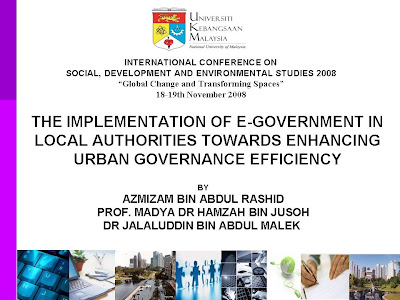
THE IMPLEMENTATION OF E-GOVERNMENT IN LOCAL AUTHORITIES TOWARDS ENHANCING URBAN GOVERNANCE EFFICIENCY


BY
AZMIZAM BIN ABDUL RASHID
PROF. MADYA DR HAMZAH BIN JUSOH
DR JALALUDDIN BIN ABDUL MALEK

ABSTRACT

Over the past decade many governments have conceived and implemented programmes intended to launch the government into the digital realm. The Electronic Government (E-Government) initiative in Malaysia was launched to lead the country into the Information Age. It has improved both how the government operates internally as well as how it deliver services to the people of Malaysia. It seeks to improve the convenience, accessibility and quality of interactions with citizens and businesses; simultaneously, it will improve information flows and processes within government to improve the speed and quality of policy development, coordination and enforcement. The vision of E-Government is a vision for government and businesses people working together for the benefit of Malaysia and all of its citizens. The proposed of this paper to study the implementation of E-Government in Local Authorities in order to enhance effectiveness and efficiency in deliver services. Majlis Perbandaran Subang Jaya (MPSJ) has been chosen in the study. The focus of study is how MPSJ implement the E-Government not only transparency and accountability, but also creates an opportunity for community to assess MPSJ performance and delivery of services and promises. An efficient public service is a key factor in ensuring a conducive environment to attract private investment.

PEOPLE AROUND ME..FAMILY AND FRIENDS.

PEOPLE AROUND ME..FAMILY AND FRIENDS.
To my Wife, Zulaini, my sons Zulazlan, Zulazman, Zulazmir, Zulazmin dan my daughter, Nuris Zulazlin...I love you all..thank you being with me

CIRCLE OF FRIENDS... KUALA LUMPUR PROJECT OFFICE

CIRCLE OF FRIENDS... KUALA LUMPUR PROJECT OFFICE
Thank you guys...for your support and encouragement

2007 / 2008 METHODOLOGY AND QUALITATIVE RESEARCH COURSE FOR PHD CANDIDATES

2007 / 2008 METHODOLOGY AND QUALITATIVE RESEARCH COURSE FOR PHD CANDIDATES
My new friends during my course in INTAN 9 Jan -2 Mac 2007

KUALA LUMPUR PROJECT OFFICE, JOURNEY TO MOUNT OF KINABALU SABAH 21-22 JANUARY 2006

KUALA LUMPUR PROJECT OFFICE, JOURNEY TO MOUNT OF KINABALU SABAH 21-22 JANUARY 2006
WE CAME, WE SAW, WE CONQUERED 4095.2 METER ABOVE SEA LEVEL

How are you, guys? Where you are now?

FOOD CLOCK