Sunday, 30 October 2011

FREQUENTLY ASKED QUESTIONS ON NATIONAL PHYSICAL PLAN

What is the National Physical Plan and function?
A written statement formulating strategic policies for determining the direction of the physical development and conservation for the whole of Peninsular Malaysia. National Physical Plan  should be provided through the consultation process between the Federal and State Governments as well as taking into account the current national municipal policy or other policies related. National Physical Plan  is provided for Peninsular Malaysia and Sabah and Sarawak are not covered because the two states subject to different legislation.

National Physical Plan  functions to translate the socio-economic objectives of the Five-Year Malaysia Plan and development policies until 2020, as well as sectoral objectives into spatial form to the user in terms of geographical distribution among the states, within states and between local areas.

What Legal Provisions Used in Preparation of National Physical Plan ?
Section 6B, Town and Country Planning Act, 1976 (Act 172) is the legal basis for the preparation of National Physical Plan  under this act where the National Physical Plan  is defined as follows:

i) Is a written statement formulating strategic policies for the purpose of directing the country's physical development and

ii) Contain other matters as may be prescribed by the National Physical Planning Council (MPFN).

This makes the National Physical Plan  as a document 'statuory', although penyediannya not provided for in the gazetted.

What are the implications to the State and Federal Agencies Should Not Comply In particular National Physical Plan  Policy on Preparation of Five-Year Malaysia Plan and Development Plan?
In terms of implications for the Federal Government and State Governments should not emmatuhi National Physical Plan  policy is considered not to comply with the directives and policies decided by the National Physical Planning Council and not carrying out his duties as provided under Subsection 6B (5), Act 172.

In terms of implications for policy compliance National Physical Plan  at the annual forecast Malaysia Plan, the National Physical Plan  policies should be the basis for budget planning Malaysia Five Year Plan. If the Development Plan, particularly the Structure Plan, regardless of National Physical Plan  policies, then penyediannya have violated the provisions under paragraph 7 (3) (aa), Act 172.

When the Review-2 National Physical Plan  To Begin And Stage Any approve?
Review of the National Physical Plan  to National Physical Plan 2 commenced on February 2, 2009. It was approved by the Cabinet on August 11, 2010 and approved by the National Physical Planning Council on August 13, 2010.

This review is provided in accordance with the provisions of Section 6B, Act 172 in relation to the requirements of National Physical Plan  to reviewed every five years consistent with the Review of Five-Year Malaysia Plan . However, not all aspects of the National Physical Plan  should be changed because there were some suggestions that should be maintained at the level of review. This includes areas identified as conservation and the protection of water resources. Similarly, the proposed construction of the country's other major infrastructure that requires continuous implementation. National Physical Plan  has both short-term perspective to meet the socio-economic objectives contained in the Five-Year Malaysia Plan. 

What are the Main Differences Between National Physical Plan  and National Physical Plan 2?
Two main differences in terms of overall concept and strategy :
i. Concept Selective Concentration in the first National Physical Plan  is focused on urban development in particular conurbation.

ii. Concept Concentrated Decentralisation the National Physical Plan  of the 2nd suggested that not only focuses on the development of conurbation, but more balanced with a focus on the onsite-selected locations in the growth corridors.

What is the objective of the Review to National Physical Plan 2?
National Physical Plan  of the 2nd goal was to "Establish a National Spatial Framework The Efficient, Equitable and Sustainable Development for All National Driving Towards Achieving Advanced Level and High-Income Countries By The Year 2020". In determining these goals, they take into account the pillars of the government including the National Key Result Areas (NKRA), Economic Transformation Programme and the 10th plan.

Tuesday, 25 October 2011

MY BOOK REVIEW - THE NEW URBAN FRONTIER: GENTRIFICATION AND THE REVANCHIST CITY


Author : Neil Smith
Title : The New Urban Frontier : Gentrification and the Revanchist City
Year of Publication : 1996
Place of Publication : London
Publisher: Routledge, London
Pages : 262
ISBN : 041513255X

This book brings together a body of research on gentrification conducted by Neil Smith over a period of nearly 20 years. The book thus reflects developments within Marxian-oriented urban theory from the late 1970s to the late 1990sto the inclusion of aspect of ethnicity and gender and the practice of discourse analysis to reveal, and the practice of discourse analysis to reveal ways of creating frontiers. Two of the ten chapters are new, while eight are updated versions of articles and chapters previously published and often cited in the gentrification literature. The two new chapters (2 and 8) address the issues: “Is gentrification a dirty words?” and “And gentrification experiences in European cities so distinct as to merit development of theories fundamentally different from those used to explain gentrification in North American cities?”This book challenges conventional wisdom, which holds gentrification to be the simple outcome of new middle-class tastes and a demand for urban living.
It reveals gentrification as part of a much larger shift in the political economy and culture of the late twentieth century. Documenting in gritty detail the conflicts that gentrification brings to the new urban 'frontiers', the author explores the interconnections of urban policy, patterns of investment, eviction, and homelessness. The failure of liberal urban policy and the end of the 1980s financial boom have made the end-of-the-century city a darker and more dangerous place. Public policy and the private market are conspiring against minorities, working people, the poor, and the homeless as never before. In the emerging revanchist city, gentrification has become part of this policy of revenge. The reader is able to follow as the reduction and centralisation of social services makes the city both a haven and a scourge. The streets offer a means of support and network, even as local councils and retail traders lobby to `keep the city clean and safe', a semantic shift on the threadbare attempts to rationalise slum clearance.
Nevertheless, there remains much to recommend in this book. Smith writes persuasively. He has a tempo and grip of the argument which allows diverse and demanding subject material to be dealt with in a conversational manner, from the history of `socialist gentrification' in post-Communist Budapest, to scientific appraisals of urban demographics. The conclusion of The New Urban Frontier could easily accommodate a `City of Quartz'-like conclusion to configure a foreseen post-apocalyptic scenario for the West's many physically expanding, but economically declining cities. It is something of a relief that this is not the case. However, Smith draws some concerning parallels between international cases of the revanchist city in its extreme--citing the murder of homeless children in Rio de Janeiro through to the bombing in Oklahoma City--as part of a continuum.
Despite rhetoric of `degentrification', the boundaries demarcated by social inequality show no sign of dissolving. Smith's frequently used frontier motif is turned on its head, as the line between `savagery' and `civilisation' is no longer seen as a one-way, expansionist trajectory, but a contested battleline.  Smith admits a `two-class analysis' to be problematic, yet this is where he returns in the end. So while the issues of revenge politics and urban decline certainly construct an environment of dualistic adversary at work, in the city of decline it is left to the reader to decide whether this is the same city that they have come to know. He is convincing theories about the gentrification of the inner city as an economic process propelled by urban land prices and city land speculation — not a cultural preference for living in the city.

Thursday, 20 October 2011

FREQUENTLY ASKED QUESTIONS ON LEGAL AND REGULATORY PLANNING

Who is responsible for urban planning?
In Peninsular Malaysia, the Central Government and State Governments are equally responsible for town and country planning, in which the Department of Town and Country Planning, Peninsular Malaysia as a whole serves to advise on national planning policies to all ministries, government departments and semi- the Government. While the Department of Town and Country Planning function to advise the State Government and Local Authorities in their respective states.

What are the functions of the Legal and Regulatory Planning?
i) Provide technical advice on town and country planning legislation to Federal agencies, State, local planning authorities and the public;

ii) Make the promotion and spread of legal policy, urban and rural planning;

iii) To coordinate and monitor the recipient clothes Act 172, the rules, guidelines and instructions under the provisions of Act 172;

iv) Provide a verification of the development application under subsection 22 (2A) of Act 172 to National Physical Planning Council;

v) Conduct investigations and monitor the planning of development projects that have been adopted and approved by National Physical Planning Council;

vi) Review and review the Town and Country Planning Act 1976 (Act 172) and prepare proposed amendments to Act 172.

vii) To prepare and review the rules, guidelines and instructions under the provisions of Act 172.

Is Planning Permission in accordance with the provisions of Act 172?
Planning permission was granted permission in writing by the local planning authority (PBPT) to a person who wishes to carry out the development. The need for planning permission has been provided under the Town and Country Planning Act 1976 (Act 172) in Part IV: Planning Control. Interpret the Act 172 planning permission as permission granted with or without conditions for carrying out the development. In general, planning permission is a procedure in which the applicant must submit an application to local planning authority to get permission before commencing any development on the land or buildings.

When planning permission period will expire?
If a development is not carried out within 12 months from the date of the planning permission granted planning permission has been granted will expire, unless extended prior to expiration.

What is the amount of fines that the wear for someone who made a mistake in connection with a promotion that is not justified?
When a person has committed an offense and liable to a fine to be imposed is five hundred thousand ringgit or to imprisonment for not more than two years or both. However for a continuing offense charged is five thousand dollars (RM5,000) for each day the offense continues after conviction for the offense.

What type of development should be referred to National Physical Planning Council?
Under subsection 22 (2A) Town and Country Planning Act 1976 (Act 172), there are three types of development that should be referred to National Physical Planning Council namely: a) Development of a municipality for a population of more than 10,000 people, or covering an area of ​​more than 100 hectares or both; b) A development for the construction of any major infrastructure or utility, and c) a development affecting the peak or hill slopes, in areas designated as Environmentally Sensitive Areas in development plan.

For projects of national interest, need be sent for approval planning permission?
It should be. Planning permission must be obtained from the local authorities involved and for projects of national interest should be taken for advice and consideration Naional Physical Planning Council chaired by the Prime Minister.

Monday, 10 October 2011

MY ACADEMIC JOURNALS PUBLICATIONS FROM 2008-2011

1. Empowering the Global City-Region - The Crucial Roles of Local Government published by World Applied Sciences Journal Volume 13 (Sustainable Development Impact from the Socio-Environmental Perspectives) page 82-86, 2011http://www.idosi.org/wasj/wasj13(SDISEP)11/5.pdf

2. The Efficient Urban Governance in Managing and Enhancing Competitiveness of Property Markets in Kuala Lumpur City-Region published by E-Bangi / The National University of Malaysia (UKM), Volume 5, Issue 1, page 116-131, October 2010.http://www.ukm.edu.my/e-bangi/index.php/en/component/jresearch/?view=publication&task=show&id=93

3 The Implementation of E-Government in Local Authorities Towards Enhancing Urban Governance Efficiency : Case Study Subang Jaya Municipal Council published by GEOGRAFIA - Malaysian Journal of Society and Space / The National University of Malaysia (UKM) Volume 6, Issue 1, page 1-12, January 2010. http://www.ukm.my/geografia/images/upload/1.2010-1-Azmizam%20Hamzah%20Jalal-english-3.pdf

4. Efficient Urban Governance in Managing and Enhancing Competitiveness of The Kuala Lumpur City-Region published by Asian Profile : Asia's International Journal, Volume 37, Issue 56, page 597-612 / Asian Research Service, Canada December 2009.
http://www.asianresearchservice.com/v37.htm#6

5. The Role of Efficient Urban Governance in Managing Kuala Lumpur City-Region Development published Asian Social Science, Volume 5, Issue 8, page 14-32 / Canadian Center of Science and Education, August 2009. http://www.ccsenet.org/journal/index.php/ass/article/view/3431/3109

6. Efficiency in Urban Governance Towards Sustainability and Competitiveness of City: A Case Study of Kuala Lumpur published by World Academy of Science, Engineering and Technology (WASET) Paris,  Issue 16 Article 79 page 443- 456, April 2008. http://www.waset.org/journals/waset/v40/v40-79.pdf

Saturday, 1 October 2011

MY MEMBERSHIP OF INTERNATIONAL ACADEMIC RESEARCH BLOGS

1. Malaysian Town Planning Researcher Network is a blog of knowledge and it allow users to exchange their ideas and sharing the information based on the present or previous research. This blog is developed by International Policy Evaluation and Research Unit, Division of Research and Development, Federal Department of Town and Country Planning, Peninsular Malaysia linked to http://issuu.com/anwar_townplan/docs/dr_azmizam_2011?mode=a_p

2.  Academia.edu is a platform for academics to share and follow research. Academics upload their papers to share them with other academics in over 100,000 research areas. They can also follow other academics, and see new papers and other research updates from those academics in their News Feeds. Linked to http://independent.academia.edu/AZMIZAMABDULRASHID

3.  ResearchGate  is the largest scientific network online with over 1.2 million members. ResearchGate began when two researchers discovered first-hand that working with a friend or colleague based on the other side of the world was no easy task. The rapid evolution of technology has opened the door to change; by providing you with the right tools, we strive to facilitate scientific collaboration on a global scale.It can be tricky to get hold of the right publications; so whether you want to find something specific, discover something new or share your own work with the community, we have the tools to make it happen.
 http://www.researchgate.net/profile/Azmizam_Abdul_Rashid/

4.  Malaysian Publications since January 2006. Refereed Journal Papers, Refereed Conference Papers, Chapters in Book, Working Papers, Theses
 
5.  Mendeley is a free reference management tool for your desktop & the web that can help dramatically increase your research productivity linked to http://www.mendeley.com/profiles/azmizam-abdul-rashid/

Saturday, 24 September 2011

EMPOWERING THE GLOBAL CITY-REGION - THE CRUCIAL ROLES OF LOCAL GOVERNMENT

My new article was published at World Applied Sciences Journal Volume 13 (Sustainable Development Impact from the Socio-Environmental Perspectives), page no 82-86 ISSN 1818-4952 by IDOSI Publication 2011. Detail article can read at http://www.idosi.org/wasj/wasj13(SDISEP)11/5.pdf. This is my 7th article published in academic journal since 2008.

Friday, 23 September 2011

22 SEPTEMBER 2011 - 1 st SUPERVISORS RECOGNITION CEREMONY AND THE WEARING OF THE ROBE FOR PHD GRADUATES - 2 DAYS BEFORE MY GRADUATION DAY

The ceremony organised for the first time today is to recognise and appreciate the sacrifices, guidance, advice and efforts of the supervisors in helping to produce the graduates. UKM Vice Chancellor Prof Tan Sri Dato' Wira Dr Sharifah Hapsah Syed Hasan Shahabudin advised us "KNOWING IS NOT ENOUGH, WE MUST APPLY. WILLING IS NOT ENOUGH, WE MUST DO". Prof Sharifah Hapsah advised the graduates to harness their ideas to create products and services and to also manage high technology projects so as to promote business development in an economy based on innovations. She said the graduates while carrying out their studies and research were guided and encouraged to use their knowledge with integrity whether in the scientific or humanities field and to come up with their thesis presenting new discoveries and findings some of which may affect the people’s lives.


Sunday, 4 September 2011

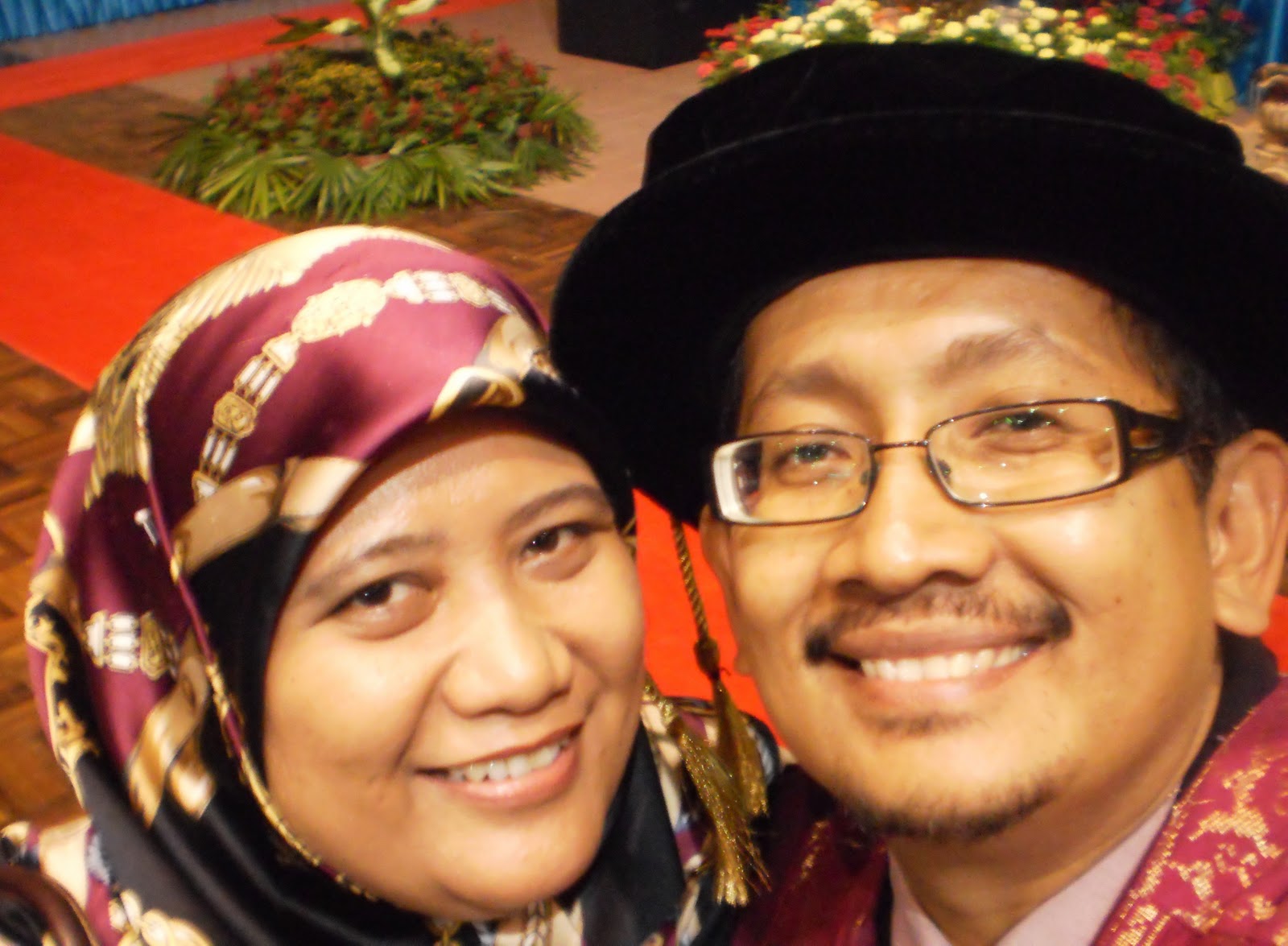
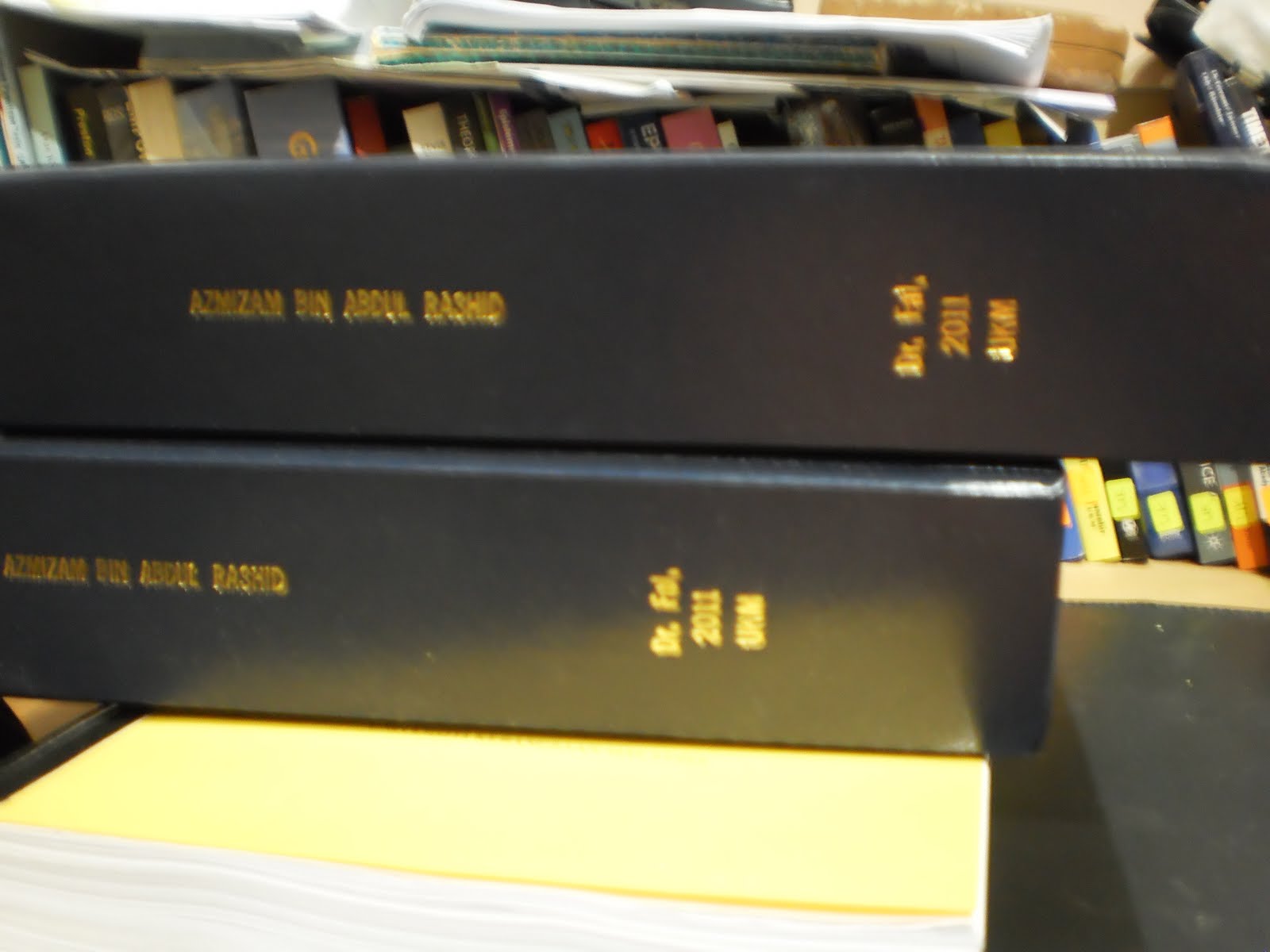
FINALLY, IN 3 YEARS MY PHD THESIS IS COMPLETED....DR AZMIZAM ABDUL RASHID


This is the best moment in my life. Finally I completed my PhD thesis in 3 years. Syukur sangat berjaya juga siapkan Ist draf tesis pada 15 Ogos 2010, 2nd draf pada 15 Oktober 2011 to my supervisors  dan final submission to deanery office pada 16 Disember 2010. Berkat usaha, tumpuan sepenuhnya kepada kerja-kerja penyelidikan dan doa keluarga terutama isteri tersayang ZUL'AINI ZULKIFLI dan kedua ibubapa aku. Akhirnya aku dapat menyiapkan tesis ini tepat pada waktunya. Ucapan setinggi-tinggi terima kasih kepada kedua-dua penyelia saya Prof Madya Dr Hamzah Jusoh dan Prof Madya Dr Jalaluddin Abdul Malek yang banyak menyumbang idea untuk proses penyelidikan PhD ini . Merekla berdua tidak jemu-jemu memberi ulasan dan pandangan yang membina pada setiap bab dalam tesis ini.


       Tidak lupa juga kepada rakan-rakan di JPBD  yang sentiasa memberi semangat dan panduan semasa penyelidikan PhD dijalankan. Begitu juga dengan rakan-rakan rapat yang lain. Sekurang-kurangnya aku tidak mensia-siakan duit rakyat untuk melanjutkan pengajian PhD ini. Sekarang kena fikirkan sesuatu untuk menyumbangkan ilmu dan pengalaman ini untuk bangsa dan negara. Tesis ini disiapkan tanpa permohonan melanjutkan masa pengajian kepada Jabatan Perkhidmatan Awam (JPA) untuk 4 tahun atau 5 tahun berbanding dengan rakan-rakan lain yang mengambil masa lebih dari 3 tahun hingga 4 tahun untuk menyiapkan tesis mereka.


        Ada juga rakan seangkatanku yang masih belum menyiapkan tesis PhD mereka hingga sekarang. Kenapa agaknya? Jika difikirkan semula melalui pengalaman rakan-rakan kakitangan Jabatan Kerajaan yang cuti belajar untuk melanjutkan pengajian PhD mereka walaupun sudah lebih 4 tahun di UKM. Dalam kotak fikiran mereka "Aku dapat cuti belajar ini tak adalah kena transfer ke bahagian lain atau ke jabatan negeri yang lain atau aku nak berehat secukupnya semasa cuti belajar lepas setahun baru start PhD atau nak duduk rumah jer boleh menonton rancangan TV kegemaranku atau dengan duit biasiswa ini boleh guna untuk renovate rumah".


         Aku nak bagi petua berdasarkan kepada pengalaman aku mengenai 'don't and do' dalam menjalani kehidupan sebagai pelajar PhD di UKM, pertama tanamkan dulu minat yang mendalam 'heart and soul' sebagai penyelidik dalam jiwa kita yang ingin menyambung pengajian dalam PhD.  PhD adalah proses penyelidikan untuk membuktikan perkaitan sesuatu teori kepada permasalahan kajian (reseach question). Adakah perkaitan itu benar atau tidak? PhD bukanlah sesuatu penulisan berbentuk laporan kajian biasa sahaja seperti mana  amalan biasa kita lakukan di jabatan. Penyelidikan PhD itu perlu dibentuk melalui analisis deskriptif and inferensi serta setiap bab itu perlu dijalinkan dengan kemas dan cantik. Kedua, buangkan sifat-sifat ego dan sombong, jangan hanya tahu mengarah itu dan ini lagaknya  seperti seorang CEO. Hormatilah penyelia kita sebagai guru, pembimbing dan sahabat kita. Ketiga, jangan sentiasa biarkan diri anda dalam keadaan selesa sebagai kakitangan kerajaan. Setiap bahan rujukan perlu dicari dan dianalisis dengan bijaksana (wisdom). Amalkan teknik 5W 1H untuk menjawab setiap persoalan dalam sumber rujukan.  Jangan jadikan sumber rujukan di internet sebagai rujukan mudah untuk "cut and paste". Keempat, jangan hanya pandai bercakap seolah-olah kita tahu segalanya  dan mencurahkan idea sahaja tanpa menterjemahkannya dalam bentuk penulisan yang penuh dengan "critical thinking".  Kelima, sentiasa merendah diri, jangan menganggap kita yang paling pandai dalam dunia ini, sebenarnya ada orang lain yang lebih pandai dari kita. Kadang-kadang orang yang tak ambil PhD pun lagi pandai dari kita. Akhir sekali, selalulah berkongsi ilmu dengan rakan-rakan yang sama-sama menjalankan penyelidikan PhD. Jangan kedekut ilmu. Selalu membantu rakan-rakan kita yang lain dalam proses penyelidikan walaupun bidang penyelidikan PhD mereka berlainan. Saya percaya "JIKA KITA SENTIASA MEMPERMUDAHKAN URUSAN ORANG LAIN, INSYALLAH ALLAH AKAN MEMPERMUDAHKAN URUSAN KITA".


          Pengalaman yang tidak boleh dilupakan sepanjang 3 tahun di UKM adalah berpeluang menjalani program 'attachment' di Global City Network and Globalization (GaWC), Loughborough University, United Kingdom selama 3 bulan mulai 22 September 2009 hingga 24 Disember 2009. Program ini  ditaja sepenuhnya oleh JPA. Pada mulanya aku berat hati nak sertai program ini takut mengganggu proses penyelidikan PhD aku. 3 bulan macam-macam benda aku boleh buat di Malaysia. Rupanya sangkaan aku meleset sama sekali. Aku berpeluang bekerjasama dan berkongsi pengalaman penyelidikan ini  di bawah penyeliaan Prof Dr Peter Taylor, Prof Dr Kathy Pain dan Dr John Harrison. Banyak perkongsian ilmu bersama mereka untuk memantapkan tesis PhD aku ini. Rakan-rakan dari negara-negara lain yang sedang menjalankan penyelidikan PhD dalam bilik siswazah di GaWC juga banyak membantu aku. Pengalaman 3 bulan di sana tidak sia-sia begitu sahaja. Segala peluang yang ada untuk menambahbaik tesis aku telah gunakan sebaik mungkin.


          Di Loughborough University juga aku berpeluang membentangkan kertas kerja aku mengenai "Efficient Urban Governance Towards Economic Competitiveness in Kuala Lumpur City-Region" di Delft University, Nertherland pada 24 - 27 November 2009. Di sana juga aku berpeluang berkenalan dan berkongsi pengalaman dengan ramai rakan-rakan dari negara Eropah yang sedang menjalankan penyelidikan PhD. Terima kasih kepada Pusat Pengurusan Siswazah (PPS), UKM dan Fakulti Sains Sosial dan Kemanusiaan (FSSK) UKM yang menaja tiket penerbangan dan yuran pendaftaran seminar ini. Terima kasih kepada Prof Dr Hazita Azman dan kedua-dua penyelia aku yang banyak menyokong dan membantu menjayakan program 'attachment' ini.


          Apabila aku kembali ke Malaysia, aku rasa lebih yakin dengan tesis aku ini yang boleh dianggap sebagai tesis PhD dan bersedia untuk viva. Aku telah melalui proses penyelidikan bermula pada 28 Disember 2008 - 26 Disember 2010. Pada 27 Disember 2010 aku mula lapor diri di JPBD dan 4 Januari 2011 aku ditempatkan di Bahagian Penyelidikan dan Pembangunan JPBD. Sekarang ini aku telah bergelar DR AZMIZAM BIN ABDUL RASHID.Walau bagaimana aku sentiasa berdoa kepada Allah s.w.t semoga aku dijauhi dengan sifat-sifat sombong dan riak. Aku takut kenikmatan yang dikurniakan oleh Allah s.w.t akan ditarik dengan sekelip mata.

Friday, 29 July 2011

MALAYSIAN TOWN PLANNING RESEARCH NETWORK


Research and Development Division, Federal Department of Town and Country Planning has created a Malaysian Town Planning Research Network (MyTOWNnet) website. MyTOWNnet aims to increase knowledge exchange between planning educators, researchers and practitioners. Its purpose is to:

1. Highlight current and proposed research in planning education and practice;

2. Develop international communication in research and educational activity;

3. Promote the exchange of information;

4. Explore new methods of planning education and knowledge development;

5. Encourage the examination of planning theory against practice;

6. Provide a sounding board for futures thinking and innovation; and

7. Support new planning researchers.

MyTOWNnet is open to anyone with an active role in planning and related to policy making, research and education. The website address is http://mytownnet.blogspot.com/. The network will promote Think Tank  and Research Capacity Development to act as sounding boards to allows urban and regional policy makers, researcher and practitioners to get feedback and advice on key issues around urban/rural futures, strategic research and policy issues. Therefore, MyTOWNnet encouraging the investment in knowledge and sharing of information within government and the academic community.

Friday, 22 July 2011

VISITING LOCAL AUTHORITIES IN SABAH AND SARAWAK 19 - 22 JULY 2011 - DATA COLLECTION FOR MURNInet TEST RUN

Dewan Bandaraya Kuching Utara Puan Maggie and her MURNInet team. Thank you for your support.

Fruitful discussion to enhance MURNInet Portal and indicators.

Mr Jafri of DBKU ....Mr Chairman of the meeting. Thank you for your supporting and hospitality.

Our dedicated team leader Puan Shinie flying with MASWING to Sandakan. Our next mission to meet Puan Faridah of Majlis Perbandaran Sandakan

Me and Faisal master MURNInet Portal

Our core team posing with MASWING

Sandakan Town view from MASWING

Azizi, one of our group member


Our team ready to the next mission Dewan Bandaraya Kota Kinabalu

PEOPLE AROUND ME..FAMILY AND FRIENDS.

PEOPLE AROUND ME..FAMILY AND FRIENDS.
To my Wife, Zulaini, my sons Zulazlan, Zulazman, Zulazmir, Zulazmin dan my daughter, Nuris Zulazlin...I love you all..thank you being with me

CIRCLE OF FRIENDS... KUALA LUMPUR PROJECT OFFICE

CIRCLE OF FRIENDS... KUALA LUMPUR PROJECT OFFICE
Thank you guys...for your support and encouragement

2007 / 2008 METHODOLOGY AND QUALITATIVE RESEARCH COURSE FOR PHD CANDIDATES

2007 / 2008 METHODOLOGY AND QUALITATIVE RESEARCH COURSE FOR PHD CANDIDATES
My new friends during my course in INTAN 9 Jan -2 Mac 2007

KUALA LUMPUR PROJECT OFFICE, JOURNEY TO MOUNT OF KINABALU SABAH 21-22 JANUARY 2006

KUALA LUMPUR PROJECT OFFICE, JOURNEY TO MOUNT OF KINABALU SABAH 21-22 JANUARY 2006
WE CAME, WE SAW, WE CONQUERED 4095.2 METER ABOVE SEA LEVEL

How are you, guys? Where you are now?

FOOD CLOCK